Maharashtra BoardEnglish MediumSTD 12 ScienceChemistryElectrochemistry4 Marks
Question
A single electrode potential can’t be measured but the cell potential can be measured. Explain.
✓
Answer
(1)
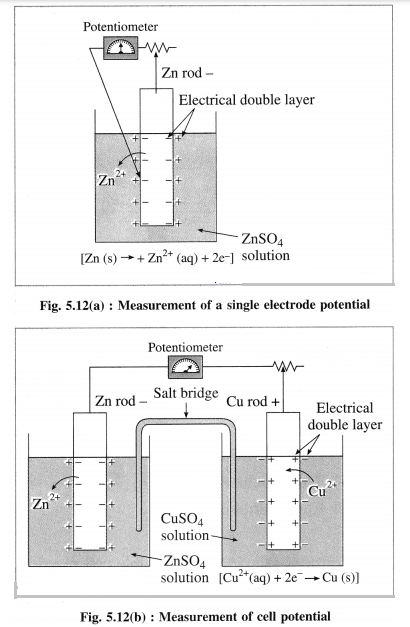
According to Nemst theory, electrode potential is the potential difference between the metal and ionic layer around it at equilibrium, i.e. the potential across the electric double layer.
(2) For measuring the single electrode potential, one part of the double layer, that is metallic layer can be connected to the potentiometer but not the ionic layer. Hence, single electrode potential can't be measured experimentally.
(3) When an electrochemical cell is developed by combining two half cells or electrodes, they can be connected to the potentiometer and the potential difference or cell potential can be measured. $E_{\text {cell }}=E_2-E_1$ where $E_1$ and $E_2$ are reduction potentials of two electrodes.
(4) If one of the electrode potentials is known or arbitrarily assumed and $E_{\text {cell }}$ is measured by potentiometer, then potential of another electrode can be obtained. Therefore it is necessary to choose a reference electrode with arbitrarily fixed potential and measure the potentials of other electrodes.
(5) Therefore Standard Hydrogen Electrode (SHE) is selected assuming arbitrary potential 0.0 volt. Hence potentials of all other electrodes are referred to as hydrogen scale potentials.
Need a full question paper?
Generate a complete, print-ready paper with questions like this in minutes — across 16+ boards, with answer keys.