Question
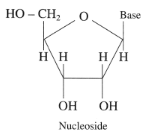
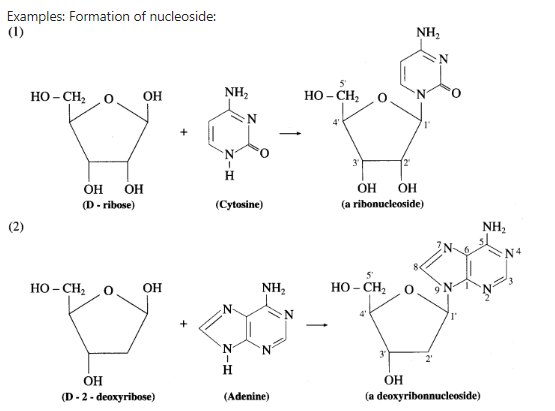
What is meant by nucleosides?###Write the structure of nucleoside. Give examples.

Answer


Image

A nucleoside contains two basic components of nucleic acids i.e. a pentose sugar and a nitrogenous base.

A nucleoside is formed when 1 -position of a pyrimidine (cytosine, thymine or uracil) or 9 -position of guanine or adenine base is attached to $C$ - I of sugar by $\beta$-linkage.
Image

Need a full question paper?

Generate a complete, print-ready paper with questions like this in minutes — across 16+ boards, with answer keys.
Start Generating Free

Similar questions

Classify the following amines as simple/mixed; $1^\circ , 2^\circ , 3^\circ $ and aliphatic or aromatic.
$(C_2H_5)_2NH, (CH_3)_3N, C_2H_5 – NH – CH_3,$

Image
Calculate the enthalpy of the reaction,
$CH _3 COOH _{( g )}+ CH _3 CH _2 OH _{( g )} \rightarrow CH _3 COOCH _2 CH _{3( g )}+ H _2 O _{( g )}$
Bond enthalpies of $O - H , C - O$, in $kJmol ^{-1}$ are 464,351 respectively.
Draw (A) enantiomers and (B) cis and trans isomers of $[Cr(H_2O)_2(OX)_2]$ :
Draw the structure of the pyran.
Write the classification of polymers based on structure. Give examples###Write the reactions involved in the preparation of (1) Polyvinyl chloride (PVC) (2) Polypropylene.
Explain Friedel$-$Craft’s acylation reaction.
Write reaction for preparation of acetophenone from benzoyl chloride.
If a mixture of formaldehyde and acetaldehyde is subjected to aldol condensation, predict the products formed and draw their structures.
From the rate expressions for the following reactions, determine their order :
(a) $2 N _2 O _{5( g )} \rightarrow 4 NO _{2( g )}+ O _{2( g )}:$ Rate $= k \left[ N _2 O _5\right]$
(b) $CHCl _{3( g )}+ Cl _{2( g )} \rightarrow CCl _{4( g )}+ HCl _{( g )}:$ Rate $= k \left[ CHL _3\right]\left[ Cl _2\right]^{1 / 2}$
(c) $C _2 H _5 Cl _{( g )} \rightarrow C _2 H _{4( g )}+ HCl _{( g )}$ : Rate $= k \left[ C _2 H _5 Cl \right]$
(d) $2 NO _{2( g )}+ F _{2( g )} \rightarrow 2 NO _2 F _{( g )} \rightarrow$ : Rate $= k \left( NO _2\right]\left[ F _2\right]$
How will you represent first-order reactions graphically.
