MCQ
A sinusoidal ac current flows through a resistor of resistance $R$. If the peak current is $I_p$, then the power dissipated is
  • A
    $I_p^2 R \cos \theta$
  • $\frac{1}{2} I_p^2 R$
  • C
    $\frac{4}{\pi} I_p^2 R$
  • D
    $\frac{1}{\pi} I_p^2 R$

Answer

Correct option: B.
$\frac{1}{2} I_p^2 R$
(b) Power $=I^2 R=\left(\frac{I_p}{\sqrt{2}}\right)^2 R=\frac{I_p^2 R}{2}$

Need a full question paper?

Generate a complete, print-ready paper with questions like this in minutes — across 16+ boards, with answer keys.
Start Generating Free

Similar questions

For proper ventilation of building, windows must be open near the bottom and top of the walls so as to let pass
A metal block is exposed to beams of $X$-ray of different wavelength. $X$-rays of which wavelength penetrate most
If pressure at half the depth of a lake is equal to $2 / 3$ pressure at the bottom of the lake then what is the depth of the lake
An iron rod of volume $10^{-4} \mathrm{~m}^3$ and relative permeability $1000$ is placed inside a long solenoid wound with $5$ turns $/ \mathrm{cm}$. If a current of $0.5 A$ is passed through the solenoid, then the magnetic moment of the rod is
lonization potential of hydrogen atom is $13.6\ V$. Hydrogen atoms in the ground state are excited by monochromatic radiation of photon energy $12.1\ eV$. The spectral lines emitted by hydrogen atoms according to Bohr's theory will be
A bar magnet of magnetic moment $3.0 \mathrm{~A}-\mathrm{m}$ is placed in a uniform magnetic induction field of $2 \times 10 . T$. If each pole of the magnet experiences a force of $6 \times 10^{-4}$, the length of the magnet is
The phosphor bronze strip is used in a moving coil galvanometer because
The sun emits a light with maximum wavelength $510\ mm$ while another star $X$ emits a light with maximum wavelength of $350\  nm$. What is the ratio of surface temperature of sun and the star $X$
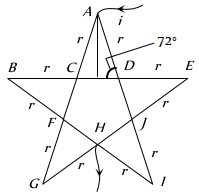
In the following star circuit diagram (figure), the equivalent resistance between the points $A$ and $H$ will be

Image

Two equal masses $m_1$ and $m_2$ moving along the same straight line with velocities $+3 \mathrm{~m} / \mathrm{s}$ and $-5 \mathrm{~m} / \mathrm{s}$ respectively collide elastically. Their velocities after the collision will be respectively