MCQ 11 Mark
A series ac circuit consist of an inductor and a capacitor. The inductance and capacitance is respectively $1$ henry and $25 \mu F$. If the current is maximum in circuit then angular frequency will be
- ✓
$200$
- B
$100$
- C
$50$
- D
$200 / 2 \pi$
View full question & answer→MCQ 21 Mark
For series $\text{LCR}$ circuit, wrong statement is
- A
Applied e.m.f. and potential difference across resistance are in same phase
- B
Applied e.m.f. and potential difference at inductor coil have phase difference of $\pi / 2$
- ✓
Potential difference at capacitor and inductor have phase difference of $\pi / 2$
- D
Potential difference across resistance and capacitor have phase difference of $\pi / 2$
AnswerCorrect option: C. Potential difference at capacitor and inductor have phase difference of $\pi / 2$
Potential difference at capacitor and inductor have phase difference of $\pi / 2$
View full question & answer→MCQ 31 Mark
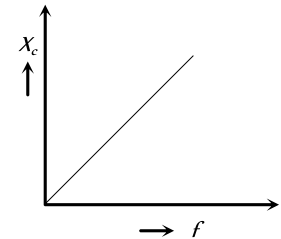
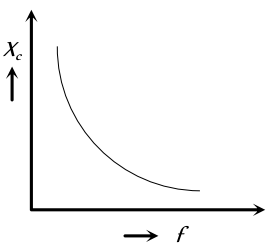
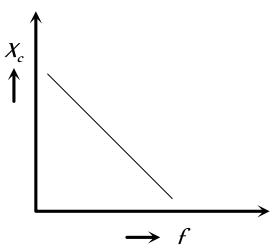
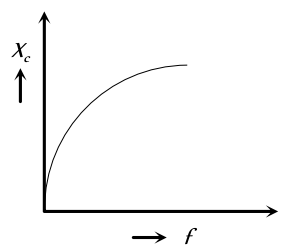
Which of the following curves correctly represents the variation of capacitive reactance $X$ with frequency $f$
Answer$X_C=\frac{1}{\omega C}=\frac{1}{2 \pi f C}$ i.e. $X_C \propto \frac{1}{f}$
View full question & answer→MCQ 41 Mark
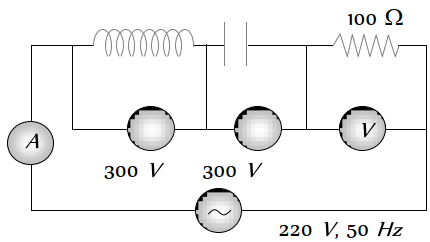
In the circuit shown below, what will be the readings of the voltmeter and ammeter
- A
$800\ V, 2 \ A$
- B
$300 \ V, 2 \ A$
- ✓
$220 \ V , 2.2\ A$
- D
$100\ V , 2 \ A$
AnswerCorrect option: C. $220 \ V , 2.2\ A$
$V^2=V_R^2+\left(V_L-V_C\right)^2 \Rightarrow V_R=V=220 V$Also $i=\frac{220}{100}=2.2 \mathrm{~A}$
View full question & answer→MCQ 51 Mark
There is a $5 \Omega$ resistance in an ac, circuit. Inductance of $0.1 H$ is connected with it in series. If equation of ac e.m.f. is $5 \sin 50 t$ then the phase difference between current and e.m.f. is
- A
$\frac{\pi}{2}$
- B
$\frac{\pi}{6}$
- ✓
$\frac{\pi}{4}$
- D
AnswerCorrect option: C. $\frac{\pi}{4}$
$ \cos \phi=\frac{R}{Z}=\frac{R}{\sqrt{R^2+\omega^2 L^2}}=\frac{5}{\sqrt{25+(50)^2 \times(0.1)^2}} $
$ =\frac{5}{\sqrt{25+25}}=\frac{1}{\sqrt{2}} \Rightarrow \phi=\pi / 4$
View full question & answer→MCQ 61 Mark
A bulb is connected first with dc and then ac of same voltage then it will shine brightly with
AnswerBrightness $\propto P_{\text {consumed }} \propto \frac{1}{R}$ for Bulb, $R_{a c}=R_{d c}$, so brightness will be equal in both the cases.
View full question & answer→MCQ 71 Mark
If instantaneous current is given by $i=4 \cos (\omega t+\phi)$ amperes, then the r.m.s. value of current is
- A
$4$ amperes
- ✓
$2 \sqrt{2}$ amperes
- C
$4 \sqrt{2}$ amperes
- D
AnswerCorrect option: B. $2 \sqrt{2}$ amperes
$i_{r . m . s .}=\frac{i_o}{\sqrt{2}}=\frac{4}{\sqrt{2}}=2 \sqrt{2}$ ampere
View full question & answer→MCQ 81 Mark
Power factor is maximum in an $L C R$ circuit when
- ✓
$X_L=X_C$
- B
$R=0$
- C
$X_L=0$
- D
$X_C=0$
AnswerCorrect option: A. $X_L=X_C$
View full question & answer→MCQ 91 Mark
- ✓
High inductance and low resistance
- B
Low inductance and high resistance
- C
High inductance and high resistance
- D
Low inductance and low resistance
AnswerCorrect option: A. High inductance and low resistance
View full question & answer→MCQ 101 Mark
For an ac circuit $V=15 \sin \omega t$ and $I=20 \cos \omega t$ the average power consumed in this circuit is
- A
$300 \ Watt$
- B
$150\ Watt$
- C
$75\ Watt$
- ✓
$0$
Answer$P=V_{r m s} I_{r m s} \cos \phi$; since $\phi=90^{\circ}$. So $P=0$
View full question & answer→MCQ 111 Mark
One $10 V, 60 W$ bulb is to be connected to $100 V$ line. The required induction coil has self inductance of value $(f=50 Hz )$
- ✓
$0.052 H$
- B
$2.42 H$
- C
$16.2 mH$
- D
$1.62 mH$
AnswerCorrect option: A. $0.052 H$
Current through the bulb $i=\frac{P}{V}=\frac{60}{10}=6 A$
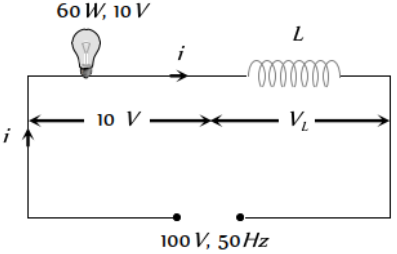
$V=\sqrt{V_R^2+V_L^2} $
$ (100)^2=(10)^2+V_L^2 \Rightarrow V_L=99.5 \text { Volt } $
$ \text { Also } V_L=i X_L=i \times(2 \pi v L)$
$ \Rightarrow 99.5=6 \times 2 \times 3.14 \times 50 \times L \Rightarrow L=0.052\ H$ View full question & answer→MCQ 121 Mark
The coefficient of induction of a choke coil is $0.1 H$ and resistance is $12 \Omega$. If it is connected to an alternating current source of frequency $60 Hz$, then power factor will be
- A
$0.32$
- ✓
$0.30$
- C
$0.28$
- D
$0.24$
AnswerCorrect option: B. $0.30$
When $dc$ is supplied $R=\frac{V}{i}=\frac{100}{1}=100 \Omega$
When $ac$ is supplied $Z=\frac{V}{i}=\frac{100}{0.5}=200 \Omega$
View full question & answer→MCQ 131 Mark
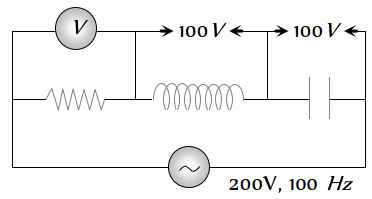
In the circuit given below, what will be the reading of the voltmeter
- A
$300 \ V$
- B
$900\ V$
- ✓
$200 \ V$
- D
$400 \ V$
AnswerCorrect option: C. $200 \ V$
$V^2=V_R^2+\left(V_L-V_C\right)^2$Since $V_L=V_C$ hence $V=V_R=200 \mathrm{~V}$
View full question & answer→MCQ 141 Mark
In the non-resonant circuit, what will be the nature of the circuit for frequencies higher than the resonant frequency
Answer$f=\frac{1}{2 \pi \sqrt{L C}} \Rightarrow f \propto \frac{1}{\sqrt{C}}$
View full question & answer→MCQ 151 Mark
What will be the phase difference between virtual voltage and virtual current, when the current in the circuit is wattless
- A
$90^{\circ}$
- B
$45^{\circ}$
- ✓
$180^{\circ}$
- D
$60^{\circ}$
AnswerCorrect option: C. $180^{\circ}$
$\tan \phi=\frac{\omega L}{R}=\frac{2 \pi \times 50 \times 0.21}{12}=5.5 \Rightarrow \phi=180^{\circ}$
View full question & answer→MCQ 161 Mark
In an ac circuit, the power factor
AnswerCorrect option: D. Is unity when the circuit contains an ideal inductance only
$X_L=2 \pi v L \Rightarrow L=\frac{X_L}{2 \pi v}=\frac{50}{2 \times 3.14 \times 50}=0.16 \mathrm{H}$
View full question & answer→MCQ 171 Mark
An alternating e.m.f. of angular frequency $\omega$ is applied across an inductance. The instantaneous power developed in the circuit has an angular frequency
- A
$\frac{\omega}{4}$
- B
$\frac{\omega}{2}$
- C
$\omega$
- ✓
$2 \omega$
AnswerCorrect option: D. $2 \omega$
The instantaneous values of emf and current in inductive circuit are given by $E=E_0 \sin \omega t$ and $i=i_0 \sin \left(\omega t-\frac{\pi}{2}\right)$ respectively.
So, $P_{\text {inst }}=E i=E_0 \sin \omega t \times i_0 \sin \left(\omega t-\frac{\pi}{2}\right)$
$=E_0 i_0 \sin \omega t\left(\sin \omega t \cos \frac{\pi}{2}-\cos \omega t \sin \frac{\pi}{2}\right)$
$=E_0 i_0 \sin \omega t \cos \omega t$
$=\frac{1}{2} E_0 i_0 \sin 2 \omega t \quad(\sin 2 \omega t=2 \sin \omega t \cos \omega t)$
Hence, angular frequency of instantaneous power is $2 \omega$.
View full question & answer→MCQ 181 Mark
A bulb and a capacitor are connected in series to a source of alternating current. If its frequency is increased, while keeping the voltage of the source constant, then
- ✓
Bulb will give more intense light
- B
Bulb will give less intense light
- C
Bulb will give light of same intensity as before
- D
Bulb will stop radiating light
AnswerCorrect option: A. Bulb will give more intense light
When a bulb and a capacitor are connected in series to an ac source, then on increasing the frequency the current in the circuit is increased, because the impedance of the circuit is decreased. So the bulb will give more intense light.
View full question & answer→MCQ 191 Mark
An alternating e.m.f. of frequency $v\left(=\frac{1}{2 \pi \sqrt{L C}}\right)$ is applied to a series $\text{LCR}$ circuit. For this frequency of the applied e.m.f.
- ✓
The circuit is at resonance and its impedance is made up only of a reactive part
- B
The current in the circuit is in phase with the applied e.m.f. and the voltage across $R$ equals this applied emf
- C
The sum of the p.d.'s across the inductance and capacitance equals the applied e.m.f. which is $180^{\circ}$ ahead of phase of the current in the circuit
- D
The quality factor of the circuit is $\omega L / R$ or $1 / \omega C R$ and this is a measure of the voltage magnification $($produced by the circuit at resonance$)$ as well as the sharpness of resonance of the circuit
AnswerCorrect option: A. The circuit is at resonance and its impedance is made up only of a reactive part
Current in $L C$ circuit becomes maximum when resonance occurs.
So$\omega=\frac{1}{\sqrt{L C}}=\frac{1}{\sqrt{1 \times 25 \times 10^{-6}}}=\frac{1000}{5}=200 \mathrm{rad} / \mathrm{sec}$
View full question & answer→MCQ 201 Mark
A virtual current of $4 A$ and $50 Hz$ flows in an ac circuit containing a coil. The power consumed in the coil is $240 W$. If the virtual voltage across the coil is $100 V$ its inductance will be
- A
$\frac{1}{3 \pi} H$
- ✓
$\frac{1}{5 \pi} H$
- C
$\frac{1}{7 \pi} H$
- D
$\frac{1}{9 \pi} H$
AnswerCorrect option: B. $\frac{1}{5 \pi} H$
$ R=\frac{P}{i_{r m s}^2}=\frac{240}{16}=15 \Omega $
$ Z=\frac{V}{i}=\frac{100}{4}=25 \Omega$
Now $X_L=\sqrt{Z^2-R^2}=\sqrt{(25)^2-(15)^2}=20\ \Omega$
$\therefore 2 \pi v L=20 \Rightarrow L=\frac{20}{2 \pi \times 50}=\frac{1}{5 \pi} H z$
View full question & answer→MCQ 211 Mark
In a purely resistive ac circuit, the current
- A
Lags behind the e.m.f. in phase
- B
ls in phase with the e.m.f.
- ✓
Leads the e.m.f. in phase
- D
Leads the e.m.f. in half the cycle and lags behind it in the other half
AnswerCorrect option: C. Leads the e.m.f. in phase
View full question & answer→MCQ 221 Mark
An ac source is rated at $220 V , 50 Hz$. The time taken for voltage to change from its peak value to zero is
- A
$50\ sec$
- B
$0.02 \ sec$
- C
$5\ sec$
- ✓
$5 \times 10^{-3} sec$
AnswerCorrect option: D. $5 \times 10^{-3} sec$
(d) Required time $t=T / 4=\frac{1}{4 \times 50}=5 \times 10^{-3} \mathrm{sec}$
View full question & answer→MCQ 231 Mark
In an ac circuit, the instantaneous values of e.m.f. and current are $e$ $=200 \sin 314 t$ volt and $i=\sin \left(314 t+\frac{\pi}{3}\right)$ ampere. The average power consumed in watt is
Answer$ V_{r m s}=\frac{200}{\sqrt{2}}, i_{r m s}=\frac{1}{\sqrt{2}} $
$ \therefore P=V_{r m s} i_{r m s} \cos \phi=\frac{200}{\sqrt{2}} \frac{1}{\sqrt{2}} \cos \frac{\pi}{3}=50\ \mathrm{watt}$
View full question & answer→MCQ 241 Mark
An alternating voltage $E=200 \sqrt{2} \sin (100 t)$ is connected to a 1 microfarad capacitor through an ac ammeter. The reading of the ammeter shall be
- A
$10\ mA$
- ✓
$20 \ mA$
- C
$40\ mA$
- D
$80\ mA$
AnswerCorrect option: B. $20 \ mA$
(b) Reading of ammeter $=i_{r m s}=\frac{V_{r m s}}{X_C}=\frac{V_0 \omega C}{\sqrt{2}}$$=\frac{200 \sqrt{2} \times 100 \times\left(1 \times 10^{-6}\right)}{\sqrt{2}}=2 \times 10^{-2} \mathrm{~A}=20 \mathrm{~mA}$
View full question & answer→MCQ 251 Mark
The frequency of ac mains in India is
- A
$30 c / s$ or $Hz$
- ✓
$50 c / s$ or $Hz$
- C
$60 c / s$ or $Hz$
- D
$120 c / s$ or $Hz$
AnswerCorrect option: B. $50 c / s$ or $Hz$
View full question & answer→MCQ 261 Mark
In an ac circuit, a resistance of $R$ ohm is connected in series with an inductance $L$. If phase angle between voltage and current be $45^{\circ}$, the value of inductive reactance will be
- A
$\frac{R}{4}$
- B
$\frac{R}{2}$
- C
$R$
- ✓
Cannot be found with the given data
AnswerCorrect option: D. Cannot be found with the given data
$i=\frac{V}{Z}=\frac{4}{\sqrt{4^2+\left(1000 \times 3 \times 10^{-3}\right)^2}}=0.8 \mathrm{~A}$
View full question & answer→MCQ 271 Mark
The phase angle between e.m.f. and current in $L C R$ series ac circuit is
- ✓
$0$ to $\pi / 2$
- B
$\pi / 4$
- C
$\pi / 2$
- D
$\pi$
AnswerCorrect option: A. $0$ to $\pi / 2$
View full question & answer→MCQ 281 Mark
A lamp consumes only $50 \%$ of peak power in an a.c. circuit. What is the phase difference between the applied voltage and the circuit current
- A
$\frac{\pi}{6}$
- ✓
$\frac{\pi}{3}$
- C
$\frac{\pi}{4}$
- D
$\frac{\pi}{2}$
AnswerCorrect option: B. $\frac{\pi}{3}$
$ P=\frac{1}{2} V_o i_o \cos \phi \Rightarrow P=P_{\text {Peak }} \cdot \cos \phi $
$\Rightarrow \frac{1}{2}\left(P_{\text {peak }}\right)=P_{\text {peak }} \cos \phi$
$ \Rightarrow \cos \phi=\frac{1}{2} \Rightarrow \phi=\frac{\pi}{3}$
View full question & answer→MCQ 291 Mark
A coil of $200\ \Omega$ resistance and $1.0\ H$ inductance is connected to an ac source of frequency $200 / 2 \pi \ Hz$. Phase angle between potential and current will be
Answer$\tan \phi=\frac{X_L}{R}=\frac{2 \pi v L}{R}=\frac{2 \pi \times \frac{200}{2 \pi} \times 1}{200}=1 \Rightarrow \phi=45^{\circ}$
View full question & answer→MCQ 301 Mark
If an $8 \Omega$ resistance and $6 \Omega$ reactance are present in an ac series circuit then the impedance of the circuit will be
- A
$20 ohm$
- ✓
$5 ohm$
- C
$10 ohm$
- D
$14 \sqrt{2} ohm$
AnswerCorrect option: B. $5 ohm$
View full question & answer→MCQ 311 Mark
The ratio of peak value and r.m.s value of an alternating current is
- A
$1$
- B
$\frac{1}{2}$
- ✓
$\sqrt{2}$
- D
$1 / \sqrt{2}$
AnswerCorrect option: C. $\sqrt{2}$
View full question & answer→MCQ 321 Mark
An alternating voltage is represented as $E=20 \sin 300 t$. The average value of voltage over one cycle will be
View full question & answer→MCQ 331 Mark
A $0.7$ henry inductor is connected across a $120\ V -60 \ Hz$ ac source. The current in the inductor will be very nearly
- A
$4.55\ amp$
- B
$0.355\ amp$
- ✓
$0.455\ amp$
- D
$3.55\ amp$
AnswerCorrect option: C. $0.455\ amp$
$i=\frac{V}{X_L}=\frac{120}{2 \times 3.14 \times 60 \times 0.7}=0.455 \mathrm{~A}$
View full question & answer→MCQ 341 Mark
The voltage of an ac supply varies with time $(t)$ as $V=120 \sin\ 100\ \pi t \cos\ 100\ \pi t$. The maximum voltage and frequency respectively are
AnswerCorrect option: D. $60$ volts, $100\ Hz$
$ V=120 \sin\ 100\ \pi t \ \cos 100\ \pi t \Rightarrow V=60\ \sin 200\ \pi t $
$ V_{\max }=60\ V \text { and } v=100 \ H z$
View full question & answer→MCQ 351 Mark
The reactance of a coil when used in the domestic ac power supply ($220$ volts, $50$ cycles per second) is $50\ ohms$. The inductance of the coil is nearly
- ✓
$ 2.2$ henry
- B
$0.22$ henry
- C
$1.6$ henry
- D
$0.16$ henry
AnswerCorrect option: A. $ 2.2$ henry
View full question & answer→MCQ 361 Mark
In an ac circuit, the current lags behind the voltage by $\pi / 3$. The components in the circuit are
- A
$R$ and $L$
- ✓
$R$ and $C$
- C
$L$ and $C$
- D
Only $R$
AnswerCorrect option: B. $R$ and $C$
$X_C=\frac{1}{2 \pi v C}=\frac{1}{0}=\infty$
View full question & answer→MCQ 371 Mark
The capacity of a pure capacitor is $1$ farad. In dc circuits, its effective resistance will be
View full question & answer→MCQ 381 Mark
Which of the following plots may represent the reactance of a series $L C$ combination 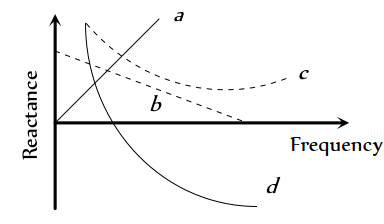
- A
(a) $a$
- B
(b) $b$
- C
(c) $c$
- ✓
(d) $d$
AnswerCorrect option: D. (d) $d$
(d) Reactance $X=X_L-X_C=2 \pi f L-\frac{1}{2 \pi f C}$
View full question & answer→MCQ 391 Mark
A coil of inductance $L$ has an inductive reactance of $X_L$ in an $AC$ circuit in which the effective current is $l$. The coil is made from a super$-$conducting material and has no resistance. The rate at which power is dissipated in the coil is
- ✓
$0$
- B
$I X_L$
- C
$I^2 X_L$
- D
$I X_L^2$
View full question & answer→MCQ 401 Mark
In an $L R$-circuit, the inductive reactance is equal to the resistance $R$ of the circuit. An e.m.f. $E=E_0 \cos (\omega t)$ applied to the circuit. The power consumed in the circuit is
- A
$\frac{E_0^2}{R}$
- B
$\frac{E_0^2}{2 R}$
- ✓
$\frac{E_0^2}{4 R}$
- D
$\frac{E_0^2}{8 R}$
AnswerCorrect option: C. $\frac{E_0^2}{4 R}$
$ P=E_{r m s} i_{r m s} \cos \phi=\frac{E_0}{\sqrt{2}} \times \frac{i_0}{\sqrt{2}} \times \frac{R}{Z} $
$ \Rightarrow \frac{E_0}{\sqrt{2}} \times \frac{E_0}{Z \sqrt{2}} \times \frac{R}{Z} \Rightarrow P=\frac{E_0^2 R}{2 Z^2}$
Given $X_L=R$ so, $Z=\sqrt{2} R \Rightarrow P=\frac{E_0^2}{4 R}$
View full question & answer→MCQ 411 Mark
An e.m.f. $E=4 \cos (1000 t) \quad$ volt is applied to an $LR-$circuit of inductance $3 mH$ and resistance $4$ ohms. The amplitude of current in the circuit is
- A
$\frac{4}{\sqrt{7}} A$
- B
$1.0 A$
- C
$\frac{4}{7} A$
- ✓
$0.8 A$
AnswerCorrect option: D. $0.8 A$
$0.8 A$
View full question & answer→MCQ 421 Mark
The voltage of an ac source varies with time according to the equation $V=100 \sin 100 \pi t \cos 100 \pi t$ where $t$ is in seconds and $V$ is in volts. Then
AnswerCorrect option: B. (b) The peak voltage of the source is 50 volts
(b)$\begin{aligned}& V=50 \times 2 \sin 100 \pi t \cos 100 \pi t=50 \sin 200 \pi t \\& \Rightarrow V_0=50 \text { Volts and } v=100 \mathrm{~Hz}\end{aligned}$
View full question & answer→MCQ 431 Mark
The reactance of a coil when used in the domestic ac power supply $(220$ volt, $50$ cycles $)$ is $100$ ohm. The self inductance of the coil is nearly
- A
$3.2$ henry
- ✓
$0.32$ henry
- C
$2.2$ henry
- D
$0.22$ henry
AnswerCorrect option: B. $0.32$ henry
$0.32$ henry
View full question & answer→MCQ 441 Mark
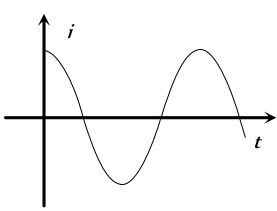
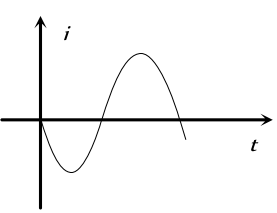
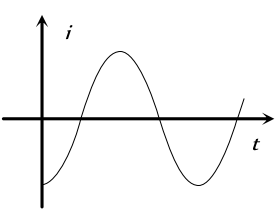
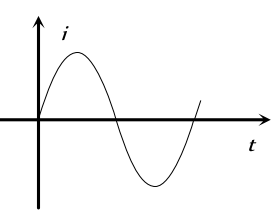
The voltage across a pure inductor is represented by the following diagram. Which one of the following diagrams will represent the current
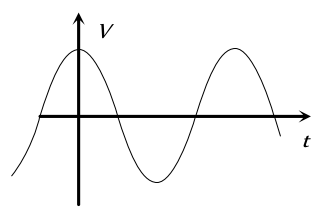
AnswerIn purely inductive circuit voltage leads the current by 90 .
View full question & answer→MCQ 451 Mark
An alternating current is given by the equation $i=i_1 \cos \omega t+i_2 \sin \omega t$. The r.m.s. current is given by
- A
$\frac{1}{\sqrt{2}}\left(i_1+i_2\right)$
- B
$\frac{1}{\sqrt{2}}\left(i_i+i_2\right)^2$
- ✓
$\frac{1}{\sqrt{2}}\left(i_1^2+i_2^2\right)^{1 / 2}$
- D
$\frac{1}{2}\left(i_1^2+i_2^2\right)^{1 / 2}$
AnswerCorrect option: C. $\frac{1}{\sqrt{2}}\left(i_1^2+i_2^2\right)^{1 / 2}$
$i_{r m s}=\sqrt{\frac{i_1^2+i_2^2}{2}}=\frac{1}{\sqrt{2}}\left(i_1^2+i_2^2\right)^{1 / 2}$
View full question & answer→MCQ 461 Mark
In general in an alternating current circuit
- ✓
The average value of current is zero
- B
The average value of square of the current is zero
- C
Average power dissipation is zero
- D
The phase difference between voltage and current is zero
AnswerCorrect option: A. The average value of current is zero
View full question & answer→MCQ 471 Mark
The power factor of a good choke coil is
MCQ 481 Mark
$L, \quad C$ and $R$ denote inductance, capacitance and resistance respectively. Pick out the combination which does not have the dimensions of frequency
AnswerCorrect option: B. (b) $\frac{R}{L}$
(b)$\begin{aligned}& Z=\sqrt{R^2+X^2}=\sqrt{4^2+3^2}=5 \\& \therefore \cos \phi=\frac{R}{Z}=\frac{3}{5}=0.6\end{aligned}$
View full question & answer→MCQ 491 Mark
In a pure inductive circuit or $\ln$ an ac circuit containing inductance only, the current
AnswerCorrect option: B. Lags behind the e.m.f. by $90$
View full question & answer→MCQ 501 Mark
The power factor of $L C R$ circuit at resonance is
AnswerAt resonance, $L C R$ circuit behaves as purely resistive circuit, for purely resistive circuit power factor $=1$
View full question & answer→