MCQ
A sinusoidal carrier voltage is amplitude modulated. The resultant amplitude modulated wave has maximum and minimum amplitude of $120\,V$ and $80\,V$ respectively. The amplitude of each sideband is $..........V$
  • A
    $15$
  • $10$
  • C
    $20$
  • D
    $5$

Answer

Correct option: B.
$10$
b
$A _{ c }+ A _{ m }=120$

$A _{ c }- A _{ m }=80$

$\therefore A _{ c }=100$

$A _{ m }=20$

Modulation index $=\frac{20}{100}=\frac{1}{5}$

Amplitude of each sideband

$= A _{ c } \frac{( mod \text { ulation index) }}{2}$

$=100 \times \frac{1}{10}=10 \text { volt }$

Need a full question paper?

Generate a complete, print-ready paper with questions like this in minutes — across 16+ boards, with answer keys.

Start Generating Free

Similar questions

The average kinetic energy of a monatomic molecule is $0.414 \mathrm{eV}$ at temperature :

(Use $\mathrm{K}_{\mathrm{B}}=1.38 \times 10^{-23} \mathrm{~J} / \mathrm{mol}-\mathrm{K}$ )
In a Young’s double slit experiment, the path difference, at a certain point on the screen, between two interfering waves is $1/8^{th}$ of wavelength. The ratio of the intensity at this point to that at the centre of a bright fringe is close to
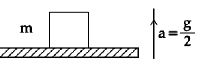
A block of mass $m$ is kept on a platform which starts from rest with constant acceleration $g/2$ upward, as shown in figure. Work done by normal reaction on block in time $t$ is
A magnetic needle of magnetic moment $6.7 \times 10^{-2} $ $Am^2$ and moment of inertia $7.5 \times  10^{-6}$ $ kgm^2$ is performing simple harmonic oscillations in a magnetic field of $0.01\ T$. Time taken for $10$ complete oscillations is.....$s$
A combination of two thin convex lenses of focal length $0.3 m$ and $0.1 m$ will have minimum spherical and chromatic aberrations if the distance between them is......$m$
If in a plano-convex lens, radius of curvature of convex surface is $10 \,cm$ and the focal length of lens is $30 \,cm$, the refractive index of the material of the lens will be ..........
Electric field at a point $(x, y, z)$ is represented by $\vec E = 2x\hat i + {y^2}\hat j$ if potential at $(0,0,0)$ is $2\, volt$ find potential at $(1, 1, 1)$
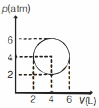
An ideal gas undergoes a circular cycle centred at $4 \,atm , 4 L$ as shown in the diagram. The maximum temperature attained in this process is close to
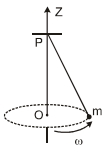
A small mass $m$ is attached to a massless string whose other end is fixed at $P$ as shown in the figure. The mass is undergoing circular motion is the $x-y$ plane with centre at $O$ and constant angular speed $\omega$. If the angular momentum of the system, calculated about $O$ and $P$ are denoted by $\vec{L}_O$ and $\vec{L}_P$ respectively, then
$A$ lateral object of height $0.5\, cm$ is placed on the optical axis of bi-convex lens of focal length $80\,cm$, at an object distance $= 60\, cm$.The image formed is :