A sinusoidal voltage of peak value $283 V$ and frequency $50 Hz$ is applied to a series $L C R$ circuit in which $R =3 \Omega, L=25.48 mH$, and $C =796 \mu F$. Find (a) the impedance of the circuit; (b) the phase difference between the voltage across the source and the current; (c) the power dissipated in the circuit; and (d) the power factor.
Example-(7.8)
Download our app for free and get started
(a) To find the impedance of the circuit, we first calculate $X_{ L }$ and $X_{ C }$.
$
\begin{array}{c}
X_L=2 \pi v L \\
=2 \times 3.14 \times 50 \times 25.48 \times 10^{-3} \Omega=8 \Omega \\
X_C=\frac{1}{2 \pi v C} \\
=\frac{1}{2 \times 3.14 \times 50 \times 796 \times 10^{-6}}=4 \Omega
\end{array}
$
Therefore,
$
\begin{aligned}
Z & =\sqrt{R^2+\left(X_L-X_C\right)^2}=\sqrt{3^2+(8-4)^2} \\
& =5 \Omega
\end{aligned}
$
(b) Phase difference, $\phi=\tan ^{-1} \frac{X_C-X_L}{R}$
$
=\tan ^{-1}\left(\frac{4-8}{3}\right)=-53.1^{\circ}
$
Since $\phi$ is negative, the current in the circuit lags the voltage across the source.
(c) The power dissipated in the circuit is
$
P=I^2 R
$
Now, $I=\frac{i_m}{\sqrt{2}}=\frac{1}{\sqrt{2}}\left(\frac{283}{5}\right)=40 A$
Therefore, $P=(40 A )^2 \times 3 \Omega=4800 W$
(d) Power factor $=\cos \phi=\cos \left(-53.1^{\circ}\right)=0.6$
$
\begin{array}{c}
X_L=2 \pi v L \\
=2 \times 3.14 \times 50 \times 25.48 \times 10^{-3} \Omega=8 \Omega \\
X_C=\frac{1}{2 \pi v C} \\
=\frac{1}{2 \times 3.14 \times 50 \times 796 \times 10^{-6}}=4 \Omega
\end{array}
$
Therefore,
$
\begin{aligned}
Z & =\sqrt{R^2+\left(X_L-X_C\right)^2}=\sqrt{3^2+(8-4)^2} \\
& =5 \Omega
\end{aligned}
$
(b) Phase difference, $\phi=\tan ^{-1} \frac{X_C-X_L}{R}$
$
=\tan ^{-1}\left(\frac{4-8}{3}\right)=-53.1^{\circ}
$
Since $\phi$ is negative, the current in the circuit lags the voltage across the source.
(c) The power dissipated in the circuit is
$
P=I^2 R
$
Now, $I=\frac{i_m}{\sqrt{2}}=\frac{1}{\sqrt{2}}\left(\frac{283}{5}\right)=40 A$
Therefore, $P=(40 A )^2 \times 3 \Omega=4800 W$
(d) Power factor $=\cos \phi=\cos \left(-53.1^{\circ}\right)=0.6$

Download our appand get started for free
Experience the future of education. Simply download our apps or reach out to us for more information. Let's shape the future of learning together!No signup needed.*
Similar Questions
- 1View SolutionCalculate the following:
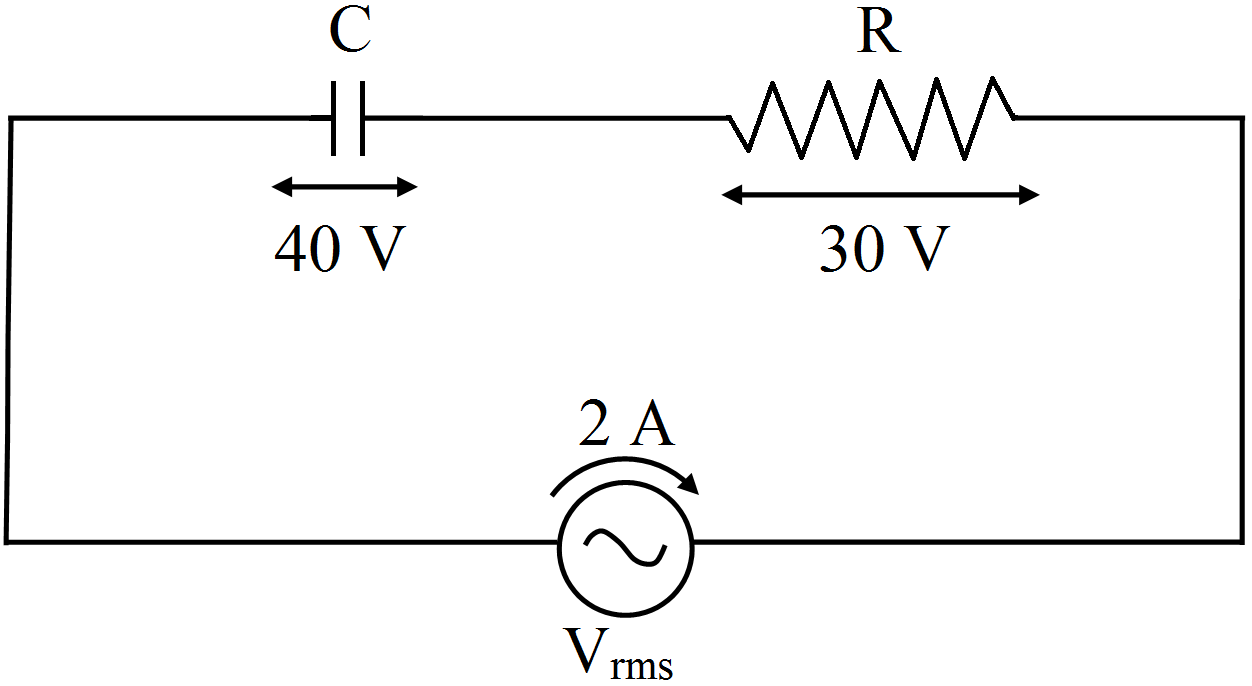
- Impedance of the given ac circuit.
- Wattless current of the given ac circuit.
- 2Half life of $^{238}\text{U}_{92}$against$\alpha$ decay is $4.5 \times 10^{9}$years. Calculate the activity of Ig sample of$^{238}\text{U}_{92}$? Given Avogadro's number $= 6 \times 10^{26}$atoms/kmol.View Solution
- 3Arrange the following electromagnetic waves in the order of their increasing wavelength:View Solution
- $\gamma- \text{rays}$.
- Microwaves.
- X-rays.
- Radio waves.
- 4View SolutionA bulb rated 60W at 220V is connected across a household supply of alternating voltage of 220V. Calculate the maximum instantaneous current through the filament.
- 5A voltage $V = V_o$ sin $\omega\text{t}$ is applied to a series LCR circuit. Derive the expression for the average power dissipated over a cycle. Under what condition is (i) no power dissipated even though the current flows through the circuit, (ii) maximum power dissipated in the circuit?View Solution
- 6View SolutionWhat is space wave propagation? State the factors which limit its range of propagation. Derive an expression for the maximum line of sight distance between two antennas for space wave propagation.
- 7In a series LCR circuit connected to an ac source of variable frequency and voltage v $v_m= \sin, $ draw a plot showing the variation of current (I) with angular frequency ($\omega$) for two different values of resistance R1 and R2(R1 > R2 ). Write the condition under which the phenomenon of resonance occurs. For which value of the resistance out of the two curves, a sharper resonance is produced? Define Q-factor of the circuit and give its significance.View Solution
- 8View Solution
- Mention two properties of soft iron due to which it is preferred for making an electromagnet.
- State Gauss's law in magnetism. How is it different from Gauss's law in electrostatics and why?
- 9View Solution
- Describe the working of photodiode by drawing the circuit diagram.
- Draw the characteristics of a photodiode for different illumination intensities.
- Why is photodiode operated in reverse bias even though the reverse bias current is much weaker than the current in forward bias?
- 10View Solution
Given below are two electric circuits A and B.
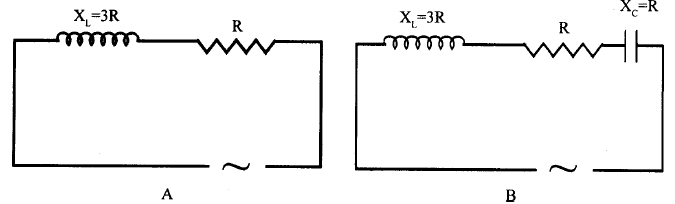
Calculate the ratio of power factor of the circuit B to the power factor of circuit A.