MCQ
A sinusoidal voltage $\text{V}=200\sin314\text{t}$ is applied to a $10\Omega$ resistor. Find the peak voltage.
- A200V
- B400V
- C600V
- D800V
Explanation:
General sinusoidal voltage variation is given by:
$\text{V}=\text{V}_0\sin(\omega\text{t})$
Here, in this equation V0 is peak voltage.
So, on comparing both equation we get:
$\text{V}_0=200\text{V},\omega=314$
Generate a complete, print-ready paper with questions like this in minutes — across 16+ boards, with answer keys.
For the production of characteristic  X-ray, the electron transition is
|
(a) n = 2 to n = 1 |
(b) n = 3 to n = 2 |
(c) n = 3 to n = 1 |
(d) n = 4 to n = 1 |
$\text{P}_0$
$\text{P}_0+ \frac{2\text{S}}{\text{r}}$
$\text{P}_0- \frac{2\text{S}}{\text{r}}$
$\text{P}_0- \frac{4\text{S}}{\text{r}}$
The ionisation energy of hydrogen atom is 13.6 eV. Following Bohr's theory, the energy corresponding to a transition between the 3rd and the 4th orbit is
|
(a) 3.40 eV |
(b) 1.51 eV |
(c) 0.85 eV |
(d) 0.66 eV |
Electric lines of force about negative point charge are
|
(a) Circular, anticlockwise |
(b) Circular, clockwise |
|
(c) Radial, inward |
(d) Radial, outward |
If the distance between the plates of parallel plate capacitor is halved and the dielectric constant of dielectric is doubled, then its capacity will
|
(a) Increase by 16 times |
(b) Increase by 4 times |
|
(c) Increase by 2 times |
(d) Remain the same |
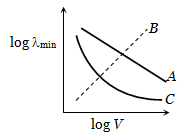
The dependence of the short wavelength limit  on the accelerating potential V is represented by the curve of figure
|
(a) A |
(b) B |
(c) C |
(d) None of these |
In the following circuit, bulb rated as 1.5 V, 0.45 W. If bulbs glows with full intensity then what will be the equivalent resistance between X and Y

|
(a) 0.45 W |
(b) 1 W |
(c) 3 W |
(d) 5 W |