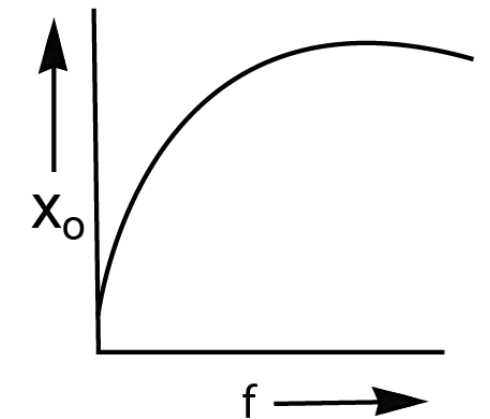
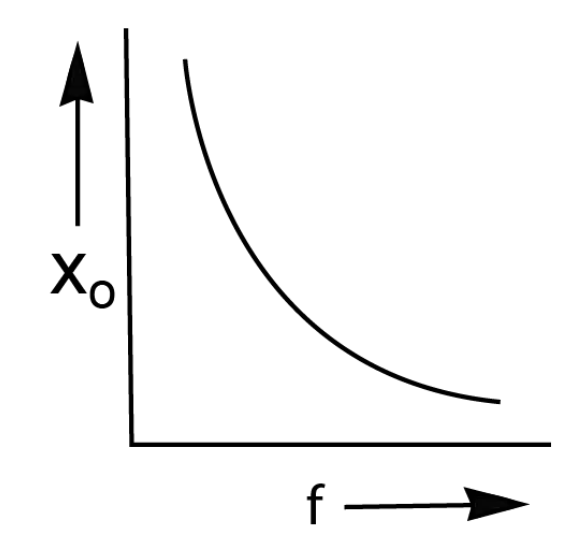
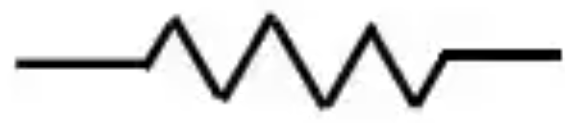
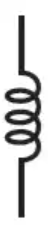
- A

- B

- C

- D


Explanation:
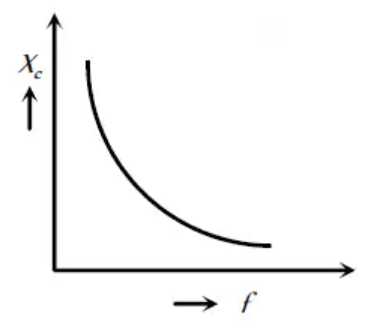
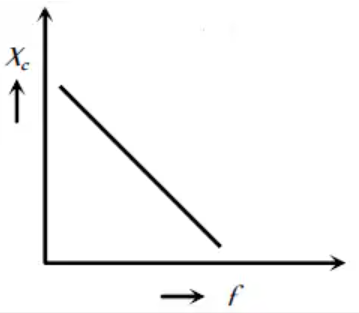
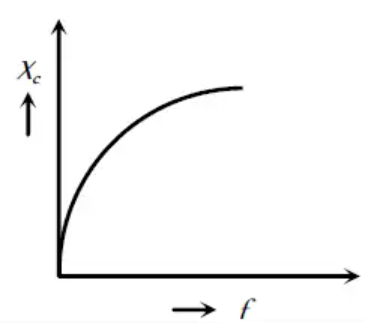
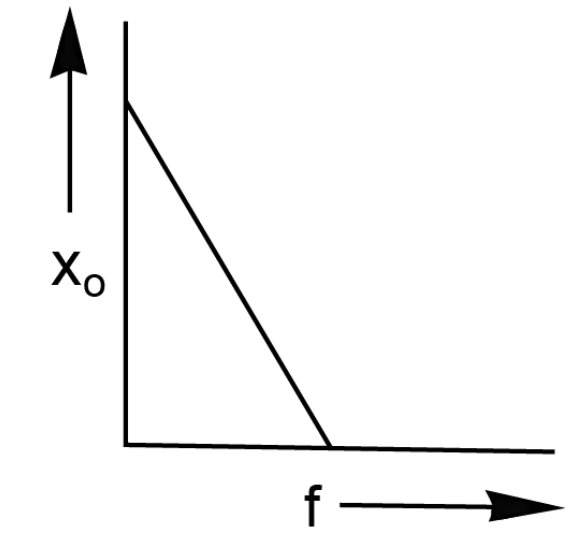
$\text{X}_\text{C}=\frac{1}{\text{C}2\pi\text{f}}$
XC and f are inversely proportional.
50 questions · timed · auto-graded


Explanation:
$\text{X}_\text{C}=\frac{1}{\text{C}2\pi\text{f}}$
XC and f are inversely proportional.

Explantion:
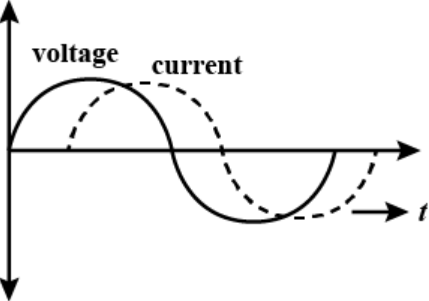
The given circuit shows that the current lags the applied voltage. This is possible if the circuit has inductive element. So, the circuit contain a pure inductor.

Explantion:
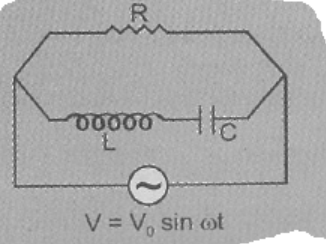
The current in inductor and capacitor is always at an phase difference of 180°
for V $=\text{V}_\text{o}\sin\omega\text{t}$
Capacitor, $\text{i}=\text{i}_\text{o}\sin(\omega\text{t}-\frac{\pi}{2})$
Capacitor, $\text{i}=\text{i}_\text{o}\sin(\omega\text{t}+\frac{\pi}{2})$
So, the current from both branches will be 0.9 + (-0.4) = 0.5A

Explanation:
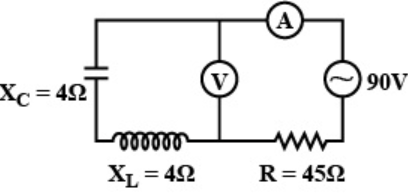
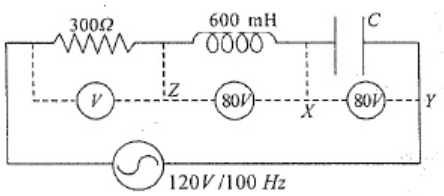
In the problem $\text{XC}=4\Omega$ and $\text{XL}=4\Omega$
So, V across XC and XL will be same and in opposite direction, So net voltage will be zero. Since voltmeter is connected parallel to Capacitor and inductor so, it will read 0 volts.
Current $=\frac{\text{V}}{\text{impedance}}$
Z = R as XL = XC
Current $=\frac{90}{45}=2\text{A}$

Explanation:
At resonance XL = XC
⇒ R & current is maximum but finite, which is
$\text{I}_\text{max}=\frac{\text{E}}{\text{R}}$ where E is applied voltag.
Explanation:
In an AC circuit, power loss can be minimized by decreasing in resistance and by increasing in inductance.


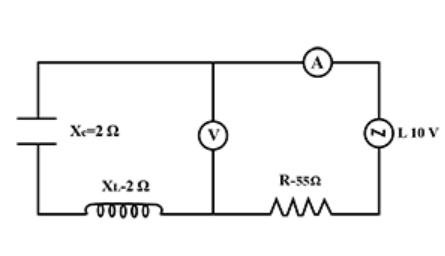
Explanation:
$\text{I}=\frac{\text{E}}{\sqrt{\text{R}^2+(\text{X}_\text{L}-\text{X}_\text{C})^2}}$
$=\frac{110}{\sqrt{55^2+(2-2)^2}}$
$=\frac{110}{55}=2\text{A}$

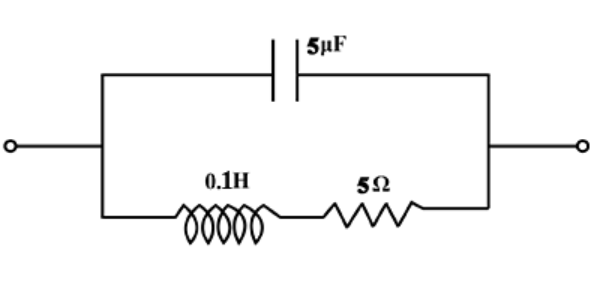
Explanation:
The resonant frequecy of a circuit is given by $\text{f}=\frac{1}{2\pi\sqrt{\text{LC}}}$
Given $\text{L}=0.1\text{H }\text{C}=5\mu\text{F }\text{R}=5\Omega$
Substituting them in formula for f gives
f = 225.08 Hz.

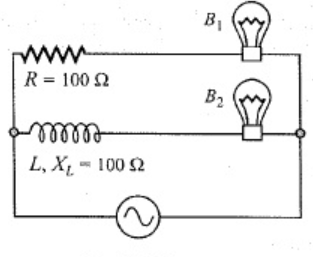
Explanation:
Impedance in branch containing bulb1
$\text{Z}_1=200\Omega$
impedance in branch containing bulb2
$\text{Z}_2\sqrt{\text{R}^2+\text{X}_\text{L}}^2$
$\text{Z}_2=\sqrt{100^2+100^2}$
$\text{Z}_2=100\sqrt{2}$
Since,
$\text{Z}_1>\text{Z}_2$
B2 will glow more than B1.

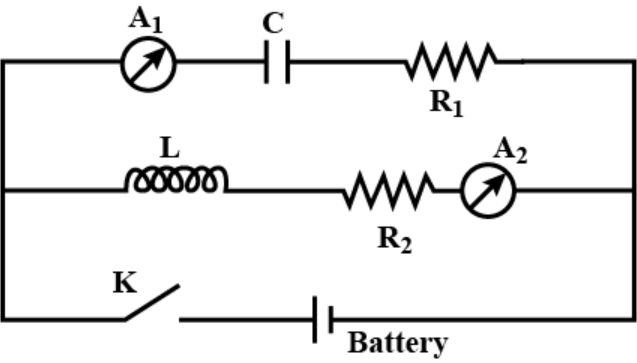
Explanation:
Initially there is no D.C current in inductive circuit and maximum D.C current is in capacitive current. Hence, the current is zero in A2 and maximum in A1

Explanation:
VZY = VC - VL = 0

Explanation:
IC is 90° ahead of the applied voltage and IL lags behind the applied voltage by 90°. So, there is a phase difference of 180° between IL and IC
$\therefore$ I = IC - IL = 0.2A

Explanation:
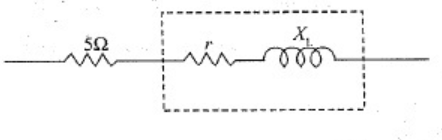
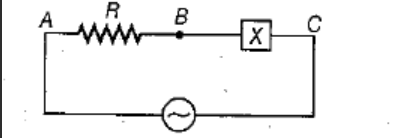
Since the voltage across the resistive element is same as the voltage applied, the voltage drop across BC is zero. This is possible only when the ohmic value of the element connected across BC is zero. So, X should be combination of inductance and capacitance at resonance.

Explanation:
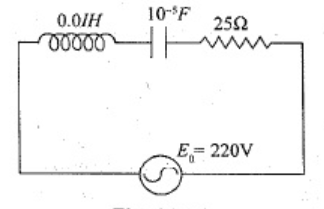
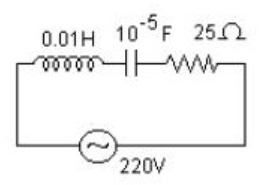
$\text{I}=\frac{220}{25+\text{j}\Big(0.1\times2\pi\text{f }-\frac{1}{10^{-5}2\pi\text{f}}\Big)}$
$\text{I}=0\text{ at }\text{f}=0$
$\text{I}=0\text{ at }\text{f}=\infty$

Explanation:
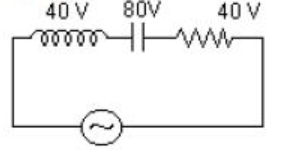
$\text{E}_\text{rms}=\sqrt{\text{V}^2_\text{R}+(\text{V}_\text{L}-\text{V}_\text{c})^2}$
$=\sqrt{40^2+(40-80)^2}$
$=\sqrt{40^2+40^2}$
$=40\sqrt{2}\text{V}$

Explanation:
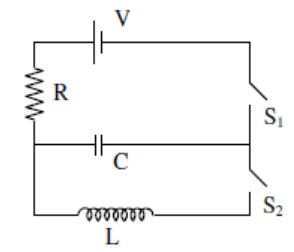
Charge on the capacitor at any time `t' is
$\text{q}=\text{CV}(1-\text{e}\frac{-\text{t}}{\tau})$
$\text{at }\text{t}=2\tau$
$\text{q}=\text{CV}(1-\text{e}^{-2})$


Explanation:
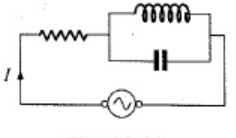
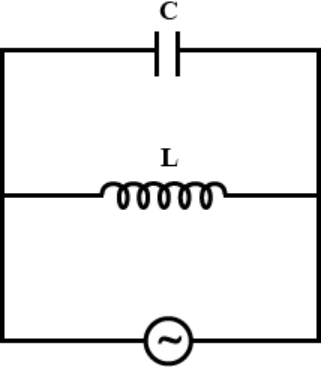
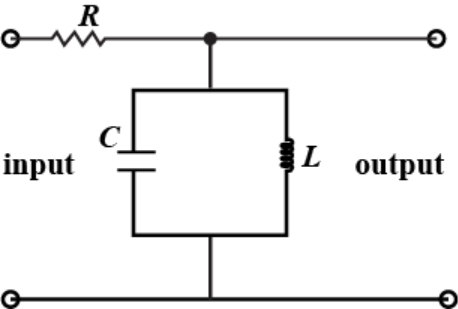
The circuit shown in figure has capacitor and inductor in parallel so their will be current flowing continuously with energy being transformed into electrical in capacitor and magnetic in inductor, hence it is a tuned filter.
Explanation:
Frequency of applied voltage and voltage or current accross any component are same. As we know,
$\text{I}=\frac{\text{V}}{\text{Z}}$ and Z has nothing to do with frequency
$\Rightarrow $$ \text{IandV}$$$ have same frequency.
And also according to KVL V = V1 + V2 + V3
⟹ voltage and current across any component have same frequency i.e 6kHz.

Explanation:
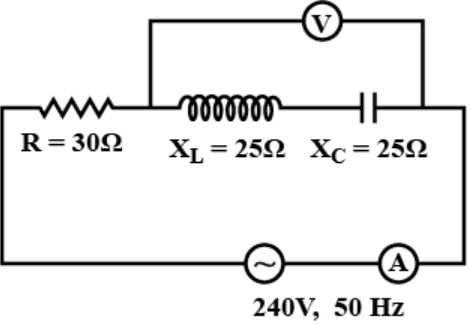
Voltmeter reading is zero since voltage in both Capacitor and inductor is same in magnitude but opposite in sign because current in series is same and both have same reactance.
So, $\text{i}=\frac{\text{V}}{\text{R}}$
$=\frac{240}{30}$
$=8\text{A}$

Explanation:
At resonance the voltage across L and C are same but opposite.
So, at resonance $\mid\text{V}_\text{L}\mid=\mid\text{V}_\text{C}\mid$
$\therefore\text{V}_\text{R}=\text{V}_\text{app}=120\text{V}$

Explanation:
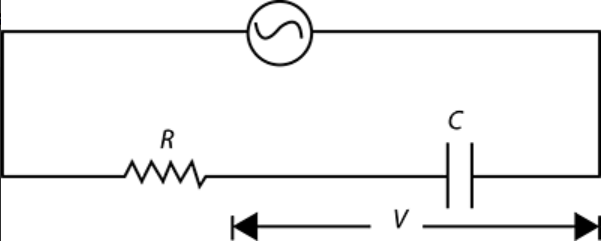
In complex plane $\text{V}=\frac{\text{V}_\text{AC}}{1+\text{jRC}\omega}$
Therefore as $\omega$(frequency) increases, V decreases.
Solution:
For maximum power to be delivered from the generator (or internal reactance Xg) to the load (of reactance, XL),
⇒ XL + Xg = 0 (the total reactance must vanish)
⇒ XL= -Xg.

Explanation:
Given circuit is one simple low-pass filter circuit consists of a resistor in series with a load, and a capacitor in parallel with the load. The capacitor exhibits reactance, and blocks low-frequency signals, forcing them through the load instead. At higher frequencies the reactance drops, and the capacitor effectively functions as a short circuit.

Explanation:
In a LCR circuit current at t = 0 is zero because inductor does not allow flow of current,
and at t = ∞ also current is zero because capacitor does not allow flow of current.

Explanation:
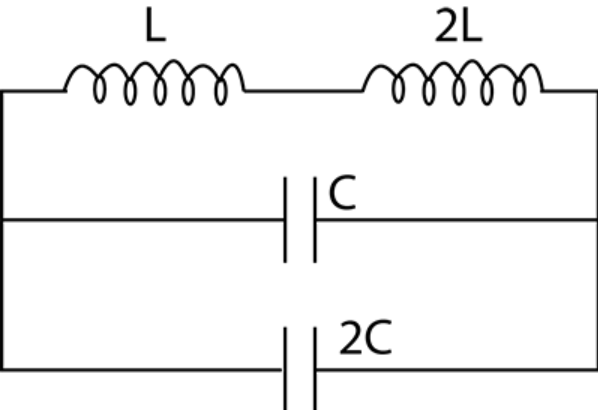
Equivalent inductance Leq = L + 2L = 3L
Ceq = C + 2C = 3C
$\therefore$ Frequency of oscillation $\text{f}=\frac{1}{2\pi\sqrt{\text{L}_\text{eq}\text{C}_\text{eq}}}=\frac{1}{6\pi\sqrt{\text{LC}}}$
Explanation:
Wattless current $=\text{I}_\text{max}\sin(\tan^{-1}[\frac{\text{L}\omega}{\text{R}}])=\frac{220}{\sqrt{\text{R}^2+\text{L}^2\omega^2}}\sin(\tan^{-1}[\frac{\text{L}\omega}{\text{R}})=0.5\text{A}$


Explanation:
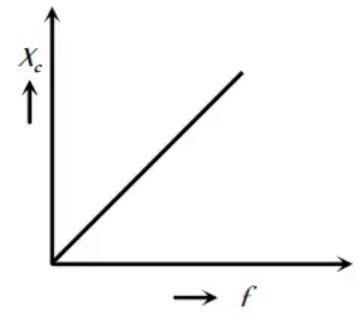
Capacitor reactance is given by: $\text{X}_\text{c}=\frac{1}{2\pi\text{fC}}$
C is the capacitance.
Xc & f are inversely proportional.


Explanation:
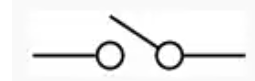
A is for resitance, B is for inductance, C is for a switch and D is for Galvanometer.
Explanation:
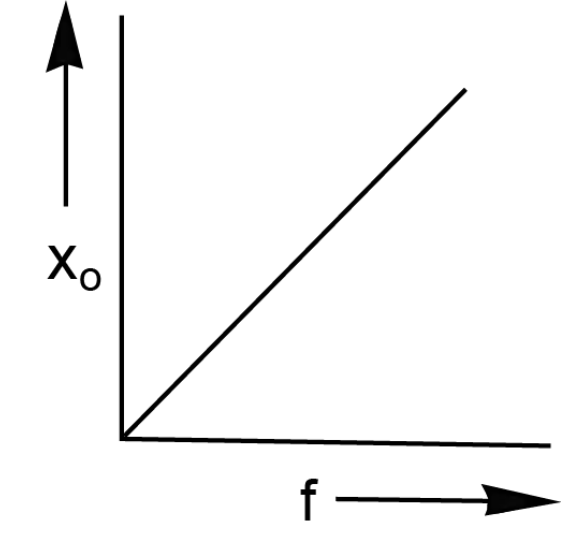
The inductive reactance $\text{Xl}=\omega\text{L}$
Hence, $\text{X}_1\propto\omega$
As frequency increases $\rightarrow\omega$
Therefore, inductive reactance increases with frequency.
Solution:
Alternation currents are used for household supplies, which are having zero average value over a cycle.
The line is having some resistance, so power factor $\cos\phi=\frac{\text{R}}{\text{Z}}\neq0$
So, $\phi\neq\frac{\pi}{2}\Rightarrow\ \phi<\frac{2}{\pi}$
i.e., phase lies between 0 and $\frac{\pi}{2}$.
Important point: The average value of alternating quantity for one complete cycle is zero.
The average value of ac over half cycle $\Big(\text{t}=0\text{ to }\frac{\text{T}}{2}\Big)$
$\text{i}_\text{av}=\frac{\int_0^{\frac{\text{T}}{2}}\text{idt}}{\int_0^{\frac{\text{T}}{2}}\text{dt}}=0.637\text{i}_0=63.7\% \ \text{of i}_0$
Similarly $\text{V}_\text{av}=\frac{2\text{V}_0}{\pi}=0.637\text{V}_0=63.7\%\ \text{of V}_0.$
Explanation:
In India, the frequency of AC voltage is 50 Hz.
It means 50 waves will be produced in 1 s.
In one wave, the direction is changed 2 times.
Thus, in 50 waves, the direction will be altered 50 × 2 = 100 times.
i.e. the direction is changed 100 times in 1 s.
Thus the direction is changed in every $\frac{1}{100}\text{second}$
Solution:
Key Concept: Resonant frequency (Natural frequency)
At resonance $\text{X}_\text{L}=\text{X}_\text{C}\Rightarrow\ \omega_0\text{L}=\frac{1}{\omega_0\text{C}}$
$\Rightarrow\ \omega_0=\frac{1}{\sqrt{\text{LC}}}\frac{\text{red}}{\sec}$
$\Rightarrow\ \text{v}_0=\frac{1}{2\pi\sqrt{\text{LC}}}\text{Hz}$
Resonant frequency in an L-C-R circuit is given by
$\text{v}_0=\frac{1}{2\pi\sqrt{\text{LC}}}$
If L or C increases, the resonant frequency will reduce.
To increase capacitance, we must connect another capacitor parallel to the first.
Explanation:
$\text{V}=\sqrt{\text{V}^2_\text{R}+(\text{V}_\text{L}-\text{V}_\text{C})^2}$
$\text{V}=\sqrt{30^2+(80-40)^2}$
$\text{V}=50\text{ Volt}$
Explanation:
We know at resonance, reactance (resistance due to inductor and capacitor) be zero (0).
At resonance, Impedance (Z) = Resistance (R)
Therefore, Z = 20 ohm
Explanation:
$\text{f}_0=\frac{1}{2\pi\sqrt{\text{LC}}}.$
Explanation:
Supply voltage of an LCR circuit
$\text{V}=\sqrt{\text{V}^2_\text{R}+(\text{V}_\text{L}-\text{V}_\text{C})^2}$
since inductor and capacitor potentials are out of phase with each other
$=\sqrt{40^2+(60-30)^2\text{V}}$
$=50\text{V}$
Explanation:
$\text{Z}=\sqrt{\text{R}^2+(\text{X}_\text{L}-\text{X}_\text{C})^2}$
$=\sqrt{(10)^2+(8-6)^2}$
$=\sqrt{10^2+2^2}$
$=\sqrt{100+4}$
$=10.2\Omega$
Explanation:
Reactance is the nonresistive component of impedance in an AC circuit, arising from the effect of inductance or capacitance or both and causing the current to be out of phase with the electromotive force causing it.
Therefore, reactance of the L - C - R circuit is XL - XC.
Explanation:
Current in the circuit is wattless,
Because power = i2R, if R = 0, then P = 0.
Explanation:
$\text{X}_\text{C}=\frac{1}{\omega\text{c}}$
$\therefore\text{X}_\text{C}\propto\frac{1}{\omega}$
Explanation:
$\tan(45)=1\frac{\text{L}\omega}{\text{R}}$
$\text{L}=\frac{\text{R}}{\omega}=\frac{\text{R}}{(2\pi1000)}=.016\text{H}$
Explanation:
$\text{Z}_\text{L}=\text{WL}\ \ \ \text{Z}_\text{C}=\frac{1}{\text{WC}}$
$\text{w}\uparrow,\text{Z}_\text{L}\uparrow\text{Z}_\text{c}\downarrow$
Explanation:
$\text{impedance}×\cos\theta = \text{resistance}$
$\text{impedance} = \frac{\text{resistance}}{\cos\theta}$
$=\frac{\sqrt{300}}{\frac{\cos\pi}{6}}$
$20\Omega$
Explanation:
Resonant frequency in the series RLC circuit $\text{v}_\text{r}=\frac{1}{2\pi\sqrt{\text{LC}}}$
$\Rightarrow\text{v}_\text{r}\propto\frac{1}{\sqrt{\text{C}}}$
Thus resonant frequency of the circuit increases if the value of C decreases.
Explanation:
In the above image waveform of current and voltage in puerly inductive circuit with time is shown.
It is clear from the image that current lags voltage by 90°.
Hence phase angle between current and voltage in purely inductive circuit is $\frac{\pi}{2}$