A siren placed at a railway platform is emitting sound of frequency $5 kHz$. A passenger sitting in a moving train $A$ records a frequency of $5.5 kHz$ while the train approaches the siren. During his return journey in a different train $B$ he records a frequency of $6.0 kHz$ while approaching the same siren. The ratio of the velocity of train $B$ to that of train $A$ is
IIT 2002, Diffcult
Download our app for free and get started
(b) In both the cases observer is moving towards, the source.
Hence by using $n' = n\left( {\frac{{v + {v_0}}}{v}} \right)$
When passenger is sitting in train $A$, then
$5.5 = 5\left( {\frac{{v + {v_A}}}{v}} \right)$ …$(i)$
when passenger is sitting in train $B$, then
$6 = 5\left( {\frac{{v + {v_B}}}{v}} \right)$ …$(ii)$
On solving equation $(i)$ and $(ii)$ we get $\frac{{{v_B}}}{{{v_A}}} = 2$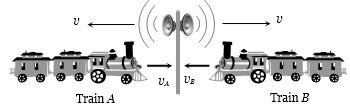

Download our appand get started for free
Experience the future of education. Simply download our apps or reach out to us for more information. Let's shape the future of learning together!No signup needed.*
Similar Questions
- 1A uniform tube of length $60.5\,cm$ is held vertically with its lower end dipped in water. A sound source of frequency $500\,Hz$ sends sound waves into the tube. When the length of tube above water is $16\,cm$ and again when it is $50\,cm,$ the tube resonates with the source of sound. Two lowest frequencies (in $Hz$), to which tube will resonate when it is taken out of water, are (approximately).View Solution
- 2$4.0 \,g$ of a gas occupies $22.4$ litres at $NTP.$ The specific heat capacity of the gas at constant volume is $5.0 \,\,J K^{-1} mol^{-1}$. If the speed of sound in this gas at $NTP$ is $952\, m s^{-1}$, then the heat capacity at constant pressure is .... $J K^{-1} mol^{-1}$ (Take gas constant $R = 8.3 \,\,J K^{-1} mol^{-1}$)View Solution
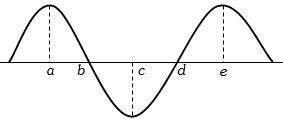
- 3The rope shown at an instant is carrying a wave travelling towards right, created by a source vibrating at a frequency $n$. Consider the following statementsView Solution
$I.$ The speed of the wave is $4n \times ab$
$II.$ The medium at $a$ will be in the same phase as $d$ after $\frac{4}{{3n}}s$
$III.$ The phase difference between $b$ and $e$ is $\frac{{3\pi }}{2}$
Which of these statements are correct
- 4A transverse wave is described by the equation $Y = {Y_0}\sin 2\pi \left( {ft - \frac{x}{\lambda }} \right)$. The maximum particle velocity is four times the wave velocity ifView Solution
- 5The intensity of sound from a radio at a distance of $2$ metres from its speaker is $1 \times {10^{ - 2}}\mu \;W/{m^2}.$ The intensity at a distance of $10$ meters would beView Solution
- 6A tuning fork $A$ of frequency $200 Hz$ is sounded with fork $B,$ the number of beats per second is $5.$ By putting some wax on $A,$ the number of beats increases to $8.$ The frequency of fork $B$ is .... $Hz$View Solution
- 7Frequency of tuning fork $A$ is $256\,Hz$ . It produces four $beats/sec$ . with tuning fork $B$ . When wax is applied at tuning fork $B$ then $6\,beats/sec$ . are heard. By reducing little amount of wax $4\,beats/sec$ . are heard. Frequency of $B$ is .... $Hz$View Solution
- 8First overtone frequency of a closed organ pipe is equal to the first overtone frequency of an open organ pipe. Further nth harmonic of closed organ pipe is also equal to the mth harmonic of open pipe, where $n$ and $m$ are:View Solution
- 9A police car with a siren of frequency $8 \ kHz$ is moving with uniform velocity $36 \ km / hr$ towards a tall building which reflects the sound waves. The speed of sound in air is $320 \ m / s$. The frequency of the siren heard by the car driver isView Solution
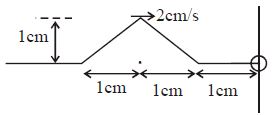
- 10A trianguler pulse moving at $2\ cm/s$ on a rope approches an end at which it is free to slide on vertical pole. What is the particle speed at the free end at $\frac{3}{4}\ sec$ from the instant shown ...... $cm/s$View Solution