MCQ
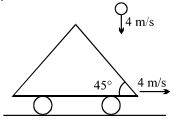
A small ball falling vertically downward with constant velocity $4m/s$ strikes elastically $a$ massive inclined cart moving with velocity $4m/s$ horizontally as shown. The velocity of the rebound of the ball is
  • A
    $4 \sqrt 2 m/s$
  • B
    $4 \sqrt 3 m/s$
  • C
    $4m/s$
  • $4 \sqrt 5m/s$

Answer

Correct option: D.
$4 \sqrt 5m/s$
d
when the ball rebounds, it experiences the same amount of momentum in the opposite direction.

Hence,

change in momentum $=2 \times \rho$

Relative velocity ( ball),

$-v$ along $x-$ axis directed to the right

$-v$ along $y$ -axis directed up

After rebound,

$V$ along $x-$ axis directed to the left

$v$ along $y-$ axis directed down

Therefore,

velocity ( rebounded ball) $=\sqrt{(} 2 v)^{2}+v^{2}$

$v \sqrt{5}$

velocity ( rebounded ball ) $=4 \sqrt{5} \mathrm{m} / \mathrm{s}$

Hence, the velocity of the rebounded ball is $4 \sqrt{5} \mathrm{m} / \mathrm{s}$
Need a full question paper?

Generate a complete, print-ready paper with questions like this in minutes — across 16+ boards, with answer keys.

Start Generating Free

Similar questions

A uniform thin rope of length $12\, m$ and mass $6\, kg$ hangs vertically from a rigid support and a block of mass $2\, kg$ is attached to its free end. A transverse short wavetrain of wavelength $6\, cm$ is produced at the lower end of the rope. What is the wavelength of the wavetrain (in $cm$ ) when it reaches the top of the rope $?$
The process of transformation of liquid into vapor is:
For a small temperature difference between the body and the surroundings the relation between the rate of loss heat $R$ and the temperature of the body is depicted by
Assume that a tunnel is dug along a chord of the earth, at a perpendicular distance $( R / 2)$ from the earth's centre, where $'R'$ is the radius of the Earth. The wall of the tunnel is frictionless. If a particle is released in this tunnel, it will execute a simple harmonic motion with a time period
We write the relation for Boyle's law in the form $PV = C$ when the temperature remains constant. In this relation, the magnitude of $C$ depends upon
The motion of planets in the solar system is an example of the conservation of
An ideal monoatomic gas expands to twice its volume. If the process is isothermal, the magnitude of work done by the gas is $W_i$. If the process is adiabatic, the magnitude of work done by the gas is $W_a$. Which of the following is true?
The damping force on an oscillator is directly proportional to the velocity. The unit of the constant of proportionality is:
 A bullet of mass A and velocity B is fired into a block of wood of mass C. If loss of any mass and friction be neglected, the velocity of the system must be:
Consider the situation shown in figure. All the surfaces are smooth. The tension in the string connected to $2\,m$ is