Question
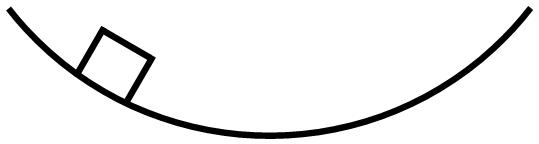
A small block oscillates back and forth on a smooth concave surface of radius R figure. Find the time period of small oscillation.
Answer

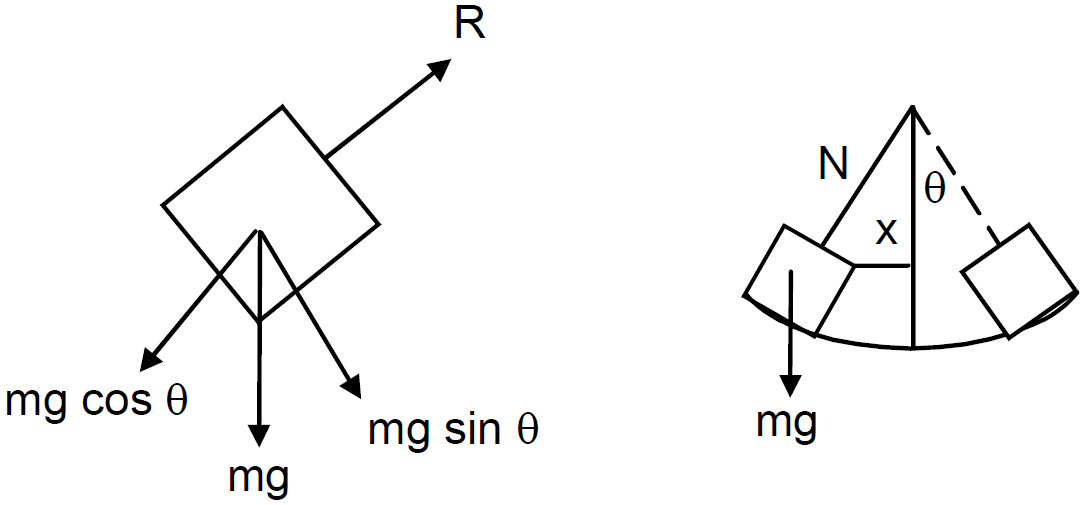
Given that, R = radius.

Let N = normal reaction.

Driving force $\text{F}=\text{mg}\sin\theta.$

Acceleration $=\text{a}=\text{g}\sin\theta$

As, $\sin\theta$ is very small, $\sin\theta\rightarrow\theta$

$\therefore$ Acceleration $\text{a}=\text{g}\theta$

Let ‘x’ be the displacement from the mean position of the body,

$\therefore\theta=\frac{\text{x}}{\text{R}}$

$\Rightarrow\text{a}=\text{g}\theta=\text{g}\Big(\frac{\text{x}}{\text{R}}\Big)\Rightarrow\Big(\frac{\text{a}}{\text{x}}\Big)=\Big(\frac{\text{g}}{\text{R}}\Big)$

So the body makes S.H.M.

$\therefore\text{T}=2\pi\sqrt{\frac{\text{Displacement}}{\text{Acceleration}}}=2\pi\sqrt{\frac{\text{x}}{\frac{\text{gx}}{\text{R}}}}=2\pi\sqrt{\frac{\text{R}}{\text{g}}}$
Need a full question paper?

Generate a complete, print-ready paper with questions like this in minutes — across 16+ boards, with answer keys.

Start Generating Free

Similar questions

  1. Explain, giving reasons, the basic difference in converting a galvanometer into (i) a voltmeter and (ii) an ammeter.
  2. Two long straight parallel conductors carrying steady currents I1 and I2 are separated by a distance 'd'. Explain briefly, with the help of a suitable diagram, how the magnetic field due to one conductor acts on the other. Hence deduce the expression for the force acting between the two conductors. Mention the nature of this force.
Suppose the gravitational potential due to a small system is $\frac{\text{k}}{\text{r}^2}$ at a distance r from it. What will be the gravitational field? Can you think of any such system? What happens if there were negative masses?
In an experiment on photoelectric effect, the stopping potential is measured for monochromatic light beams corresponding to different wavelengths. The data collected are 11s follows:

wavelength (nm) 350 400 450 500 550
stopping potential(V): 1.45 1.00 0.66 0.38 0.16

Plot the stopping potential against inverse of wavelength $\big(\frac{1}{\lambda}\big) $ on a graph paper and find

  1. The Planck constant,
  2. The work function of the emitter and.
  3. The threshold wavelength.
What do you understand by self-induction?Obtain an expression for self-induction of a solenoid.###Define self-induction. Obtain an expression for self-induction of a solenoid of N turns, length $l$ and area of cross-section A.
A convex lens of focal length 20cm and a concave lens of focal length 10cm are placed 10cm apart with their principal axes coinciding. A beam of light travelling parallel to the principal axis and having a beam diameter 5.0mm, is incident on the combination. Show that the emergent beam is parallel to the incident one. Find the beam diameter of the emergent beam.
A block of mass m is placed on a smooth inclined plane of inclination 0 with the horizontal. The force exerted by the plane on the block has a magnitude:

  1. $\text{mg}$

  2. $\frac{\text{mg}}{\cos\theta}$

  3. $\text{mg}\cos\theta$

  4. $\text{mg}\tan\theta$

Consider the circuit shown in the figure. Find (a) the current in the circuit (b) the potential drop across the $5\Omega$ resistor (c) the potential drop across the $10\Omega$ resistor. (d) Answer the parts (a), (b) and (c) with reference to the figure.


A plane electromagnetic wave is passing through a region. Consider (a) electric field (b) magnetic field (c) electrical energy in a small volume and (d) magnetic energy in a small volume. Construct the pairs of the quantities that oscillate with equal frequencies.
A source of sound operates at 2.0kHz, 20W emitting sound uniformly in all directions. The speed of sound in air is 340m/s and the density of air is 1.2kg/m3.
  1. What is the intensity at a distance of 6.0m from the source?
  2. What will be the pressure amplitude at this point?
  3. What will be the displacement amplitude at this point ?
A coil of resistance $40\Omega$ is connected across a 4.0V battery 0.10s after the battery is connected, the current in the coil is 63mA. Find the inductance of the coil.