MCQ
A small block slides down on a smooth inclined plane, starting from rest at time $t=0 .$ Let $S_{n}$ be the distance travelled by the block in the interval $\mathrm{t}=\mathrm{n}-1$ to $\mathrm{t}=\mathrm{n} .$ Then, the ratio $\frac{\mathrm{S}_{\mathrm{n}}}{\mathrm{S}_{\mathrm{n}+1}}$ is
  • A
    $\frac{2 n-1}{2 n}$
  • $\frac{2 n-1}{2 n+1}$
  • C
    $\frac{2 n+1}{2 n-1}$
  • D
    $\frac{2 n}{2 n-1}$

Answer

Correct option: B.
$\frac{2 n-1}{2 n+1}$
b
$\frac{s_{n}}{S_{n+1}}=\frac{\frac{a}{2}(2 n-1)}{\frac{a}{2}(2(n+1)-1)}=\frac{2 n-1}{2 n+2-1}=\frac{2 n-1}{2 n+1}$

Need a full question paper?

Generate a complete, print-ready paper with questions like this in minutes — across 16+ boards, with answer keys.

Start Generating Free

Similar questions

For a projectile, the ratio of maximum height reached to the square of flight time is ($g = 10 ms^{-2}$)
A body of mass $(4m)$ is lying in $x-y$ plane at rest. It suddenly explodes into three pieces. Two pieces, each of mass $(m)$ move perpendicular to each other with equal speeds $(v).$ The total kinetic energy generated due to explosion is................. $mv^2$
A block of mass $m$ is connected to another block of mass $M$ by a spring (massless) of spring constant $k$. The block are kept on a smooth horizontal plane. Initially the blocks are at rest and the spring is unstretched. Then a constant force $F$ starts acting on the block of mass $M$ to pull it. Find the force of the block of mass $m.$
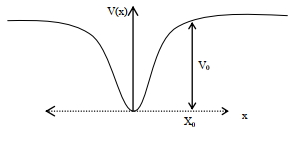
When a particle of mass $m$ moves on the $x$-axis in a potential of the form $V(x)=\mathrm{kx}^2$ it performs simple harmonic motion. The corresponding time period is proportional to $\sqrt{\frac{\mathrm{m}}{\mathrm{k}}}$, as can be seen easily using dimensional analysis. However, the motion of a particle can be periodic even when its potential energy increases on both sides of $\mathrm{x}=0$ in a way different from $\mathrm{kx}^2$ and its total energy is such that the particle does not escape to infinity. Consider a particle of mass $\mathrm{m}$ moving on the $x$-axis. Its potential energy is $V(x)=\alpha x^4(\alpha>0)$ for $|x|$ near the origin and becomes a constant equal to $\mathrm{V}_0$ for $|x| \geq X_0$ (see figure). $Image$

$1.$ If the total energy of the particle is $E$, it will perform periodic motion only if

$(A)$ $E$ $<0$ $(B)$ $E$ $>0$ $(C)$ $\mathrm{V}_0 > \mathrm{E}>0$ $(D)$ $E > V_0$

$2.$ For periodic motion of small amplitude $\mathrm{A}$, the time period $\mathrm{T}$ of this particle is proportional to

$(A)$ $\mathrm{A} \sqrt{\frac{\mathrm{m}}{\alpha}}$ $(B)$ $\frac{1}{\mathrm{~A}} \sqrt{\frac{\mathrm{m}}{\alpha}}$ $(C)$ $\mathrm{A} \sqrt{\frac{\alpha}{\mathrm{m}}}$ $(D)$ $\mathrm{A} \sqrt{\frac{\alpha}{\mathrm{m}}}$

$3.$ The acceleration of this particle for $|\mathrm{x}|>\mathrm{X}_0$ is

$(A)$ proportional to $\mathrm{V}_0$

$(B)$ proportional to $\frac{\mathrm{V}_0}{\mathrm{mX}_0}$

$(C)$ proportional to $\sqrt{\frac{\mathrm{V}_0}{\mathrm{mX}_0}}$

$(D)$ zero

Give the answer qustion $1,2$ and $3.$
A person with his hand in his pocket is skating on ice at the rate of $10 m / s$ and describes a circle of radius $50 m$. What is his inclination to vertical: $\left( g =10 m / sec ^2\right)$
A black body at $227^o C$ radiates heat at the rate of $7\; cals/cm^2 s$. At a temperature of $727^o C$, the rate of heat radiated in the same units will be 
A cart is moving horizontally along a straight line with a constant speed of $30\,m / s$. A projectile is to be fired from the moving cart in such a way that it will retum to the cart (at the same point on cart) after the cart has moved $80\,m$. At what velocity (relative to the cart) must be projectile be fired? (Take $=10\,m / s ^2$ )
A particle has initial velocity of $\left( {\widehat i + \widehat j} \right)\, m/s$ and an acceleration of $\left( {\widehat i + \widehat j} \right)\, m/s^2$. Its speed after $10s$ will be :-
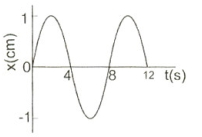
The $x$-t graph of a particle undergoing simple harmonic motion is shown below. The acceleration of the particle at $t=4 / 3 \mathrm{~s}$ is
A hollow tube is carrying an electric current along its length distributed uniformly over its surface. The magnetic field:
  1. Increases linearly from the axis to the surface.
  2. Is constant inside the tube.
  3. Is zero at the axis.
  4. Is zero just outside the tube.