MCQ
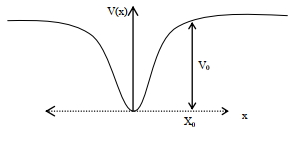
When a particle of mass $m$ moves on the $x$-axis in a potential of the form $V(x)=\mathrm{kx}^2$ it performs simple harmonic motion. The corresponding time period is proportional to $\sqrt{\frac{\mathrm{m}}{\mathrm{k}}}$, as can be seen easily using dimensional analysis. However, the motion of a particle can be periodic even when its potential energy increases on both sides of $\mathrm{x}=0$ in a way different from $\mathrm{kx}^2$ and its total energy is such that the particle does not escape to infinity. Consider a particle of mass $\mathrm{m}$ moving on the $x$-axis. Its potential energy is $V(x)=\alpha x^4(\alpha>0)$ for $|x|$ near the origin and becomes a constant equal to $\mathrm{V}_0$ for $|x| \geq X_0$ (see figure). $Image$

$1.$ If the total energy of the particle is $E$, it will perform periodic motion only if

$(A)$ $E$ $<0$ $(B)$ $E$ $>0$ $(C)$ $\mathrm{V}_0 > \mathrm{E}>0$ $(D)$ $E > V_0$

$2.$ For periodic motion of small amplitude $\mathrm{A}$, the time period $\mathrm{T}$ of this particle is proportional to

$(A)$ $\mathrm{A} \sqrt{\frac{\mathrm{m}}{\alpha}}$ $(B)$ $\frac{1}{\mathrm{~A}} \sqrt{\frac{\mathrm{m}}{\alpha}}$ $(C)$ $\mathrm{A} \sqrt{\frac{\alpha}{\mathrm{m}}}$ $(D)$ $\mathrm{A} \sqrt{\frac{\alpha}{\mathrm{m}}}$

$3.$ The acceleration of this particle for $|\mathrm{x}|>\mathrm{X}_0$ is

$(A)$ proportional to $\mathrm{V}_0$

$(B)$ proportional to $\frac{\mathrm{V}_0}{\mathrm{mX}_0}$

$(C)$ proportional to $\sqrt{\frac{\mathrm{V}_0}{\mathrm{mX}_0}}$

$(D)$ zero

Give the answer qustion $1,2$ and $3.$
  • A
    $(A,B,C)$
  • $(C,B,D)$
  • C
    $(C,B,A)$
  • D
    $(A,C,D)$

Answer

Correct option: B.
$(C,B,D)$
b
$1.$ Energy must be less than $\mathrm{V}_0$

$2.$  $[\alpha]=\mathrm{ML}^{-2} \mathrm{~T}^{-2}$

Only $(B)$ option has dimension of time Alternatively

$ \frac{1}{2} \mathrm{~m}\left(\frac{\mathrm{dx}}{\mathrm{dt}}\right)^2+\mathrm{kx}^4=\mathrm{kA}^4 $

$ \left(\frac{\mathrm{dx}}{\mathrm{dt}}\right)^2=\frac{2 \mathrm{k}}{\mathrm{m}}\left(\mathrm{A}^4-\mathrm{x}^4\right) $

$ 4 \sqrt{\frac{\mathrm{m}}{2 \mathrm{k}}} \int_0^{\mathrm{A}} \frac{\mathrm{dx}}{\sqrt{\mathrm{A}^4-\mathrm{x}^4}}=\int \mathrm{dt}=\mathrm{T} $

$ 4 \sqrt{\frac{\mathrm{m}}{2 \mathrm{k}}} \frac{1}{\mathrm{~A}} \int_0^1 \frac{\mathrm{du}}{\sqrt{1-\mathrm{u}^4}}=\mathrm{T} \quad \text { Substitute } \mathrm{x}=\mathrm{Au}$

$3.$ As potential energy is constant for $|\mathrm{x}|>\mathrm{X}_0$, the force on the particle is zero hence acceleration is zero.

Need a full question paper?

Generate a complete, print-ready paper with questions like this in minutes — across 16+ boards, with answer keys.

Start Generating Free

Similar questions

The potential energy between two atoms in a molecule is given by $U(x) = \frac{a}{{{x^{12}}}} - \frac{b}{{{x^6}}}$; where $a$ and $b$ are positive constants and $x$  is the distance between the atoms. The atom is in stable equilibrium when
The magnitude of the vector product of two vectors $\big|\overrightarrow{\text{A}}\big|$ and $\big|\overrightarrow{\text{B}}\big|$ may be:
A resonance air column of length $20 cm$ resonates with a tuning fork of frequency $250 Hz$. The speed of sound in air is .... $m/s$
A uniform bar of length $'6l'$ and mass $'8m'$ lies on a smooth horizontal table. Two point masses $m$ and $2m$ moving in the same horizontal plane with speed $2v$ and $v$ respectively, strike the bar (as shown in the fig.) and stick to the bar after collision. Total energy after collision (about the center of mass, $c$) will be :-
Three particles ${P}, {Q}$ and ${R}$ are moving along the vectors ${A}=\hat{{i}}+\hat{{j}}, {B}=\hat{{j}}+\hat{{k}}$ and ${C}=-\hat{{i}}+\hat{{j}}$ respectively. They strike on a point and start to move in different directions. Now particle $P$ is moving normal to the plane which contains vector $\vec{A}$ and $\vec{B} .$ Similarly particle $Q$ is moving normal to the plane which contains vector $\vec{A}$ and $\vec{C} .$ The angle between the direction of motion of $P$ and $Q$ is $\cos ^{-1}\left(\frac{1}{\sqrt{x}}\right)$. Then the value of $x$ is ...... .
A projectile crosses two walls of equal height $H$ symmetrically as shown  The time of flight $T$ is given by  ........ $\sec$
A body falling for $2 \,seconds$ covers a distance $S$ equal to that covered in next second. Taking $g = 10\,m/{s^2},\,S =..........m$
From the following displacement-time graph find out the velocity of a moving body
A uniform narrow $1.95\,\, m$ long pipe is open at both ends. It resonates at two successive harmonic of frequency $275\,\, Hz$ and $330 \,Hz.$The speed of sound in the tube is ...... $m/s$
Among the given following system of unit which is not based on unit of mass, length and time?