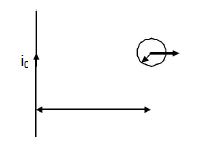
- ✓$ \frac{2x^2}{\mu_0 i_0 a^2}\sqrt{Pr}$
- B$ \frac{4x^2}{\mu_0 i_0 a^2}\sqrt{Pr}$
- C$ \frac{6x^2}{\mu_0 i_0 a^2}\sqrt{Pr}$
- Dnone of these

$\phi=\frac{\mu_{0} \mathrm{i}}{2 \mathrm{x}}\left(\pi \mathrm{a}^{2}\right)$ ........$(1)$
$\varepsilon=\frac{\mathrm{d} \phi}{\mathrm{dt}}=\frac{\mu_{0} \mathrm{i}\left(\pi \mathrm{a}^{2}\right)}{2}\left(\frac{-1}{\mathrm{x}^{2}}\right)(\mathrm{v})$ .........$(2)$
$\mathrm{i}=\frac{\mu_{0} i_{0} \pi \mathrm{a}^{2} \mathrm{v}}{\mathrm{r} \mathrm{x}^{2}}$ ..........$(3)$
$\mathrm{P}=\mathrm{i}^{2} \mathrm{r}$ ..........$(4)$
Generate a complete, print-ready paper with questions like this in minutes — across 16+ boards, with answer keys.


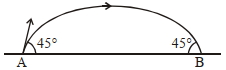
The initial velocity of the particle is $5 \sqrt{2}\, ms ^{-1}$ and the air resistance is assumed to be negligible. The magnitude of the change in momentum between the points $A$ and $B$ is $x \times 10^{-2}\, kgms ^{-1} .$ The value of $x ,$ to the nearest integer, is ...... .


$\left[ g =10 m / s ^{2} ; \sin 60^{\circ}=\frac{\sqrt{3}}{2} ; \cos 60^{\circ}=\frac{1}{2}\right]$