A jet of water with cross section of $6$ $cm^2$ strikes a wall at an angle of $60^o $ to the normal and rebounds elastically from the wall without losing energy. If the velocity of the water in the jet is $12$ $m/s$, the force acting on the wall is ....... $N$
Medium


Download our appand get started for free
Experience the future of education. Simply download our apps or reach out to us for more information. Let's shape the future of learning together!No signup needed.*
Similar Questions
- 1Two cyllinders of same cross-section and length $L$ but made of two material of densities $d_1$ and $d_2$ are cemented together to form a cylinder of length $2L$. The combination floats in a liquid of density $d$ with $a$ length $L/2$ above the surface of the liquid. If $d_1 > d_2$ then:View Solution
- 2Water is flowing through a tube of non-uniform cross-section. Ratio of the radius at entry and exit end of the pipe is $3$ : $2$. Then the ratio of velocities at entry and exit of liquid isView Solution
- 3In a test experiment on a model aeroplane in a wind tunnel, the flow speeds on the upper and lower surfaces of the wing are $70 \;m s ^{-1}$ and $63\; m s ^{-1}$ respectively. What is the lift on the wing if its area is $2.5 \;m ^{2}$ ? Take the density of atr to be $1.3\; kg m ^{-3} .$View Solution
- 4Which of the following option correctly describes the variation of the speed $v$ and acceleration $'a'$ of a point mass falling vertically in a viscous medium that applies a force $F = -kv,$ where $'k'$ is a constant, on the body? (Graphs are schematic and not drawn to scale)View Solution
- 5View SolutionAn application of Bernoulli's equation for fluid flow is found in
- 6A solid sphere of radius $R$ and density $\rho$ is attached to one end of a mass-less spring of force constant $k$. The other end of the spring is connected to another solid sphere of radius $R$ and density $3 p$. The complete arrangement is placed in a liquid of density $2 p$ and is allowed to reach equilibrium. The correct statement$(s)$ is (are)View Solution
$(A)$ the net elongation of the spring is $\frac{4 \pi R^3 \rho g}{3 k}$
$(B)$ the net elongation of the spring is $\frac{8 \pi R^3 \rho g}{3 k}$
$(C)$ the light sphere is partially submerged.
$(D)$ the light sphere is completely submerged.
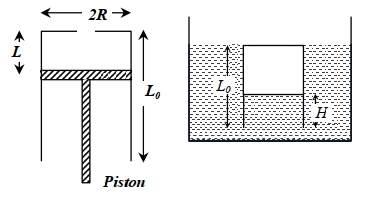
- 7A fixed thermally conducting cylinder has a radius $\mathrm{R}$ and height $\mathrm{L}_0$. The cylinder is open at its bottom and has a small hole at its top. A piston of mass $M$ is held at a distance $L$ from the top surface, as shown in the figure. The atmospheric pressure is $\mathrm{P}_0$.View Solution
$1.$ The piston is now pulled out slowly and held at a distance $2 \mathrm{~L}$ from the top. The pressure in the cylinder between its top and the piston will then be
$(A)$ $\mathrm{P}_0$ $(B)$ $\frac{\mathrm{P}_0}{2}$ $(C)$ $\frac{P_0}{2}+\frac{M g}{\pi R^2}$ $(D)$ $\frac{\mathrm{P}_0}{2}-\frac{\mathrm{Mg}}{\pi \mathrm{R}^2}$
$2.$ While the piston is at a distance $2 \mathrm{~L}$ from the top, the hole at the top is sealed. The piston is then released, to a position where it can stay in equilibrium. In this condition, the distance of the piston from the top is
$(A)$ $\left(\frac{2 \mathrm{P}_0 \pi \mathrm{R}^2}{\pi \mathrm{R}^2 \mathrm{P}_0+\mathrm{Mg}}\right)(2 \mathrm{~L})$ $(B)$ $\left(\frac{\mathrm{P}_0 \pi R^2-\mathrm{Mg}}{\pi R^2 \mathrm{P}_0}\right)(2 \mathrm{~L})$
$(C)$ $\left(\frac{\mathrm{P}_0 \pi \mathrm{R}^2+\mathrm{Mg}}{\pi \mathrm{R}^2 \mathrm{P}_0}\right)(2 \mathrm{~L})$ $(D)$ $\left(\frac{\mathrm{P}_0 \pi \mathrm{R}^2}{\pi \mathrm{R}^2 \mathrm{P}_0-\mathrm{Mg}}\right)(2 \mathrm{~L})$
$3.$ The piston is taken completely out of the cylinder. The hole at the top is sealed. A water tank is brought below the cylinder and put in a position so that the water surface in the tank is at the same level as the top of the cylinder as shown in the figure. The density of the water is $\rho$. In equilibrium, the height $\mathrm{H}$ of the water column in the cylinder satisfies
$(A)$ $\rho g\left(\mathrm{~L}_0-\mathrm{H}\right)^2+\mathrm{P}_0\left(\mathrm{~L}_0-\mathrm{H}\right)+\mathrm{L}_0 \mathrm{P}_0=0$
$(B)$ $\rho \mathrm{g}\left(\mathrm{L}_0-\mathrm{H}\right)^2-\mathrm{P}_0\left(\mathrm{~L}_0-\mathrm{H}\right)-\mathrm{L}_0 \mathrm{P}_0=0$
$(C)$ $\rho g\left(\mathrm{~L}_0-\mathrm{H}\right)^2+\mathrm{P}_0\left(\mathrm{~L}_0-\mathrm{H}\right)-\mathrm{L}_0 \mathrm{P}_0=0$
$(D)$ $\rho \mathrm{g}\left(\mathrm{L}_0-\mathrm{H}\right)^2-\mathrm{P}_0\left(\mathrm{~L}_0-\mathrm{H}\right)+\mathrm{L}_0 \mathrm{P}_0=0$
Give the answer question $1,2$ and $3.$
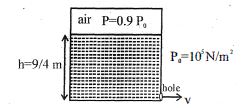
- 8A closed vessel have a small hole in one face of vessel near the bottom as shown. The velocity of water coming out from the given hole at given instant is ....... $m/s$View Solution
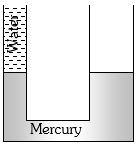
- 9A $U-$ tube in which the cross-sectional area of the limb on the left is one quarter, the limb on the right contains mercury (density $13.6 g/cm^3$). The level of mercury in the narrow limb is at a distance of $36 cm$ from the upper end of the tube. What will be the rise in the level of mercury in the right limb if the left limb is filled to the top with water ........ $cm$View Solution
- 10Suppose you have taken a dilute solution of oleic acid in such a way that its concentration becomes $0.01 \,cm ^{3}$ of oleic acid per $cm ^{3}$ of the solution. Then you make a thin film of this solution (monomolecular thickness) of area $4\, cm ^{2}$ by considering $100$ spherical drops of radius $\left(\frac{3}{40 \pi}\right)^{\frac{1}{3}} \times 10^{-3}\, cm .$ Then the thickness of oleic acid layer will be $x \times 10^{-14} \,m$. Where $x$ is ...... .View Solution