Question
A small creature moves with constant speed in a vertical circle on a bright day. Does its shadow formed by the sun on a horizontal plane move in a simple harmonic motion?

Answer

Yes, its shadow on a horizontal plane moves in simple harmonic motion. The projection of a uniform circular motion executes simple harmonic motion along its diameter (which is the shadow on the horizontal plane), with the mean position lying at the centre of the circle.

Need a full question paper?

Generate a complete, print-ready paper with questions like this in minutes — across 16+ boards, with answer keys.
Start Generating Free

Similar questions

Two particles A and B start from rest and move for equal time on a straight line. The particle A has an acceleration a for the first half of the total time and 2a for the second half. The particle B has an acceleration 2a for the first half and a for the second half. Which particle has covered larger distance?
An electron, an alpha particle and a proton have the same kinetic energy. Which one of these particles has the largest de-Broglie wavelength?
If a thin lens is dipped in water, does its focal length change?
The instantaneous magnitudes of current and voltage in an ac circuit are given as $I =10 \sin 314 t A$ and $V =50 \sin \left(314 t +\frac{\pi}{2}\right) \quad V$ respectively. What is the dissipation of average power in the circuit?
What is find by using the Huygens' principle?
Write the value of the electric potential at the distance r from the centre of the dipole on the axis of the electric dipole of dipole moment p.
A resistor R is joined across a cell of internal resistance r and electromotive force E. Now a potentiometer measures potential difference V across the ends of the cell. Write an expression for r in terms of E, V and R.
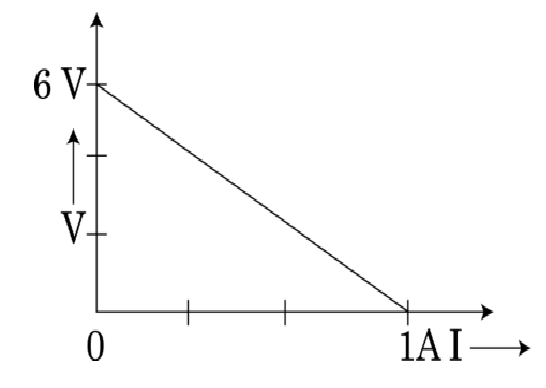
The plot of the variation of potential different across a combination of three identical cells in series, versus current is shown below. What is the emf and internal resistance of each cell?
Solve the previous problem if the lead piece is fastened on the top surface of the block and the block is to float with its upper surface just dipping into water.
As $\text{C}=\Big(\frac{1}{\text{V}}\Big)\text{Q},$ can you say that the capacitance C is proportional to the charge Q?