Question
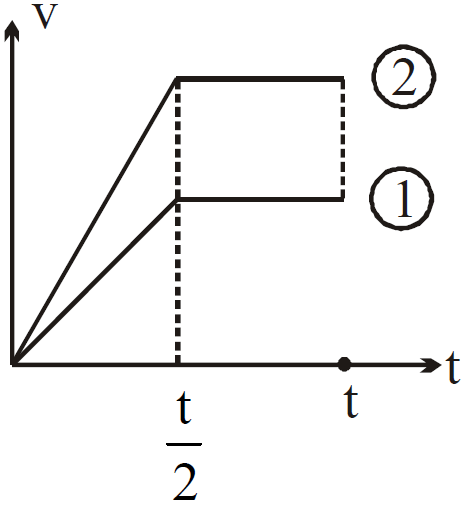
Two particles A and B start from rest and move for equal time on a straight line. The particle A has an acceleration a for the first half of the total time and 2a for the second half. The particle B has an acceleration 2a for the first half and a for the second half. Which particle has covered larger distance?
Answer

Second particle

Area under (v, t) graph gives displacement. For graph (2) area is more.

Need a full question paper?

Generate a complete, print-ready paper with questions like this in minutes — across 16+ boards, with answer keys.

Start Generating Free

Similar questions

A thin converging lens is formed with one surface convex and the other plane. Does the position of image depend on whether the convex surface or the plane surface faces the object?
What is the function of a dielectric in a capacitor?
A cube of iron $($density $= 8000\ kg m^{-3},$ specific heat capacity $= 470J \ kg^{-1} K^{-1})$ is heated to a high temperature and is placed on a large block of ice at $0^\circ C$. The cube melts the ice below it, displaces the water and sinks. In the final equilibrium position, its upper surface just goes inside the ice. Calculate the initial temperature of the cube. Neglect any loss of heat outside the ice and the cube. The density of ice $= 900\ kg m^{-3}$ and the latent heat of fusion of ice $= 3.36 \times 10^5J \ kg^{-1}$.
A charged particle is projected at a very high speed perpendicular to a uniform magnetic field. The particle will$:$
Which part of electromagnetic spectrum is used in satellite communication?
Why do light nuclei always participate in nuclear fusion reaction?
A ball is moved on a horizontal table with some velocity. The ball stops after moving some distance. Which external force is responsible for the change in the momentum of the ball?
Does a solid also have two kinds of molar heat capacities $C_P$ and $C_v?$ If yes, do we have $C_P > C_v?$ Is $C_P - C_{v }= R?$
Define minimum deviation angle.
The brightness producing capacity of a source:
  1.  Does not depend on its power.
  2.  Does not depend on the wavelength emitted.
  3.  Depends on its power.
  4.  Depends on the wavelength emitted.