Question
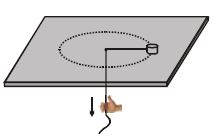
A small disk is attached to the end of a light inextensible string, which passes through a hole in a frictionless horizontal tabletop. Initially the disk moves on a circle of radius $R$ with kinetic energy $K_0$. The string is then slowly pulled so that the disk finally rotates on a circle of radius $\frac{R}{\eta }$. What is the work $W$ done in pulling the string

Answer

Torque by tension force is zero

$\Rightarrow$ angular momentum conservation

$\mathrm{I}_{1} \mathrm{\omega}_{1}=\mathrm{I}_{2} \mathrm{\omega}_{2}$

Let $\mathrm{\omega}_{1}=\mathrm{\omega}_{0}$

$\mathrm{mR}^{2} \mathrm{\omega}_{0}=\frac{\mathrm{mR}^{2}}{\mathrm{n}^{2}} \mathrm{\omega}^{2}$

$\Rightarrow \mathrm{\omega}_{2}=\mathrm{\omega}_{0} \eta^{2}$

$=\left(\mathrm{k}_{0}=\frac{1}{2} \mathrm{I}_{1} \mathrm{\omega}^{2}\right)$

$\mathrm{k}_{0}=\frac{1}{2} \times\left(\mathrm{mR}_{0}^{2}\right) \mathrm{\omega}_{0}^{2}=\frac{\mathrm{m} \mathrm{R}_{0}^{2} \mathrm{\omega}_{0}^{2}}{2}$

Here change in $\mathrm{K} . \mathrm{E} .=(\mathrm{WD})$

$\mathrm{k}_{f}=\frac{1}{2} \mathrm{I}_{2} \mathrm{\omega}_{2}^{2}=\frac{1}{2} \times\left(\frac{\mathrm{mR}^{2}}{\eta^{2}}\right) \times \mathrm{\omega}_{0}^{2} \eta^{4}$

$=\left(\frac{1}{2} \mathrm{mR}^{2} \mathrm{\omega}_{0}^{2}\right) \eta^{2}$

$\mathrm{WD}=\mathrm{k}_{\mathrm{f}}-\mathrm{k}_{\mathrm{i}}=\frac{1}{2} \mathrm{mR}^{2} \mathrm{\omega}_{0}^{2}\left(\eta^{2}-1\right)$

$=k_{0}\left(\eta^{2}-1\right)$
Need a full question paper?

Generate a complete, print-ready paper with questions like this in minutes — across 16+ boards, with answer keys.

Start Generating Free

Similar questions

A scalar quantity is one that
The displacement equation of a particle is $x = 3\sin 2t + 4\cos 2t.$ The amplitude and maximum velocity will be respectively
In an experiment to determine the focal length $(f)$ of a concave mirror by the $u-v$ method, a student places the object pin $A$ on the principal axis at a distance $x$ from the pole $P$. The student looks at the pin and its inverted image from a distance keeping his/her eye in line with $PA$. When the student shifts his/her eye towards left, the image appears to the right of the object pin. Then,
In an $LC$ oscillator, if values of inductance and capacitance become twice and eight times, respectively, then the resonant frequency of oscillator becomes $x$ times its initial resonant frequency $\omega_0$. The value of $x$ is:
In Young's double slit experiment, the slits are $2\,\, mm$ apart and are illuminated by photons of two wavelengths $\lambda_1 = 12000 \;\mathring A$ and $\lambda _2= 10000 \;\mathring A$ At what minimum distance from the common central bright fringe on the screen $2\,\, m$ from the slit will a bright fringe from one interference pattern coincide with a bright fringe from the other?....$mm$
A sample contains mixture of helium and oxygen gas. The ratio of root mean square speed of helium and oxygen in the sample, is:
A capacitor of capacitance $900\,\mu F$ is charged by a $100\,V$ battery. The capacitor is disconnected from the battery and connected to another uncharged identical capacitor such that one plate of uncharged capacitor connected to positive plate and another plate of uncharged capacitor connected to negative plate of the charged capacitor. The loss of energy in this process is measured as $x \times 10^{-2}\,J$. The value of $x$ is $..............$
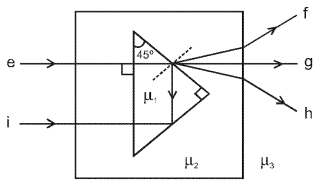
A right angled prism of refractive index $\mu_1$ is placed in a rectangular block of refractive index $\mu_2$, which is surrounded by a medium of refractive index $\mu_3$, as shown in the figure, A ray of ligth 'e' enters the rectangular block at normal incidence. Depending upon the relationships between $\mu_1, \mu_2$ and $\mu_3$, it takes one of the four possible paths $'ef', 'eg', 'eh'$ or $'ei'$. $Image$

Match the paths in List $I$ with conditions of refractive indices in List $II$ and select the correct answer using the codes given below the lists :

List $I$ List $II$
$P$. $\quad e \rightarrow f$ $1.$ $\quad \mu_1>\sqrt{2} \mu_2$
$Q.$ $\quad e \rightarrow g$ $2.$ $\quad \mu_1>\mu_1$ and $\mu_2>\mu_3$
$R.$ $\quad e \rightarrow h$ $3.$ $\quad \mu_1=\mu_2$
$S.$ $\quad e \rightarrow i$ $4.$ $\quad \mu_2<\mu_1<\sqrt{2} \mu_2$ and $\mu_2>\mu_3$

Codes: $\quad \quad P \quad Q \quad R \quad S $ 

A parallel plate capacitor is charged to a potential difference of $50\, V$. It is discharged through a resistance. After $1$ second, the potential difference between plates becomes $40 \,V$. Then
A solid cylinder $P$ rolls without slipping from rest down an inclined plane attaining a speed $v_p$ at the bottom. Another smooth solid cylinder $Q$ of same mass and dimensions slides without friction from rest down the inclined plane attaining a speed $v_q$ at the bottom. The ratio of the speeds $\frac{v_q}{v_p}$ is