MCQ
A small object placed on a rotating horizontal turn table just slips when it is placed at a distance $4\, cm$ from the axis of rotation. If the angular velocity of the turn-table is doubled, the object slips when its distance from the axis of rotation is
  • $1\,cm$
  • B
    $2\,cm$
  • C
    $4\,cm$
  • D
    $8\,cm$

Answer

Correct option: A.
$1\,cm$
a
The object will slip if centripetal force $\geq$ force of

friction

${\operatorname{mr} \omega^{2} \geq \mu m g} $

${r \omega^{2} \geq \mu g}$

$\mathrm{r} \omega^{2} \geq \mathrm{constant}, \mathrm{or}\left(\frac{\mathrm{r}_{1}}{\mathrm{r}_{2}}\right)=\left(\frac{\omega_{2}}{\omega_{1}}\right)^{2}$

$\frac{4 \mathrm{cm}}{\mathrm{r}_{2}}=\left(\frac{2 \omega}{\omega}\right)^{2} \quad \therefore \mathrm{r}_{2}=1 \mathrm{cm}$

Need a full question paper?

Generate a complete, print-ready paper with questions like this in minutes — across 16+ boards, with answer keys.

Start Generating Free

Similar questions

A big explosion on the moon cannot be heard on the earth because
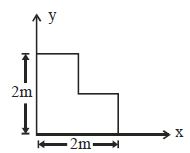
The $x, y$ coordinates of the centre of mass of a uniform $L-$ shaped lamina of mass $3\, kg$ is
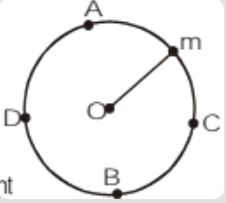
A mass is performing vertical circular motion (see figure). If the average velocity of the particle is increased, then at which point is the maximum breaking possibility of the string:
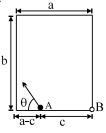
A billiard table whose length and width are as shown in the figure. $A$ ball is placed at point $A$. At what angle ‘$\theta $ ’the ball be projected so that after colliding with two walls, the ball will fall in the pocket $B$ .Assume that all collisions are perfectly elastic (neglect friction)
If $ V, R$ and $g$ denote respectively the escape velocity from the surface of the earth radius of the earth, and acceleration due to gravity, then the correct equation is
The equation of state of some gases can be expressed as $\left( {P + \frac{a}{{{V^2}}}} \right)\,(V - b) = RT$. Here $P$ is the pressure, $V$ is the volume, $T$ is the absolute temperature and $a,\,b,\,R$ are constants. The dimensions of $'a'$ are
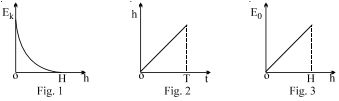
$A$ ball is projected vertically upwards. Air resistance  variation in $g$ may be neglected. The ball rises to its maximum height $H$ in a time $T$, the height being $h$ after a time $t$

$[1]$ The graph of kinetic energy $E_k$ of the ball against height $h$ is shown in figure $1$

$[2]$ The graph of height $h$ against time $t$ is shown in figure $2$

$[3]$ The graph of gravitational energy $E_g$ of the ball against height $h$ is shown in figure $3$

Which of $A, B, C, D, E$ shows the correct answers?

A stream-lined body falls through air from a height $h$ on the surface of liquid. Let $d$ and $D$ denote the densities of the materials of the body and the liquid respectively. If  $D > d$, then the time after which the body will be instantaneously at rest, is
The mass of a lift is $500\, kg$. When it ascends with an acceleration of $2\,m/{s^2}$, the tension in the cable will be........... $N$ $[g = 10\,m/{s^2}]$
For a stationary object at x = 40m, the position-time graph is: