Question
A block is projected along a rough horizontal road with a speed of 10m/s. If the coefficient of kinetic friction is 0.10, how far will it travel before coming to rest?
Answer


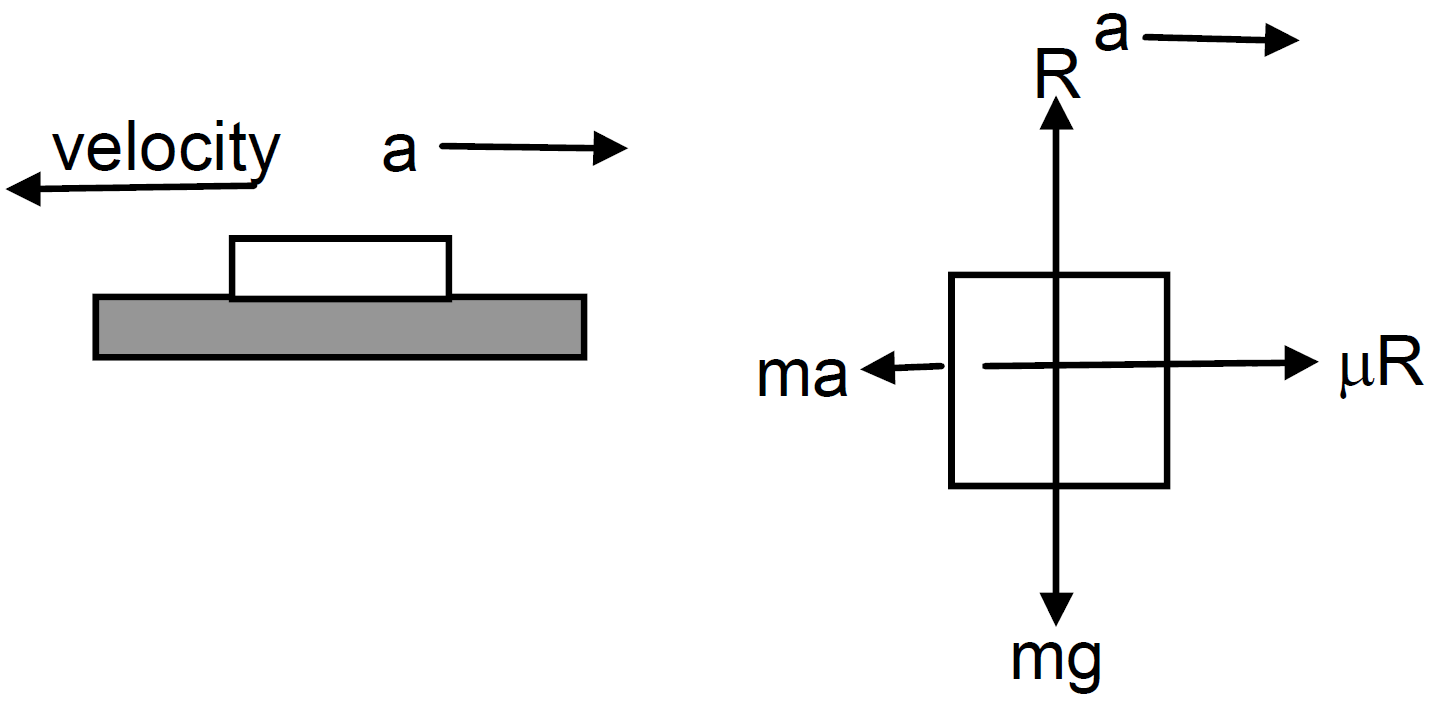
Due to friction the body will decelerate
Let the deceleration be ‘a’
$\text{R}-\text{mg}=0\Rightarrow\text{R = mg} \ ...(1)$
$\text{ma}-\mu\text{R}=0\Rightarrow\text{ma}=\mu\text{R}=\mu\text{mg}$ (from(1))
$\Rightarrow\text{a}=\mu\text{g}=0.1\times10=1\text{m/s}^2$
Initial velocity u = 10m/s
Final velocity v = 0m/s
$\text{a}=-1\text{m/s}^2$
$\text{S}=\frac{\text{v}^2-\text{u}^2}{2\text{a}}=\frac{0-10^2}{2(-1)}=\frac{100}{2}=50\text{m}$
It will travel 50m before coming to rest.

Need a full question paper?

Generate a complete, print-ready paper with questions like this in minutes — across 16+ boards, with answer keys.
Start Generating Free

Similar questions

Two identically charged particles are fastened to the two ends of a spring of spring constant $100Nm^{-1}$ and natural length 10cm. The system rests on a smooth horizontal table. If the charge on each particle is $2.0 \times 10^{-8}C,$ find the extension in the length of the spring. Assume that the extension is small as compared to the natural length. Justify this assumption after you solve the problem.
(I) Draw a ray diagram for the formation of image by a Cassegrain telescope.
(II) Why these types of telescopes are preferred over refracting type telescopes.
What is Motional electromotive force $(\text{emf})$ ? Obtain motional emf $(\varepsilon)= B I {v}$ using proper example.
  1. For a glass prism $(\mu =\sqrt{3} )$ the angle of minimum deviation is equal to the angle of the prism. Calculate the angle of the prism.
  2. Draw ray diagram when incident ray falls normally on one of the two equal sides of a right angled isosceles prism having refractive index $\mu = \sqrt{3} . $
A point charge of 2.0 μC is at the centre of a cubic Gaussian surface 9.0 cm on edge. What is the net electric flux through the surface?
A long straight wire in the horizontal plane carries a current of 50 A in north to south direction. Give the magnitude and direction of B at a point 2.5 m east of the wire.
Consider the situation of the previous problem. Find the average electric field energy stored in the capacitor and the average magnetic field energy stored in the coil.
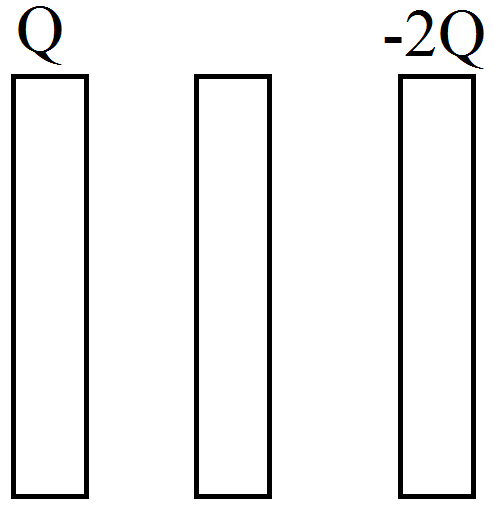
Three identical metal plates with large surface areas are kept parallel to each other as shown in figure. The leftmost plate is given a charge Q, the rightmost a charge -2Q and the middle one remains neutral. Find the charge appearing on the outer surface of the rightmost plate.
Given a uniformly charged plane/sheet of surface charge density, $\sigma=2\times10^{17}\text{C/m}^2.$Image
  1. Find the electric field intensity at a point A, 5mm away from the sheet on the left side.
  2. Given a straight line with three points X, Y and Z placed 50cm away from the charged sheet on the right side. At which of these points, the field due to the sheet remain the same as that of point A and why?
A human body excretes (removes by waste discharge, sweating, etc.) certain materials by a law similar to radioactivity. If technetium is injected in some form in a human body, the body excretes half the amount in 24 hours. A patient is given an injection containing $^{99}Tc$. This isotope is radioactive with a half-life of 6 hours. The activity from the body just after the injection is $6\mu\text{Ci}.$ How much time will elapse before the activity falls to $3\mu\text{Ci}?$