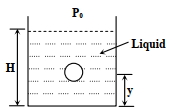
A small spherical monoatomic ideal gas bubble $\left(\gamma=\frac{5}{3}\right)$ is trapped inside a liquid of density $\rho_{\ell}$ (see figure). Assume that the bubble does not exchange any heat with the liquid. The bubble contains n moles of gas. The temperature of the gas when the bubble is at the bottom is $\mathrm{T}_0$, the height of the liquid is $\mathrm{H}$ and the atmospheric pressure is $\mathrm{P}_0$ (Neglect surface tension).

Figure: $Image$

$1.$ As the bubble moves upwards, besides the buoyancy force the following forces are acting on it

$(A)$ Only the force of gravity

$(B)$ The force due to gravity and the force due to the pressure of the liquid

$(C)$ The force due to gravity, the force due to the pressure of the liquid and the force due to viscosity of the liquid

$(D)$ The force due to gravity and the force due to viscosity of the liquid

$2.$ When the gas bubble is at a height $\mathrm{y}$ from the bottom, its temperature is

$(A)$ $\mathrm{T}_0\left(\frac{\mathrm{P}_0+\rho_0 \mathrm{gH}}{\mathrm{P}_0+\rho_t \mathrm{gy}}\right)^{2 / 5}$

$(B)$ $T_0\left(\frac{P_0+\rho_t g(H-y)}{P_0+\rho_t g H}\right)^{2 / 5}$

$(C)$ $\mathrm{T}_0\left(\frac{\mathrm{P}_0+\rho_t \mathrm{gH}}{\mathrm{P}_0+\rho_t \mathrm{gy}}\right)^{3 / 5}$

$(D)$ $T_0\left(\frac{P_0+\rho_t g(H-y)}{P_0+\rho_t g H}\right)^{3 / 5}$

$3.$ The buoyancy force acting on the gas bubble is (Assume $R$ is the universal gas constant)

$(A)$ $\rho_t \mathrm{nRgT}_0 \frac{\left(\mathrm{P}_0+\rho_t \mathrm{gH}\right)^{2 / 5}}{\left(\mathrm{P}_0+\rho_t \mathrm{gy}\right)^{7 / 5}}$

$(B)$ $\frac{\rho_{\ell} \mathrm{nRgT}_0}{\left(\mathrm{P}_0+\rho_{\ell} \mathrm{gH}\right)^{2 / 5}\left[\mathrm{P}_0+\rho_{\ell} \mathrm{g}(\mathrm{H}-\mathrm{y})\right]^{3 / 5}}$

$(C)$ $\rho_t \mathrm{nRgT} \frac{\left(\mathrm{P}_0+\rho_t g \mathrm{H}\right)^{3 / 5}}{\left(\mathrm{P}_0+\rho_t g \mathrm{~g}\right)^{8 / 5}}$

$(D)$ $\frac{\rho_{\ell} \mathrm{nRgT}_0}{\left(\mathrm{P}_0+\rho_{\ell} \mathrm{gH}\right)^{3 / 5}\left[\mathrm{P}_0+\rho_t \mathrm{~g}(\mathrm{H}-\mathrm{y})\right]^{2 / 5}}$

Give the answer question $1,2,$ and $3.$
IIT 2008, Advanced
Download our app for free and get startedPlay store
$1.$ Buoyant force is resultant of pressure-force of liquid.

$2.$  $ \mathrm{P}_1^{1-\gamma} \mathrm{T}_1^\gamma=\mathrm{P}_2^{l-\gamma} \mathrm{T}_2^\gamma $

$ \mathrm{P}_1=\mathrm{P}_0+\rho_{\ell} \mathrm{gH}, \quad \mathrm{T}_1=\mathrm{T}_0 $

$ \mathrm{P}_2=\mathrm{P}_0+\rho_{\ell} \mathrm{g}(\mathrm{H}-\mathrm{y})$

$3.$ $ \rho_{\ell} \mathrm{Vg}=\text { Buoyancy force }=\rho_{\ell} g \frac{n R T_2}{P_2} $

$ \mathrm{~T}_2=\mathrm{T}_0\left[\frac{\mathrm{P}_0+\rho_t g(\mathrm{H}-\mathrm{y})}{\mathrm{P}+\rho_t \mathrm{gH}}\right]^{2 / 5} $

$ \mathrm{P}_2=\mathrm{P}_0+\rho_{\ell} \mathrm{g}(\mathrm{H}-\mathrm{y})$

art

Download our app
and get started for free

Experience the future of education. Simply download our apps or reach out to us for more information. Let's shape the future of learning together!No signup needed.*

Similar Questions

  • 1
    Two cylindrical vessels of equal cross-sectional area $16\,cm ^{2}$ contain water upto herghts $100\,cm$ and $150\,cm$ respectively. The vessels are interconnected so that the water levels in them become equal. The work done by the force of gravity during the process, is $......J$ [Take density of water $=10^{3}\,kg / m ^{3}$ and $g =10\,ms ^{-2}$ ]
    View Solution
  • 2
    A rectangular block is $10 \,cm \times 10 \,cm \times 15 \,cm$ in size is floating in water with $10 \,cm$ side vertical. If it floats with $15 \,cm$ side vertical, then the level of water will ..........
    View Solution
  • 3
    A cylindrical block of wood of base area $30\ cm^2$ , floats in a liquid of density $900\ kg/m^3$ . The block is depressed lightly and then released. The time period of the resulting oscillations of the block is equal to that of spring with block of same mass, then spring constant is equal to ........ $N/m$
    View Solution
  • 4
    In a $U-$tube as shown in figure, water and oil are in the left side and right side of the tube respectively. The helghts from the bottom for water and oil columns are $15\; \mathrm{cm}$ and $20\; \mathrm{cm}$ respectively. The density of the oil is......$kg/{m}^{3}$

    [take $\rho_{water} \left.=1000 \;\mathrm{kg} / \mathrm{m}^{3}\right]$

    View Solution
  • 5
    There are two identical small holes of area of cross-section a on the opposite sides of a  tank containing a liquid of density $\rho$. The difference in height between the holes is $h$. Tank  is resting on a smooth horizontal surface. Horizontal force which will have to be  applied on the tank to keep it in equilibrium is
    View Solution
  • 6
    A manometer connected to a closed tap reads $4.5 \times {10^5}$ pascal. When the tap is opened the reading of the manometer falls to $4 \times {10^5}$ pascal. Then the velocity of flow of water is ........  $m{s^{ - 1}}$
    View Solution
  • 7
    Water containing air bubbles flows without turbulence through a horizontal pipe which has a region of narrow cross-section. In this region, the bubbles
    View Solution
  • 8
    A cubical block of wood of specific gravity $0.5$ and a chunk of concrete of specific gravity $2.5$ are fastened together. The ratio of the mass of wood to the mass of concrete which makes the combination to float with its entire volume submerged under water is
    View Solution
  • 9
    Two solid spheres $A$ and $B$ of equal volumes but of different densities $d_A$ and $d_B$ are connected by a string. They are fully immersed in a fluid of density $d_F$. They get arranged into an equilibrium state as shown in the figure with a tension in the string. The arrangement is possible only if

    $(A)$ $d_Ad_F$  $(B)$ $d_B > d_F$ $(C)$ $d_A>d_F$ $(D)$ $d_A+d_B=2 d_F$

    View Solution
  • 10
    A flat plate moves normally with a speed ${v_1}$ towards a horizontal jet of water of uniform area of cross-section. The jet discharges water at the rate of volume $V$ per second at a speed of ${v_2}$. The density of water is $\rho $. Assume that water splashes along the surface of the plate at right angles to the original motion. The magnitude of the force acting on the plate due to the jet of water is
    View Solution