Two solid spheres $A$ and $B$ of equal volumes but of different densities $d_A$ and $d_B$ are connected by a string. They are fully immersed in a fluid of density $d_F$. They get arranged into an equilibrium state as shown in the figure with a tension in the string. The arrangement is possible only if
$(A)$ $d_Ad_F$ $(B)$ $d_B > d_F$ $(C)$ $d_A>d_F$ $(D)$ $d_A+d_B=2 d_F$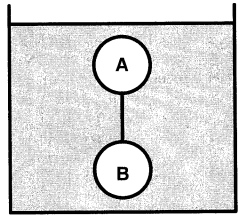
IIT 2011, Diffcult
Download our app for free and get started
$(a, b, c)$ Let $V$ be the volume of shperes.
For equilibrium of $A$ :
$T+v d_A g=V D_f g$
$\therefore T=V_g\left(d_f-d_A\right) \cdots(1)$
$f \text { or } T > 0, d_f > d_A \text { or } d_A < d_f$
$(a)$ is the correct option
For equilibrium of $B$ :
$T+V d_f g=V d_B g$
$\therefore T=V_g\left(d_B \cdot d_f\right) \cdots$
$F \text { or } T > 0, d_B > d_f$
$(b)$ is the correct option
$\text { From (1) and (2) Vg }\left(d_f-d_A\right)=V g\left(d_B-d_f\right)$
$\therefore d_f-d_A=d_B-d_f$
$\therefore 2 d_f=d_A+d_B$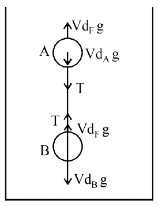

Download our appand get started for free
Experience the future of education. Simply download our apps or reach out to us for more information. Let's shape the future of learning together!No signup needed.*
Similar Questions
- 1A table tennis ball has radius $(3 / 2) \times 10^{-2} m$ and mass $(22 / 7) \times 10^{-3} kg$. It is slowly pushed down into a swimming pool to a depth of $d=0.7 m$ below the water surface and then released from rest. It emerges from the water surface at speed $v$, without getting wet, and rises up to a height $H$. Which of the following option(s) is (are) correct?View Solution
[Given: $\pi=22 / 7, g=10 ms ^{-2}$, density of water $=1 \times 10^3 kg m ^{-3}$, viscosity of water $=1 \times 10^{-3} Pa$-s.]
$(A)$ The work done in pushing the ball to the depth $d$ is $0.077 J$.
$(B)$ If we neglect the viscous force in water, then the speed $v=7 m / s$.
$(C)$ If we neglect the viscous force in water, then the height $H=1.4 m$.
$(D)$ The ratio of the magnitudes of the net force excluding the viscous force to the maximum viscous force in water is $500 / 9$.
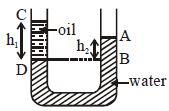
- 2In a $U-$ tube experiment, a column $AB$ of water is balanced by a column $‘CD’$ of oil, as shown in the figure. Then the relative density of oil isView Solution
- 3Water flows into a large tank with flat bottom at the rate of ${10^{ - 4}}\,{m^3}{s^{ - 1}}$. Water is also leaking out of a hole of area $1\, cm^2$ at its bottom. If the height of the water in the tank remains steady, then this height is........ $cm$View Solution
- 4At what speed the velocity head of a stream of water be equal to $40 cm $ of $Hg$ ........ $cm/sec$View Solution
- 5View SolutionScent sprayer is based on
- 6In Millikan's oil drop experiment, what is viscous force acting on an uncharged drop of radius $2.0 \times 10^{-5}\, {m}$ and density $1.2 \times 10^{3} \,{kgm}^{-3}$ ? Take viscosity of liquid $=1.8 \times 10^{-5}\, {Nsm}^{-2} .$ (Neglect buoyancy due to air).View Solution
- 7The atmospheric pressure at a place is $10^5 \,Pa$. If tribromomethane (specific gravity $=2.9$ ) be employed as the barometric liquid, the barometric height is .......... $m$View Solution
- 8A liquid is flowing in a horizontal uniform capillary tube under a constant pressure difference $P$. The value of pressure for which the rate of flow of the liquid is doubled when the radius and length both are doubled isView Solution
- 9An inverted bell lying at the bottom of a lake $ 47.6 m$ deep has $50$ $cm^3$ of air trapped in it. The bell is brought to the surface of the lake. The volume of the trapped air will be ......... $cm^3$ (atmospheric pressure $ = 70\,cm$ of $Hg$ and density of $Hg = 13.6$ $cm^3$)View Solution
- 10A $U-$ tube containing a liquid moves with a horizontal acceleration a along a direction joining the two vertical limbs. The separation between these limbs is $d$ . The difference in their liquid levels isView Solution