MCQ
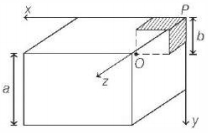
A smaller cube with side $b$ (depicted by dashed lines) is excised from a bigger uniform cube with side $\alpha$ as shown below, such that both cubes have a common vertex $P$. Let $X=a / b$. If the centre of mass of the remaining solid is at the vertex $O$ of smaller cube, then $X$ satisfies
  • $X^3-X^2-X-1=0$
  • B
    $X^2-X-1=0$
  • C
    $X^3+X^2-X-1=0$
  • D
    $X^3-X^2-X+1=0$

Answer

Correct option: A.
$X^3-X^2-X-1=0$
a
(a)

We choose origin at point $P$.

Now, given centre of mass of remaining solid is at point $O$. Coordinates of $O$ as per axes choosen are $O \equiv(b, b, b)$

i.e. $x=b, y=b$ and $z=b$

Centre of mass of complete large cube lies at its centre.

$\therefore$ Coordinates of centre of mass of large cube are $x_1=\frac{a}{2}, y_1=\frac{a}{2}, z_1=\frac{ a }{2}$

And centre of mass of removed cube of side $b$ is $x_2=\frac{b}{2}, y_2=\frac{b}{2}, z_2=\frac{b}{2}$.

Treating removed mass as negative mass, we have

$x_{ CM }\left(\right.$ of remaining part) $=\frac{m_1 x_1-m_2 x_2}{m_1-m_2}$

$\Rightarrow \quad b=\frac{\rho a^3 \times \frac{a}{2}-\rho b^3 \times \frac{b}{2}}{\rho a^3-\rho b^3}$

where, $\rho=$ mass density.

$\Rightarrow \quad a^3 b-b^4=\frac{a^4}{2}-\frac{b^4}{2}$

$\Rightarrow \quad \frac{a^3}{b^3}-1=\frac{a^4}{2 b^4}-\frac{1}{2}$

As $X=\frac{ a }{b}$, we have

$X^{-3}-1=\frac{X^4}{2}-\frac{1}{2}$

$\Rightarrow \quad 2 X^3-1=X^4$

$\Rightarrow \quad 2\left(X^3-1\right)=X^4-1$

$\Rightarrow 2(X-1)\left(X^2+1+X\right)$

$=(X-1)(X+1)\left(X^2+1\right)$

$\Rightarrow \quad X^3-X^2-X-1=0$
Need a full question paper?

Generate a complete, print-ready paper with questions like this in minutes — across 16+ boards, with answer keys.

Start Generating Free

Similar questions

The fundamental frequency of a sonometer wire increases by $6$ $Hz$ if its tension is increased by $44\%$ keeping the length constant. The change in the fundamental frequency of the sonometer wire in $Hz$ when the length of the wire is increased by $20\%$, keeping the original tension in the wire will be :-
The moon revolves around the earth because the earth exerts a radial force on the moon. Does the earth perform work on the moon?
On which of the following four processes, does the functioning of a bimetallic strip depends

$(i)$ Radiation

$(ii)$ Energy conversion

$(iii)$ Melting

$(iv)$ Thermal expansion

The magnitudes of vectors $\vec A,\,\vec B$ and $\vec C$ are $3, 4$ and $5$ units respectively. If $\vec A + \vec B = \vec C$, the angle between $\vec A$ and $\vec B$ is
If a watch with a wound spring is taken on to the moon, it
Displacement $(x)$ of a particle is related to time $(t)$ as:

$x = at + bt^2 -ct^3$

where $a, b$ and $c$ are constants of the motion. The velocity of the particle when its acceleration is zero is given by

The distance of a geo-stationary satellite from the centre of the earth (Radius $R = 6400\, km$) is nearest to
In the figure shown the velocity of lift is $2\,m / s$ while string is winding on the motor shaft with velocity $2\,m / s$ and block $A$ is moving downwards with a velocity of $2\,m / s$, then find out the velocity of block $B -$
A thin ring of mass $2 \ kg$ and radius $0.5 \ m$ is rolling without slipping on a horizontal plane with velocity $1 \ m / s$. A small ball of mass $0.1 \ kg$, moving with velocity $20 \ m / s$ in the opposite direction, hits the ring at a height of $0.75 \ m$ and goes vertically up with velocity $10 \ m / s$. Immediately after the collision

$(A)$ the ring has pure rotation about its stationary $CM$.

$(B)$ the ring comes to a complete stop.

$(C)$ friction between the ring and the ground is to the left.

$(D)$ there is no friction between the ring and the ground.

A particle is projected vertically upwards from $O$ with velocity $v$ and a second particle is projected at the same instant from $P$ (at a height h above $O$) with velocity $v$ at an angle of projection $\theta$ . The time when the distance between them is minimum is