Question
A smooth sphere $A$ is moving on a frictionless horizontal plane with angular speed $\omega $ and center of mass with velocity $v$. It collides elastically and head-on with an identical sphere $B$ at rest. Neglect friction everywhere. After the collision, their angular speeds are ${\omega _A}$ and ${\omega _B}$ respectively. Then
Answer

As the spheres are smooth there will be no friction (no torque) and therefore there will be no transfer of angular momentum. Thus $\mathrm{A}$, after collision will remain with its intial angular momentum $i . e ., \omega_{A}=\omega$

Need a full question paper?

Generate a complete, print-ready paper with questions like this in minutes — across 16+ boards, with answer keys.

Start Generating Free

Similar questions

A body of mass $3\, kg$ is under a constant force which causes a displacement $s$ in metres in it, given by the relation $s=$$\frac{1}{3}{t^2}$ , where $t$ is in seconds. Work done by the force in $2$ seconds is
A student obtained following observations in an experiment of meter bridge to find the unknown resistance of the circuit The most accurate value of unknown resistance is ............ $\Omega$
S.No. $R$ $l$ $100-l$ $S = \left( {\frac{{100 - l}}{l}} \right)R$
$1$ $20\,\Omega $ $43$ $57$ $26.51\,\Omega $
$2$ $30\,\Omega $ $51$ $49$ $28.82\,\Omega $
$3$ $40\,\Omega $ $59$ $41$ $27.80\,\Omega $
$4$ $60\,\Omega $ $70$ $30$ $25.71\,\Omega $
In helium nucleus, there are
Energy of $10$ non rigid diatomic molecules at temperature $\mathrm{T}$ is :
Measure of two quantities along with the precision of respective measuring instrument  $A = 2.5\,m{s^{ - 1}} \pm 0.5\,m{s^{ - 1}}$, $B = 0.10\,s \pm 0.01\,s$ The value of $AB$ will be
Dependence of intensity of gravitational field  $(E)$ of earth with distance $(r)$ from centre of earth is correctly represented by
A car is moving along a straight horizontal road with a speed ${v_0}$. If the coefficient of friction between the tyres and the road is $\mu $, the shortest distance in which the car can be stopped is
No current flows between two charged bodies connected together when they have the same
If the breaking force for a given wire is $F$, then the breaking force of two wires of same magnitude will be
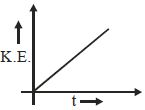
The kinetic energy of a body moving along a straight line varies with time as shown in figure. The force acting on body