If the breaking force for a given wire is $F$, then the breaking force of two wires of same magnitude will be
Easy


Download our appand get started for free
Experience the future of education. Simply download our apps or reach out to us for more information. Let's shape the future of learning together!No signup needed.*
Similar Questions
- 1The Young's modulus of a wire of length $L$ and radius $r$ is $Y$. If the length is reduced to $\frac{L}{2}$ and radius is $\frac{r}{2}$ , then the Young's modulus will beView Solution
- 2How much force is required to produce an increase of $0.2\%$ in the length of a brass wire of diameter $0.6\, mm$ (Young’s modulus for brass = $0.9 \times {10^{11}}N/{m^2}$)View Solution
- 3A uniform cubical block is subjected to volumetric compression, which decreases its each side by $2 \%$. The Bulk strain produced in it is ............View Solution
- 4A wire can be broken by applying a load of $20\,\,kg$ weight. The force required to break the wire of twice the diameter is ......... $kg\,wt$View Solution
- 5A uniform wire (Young's modulus $2 \times 10^{11}\, Nm^{-2}$ ) is subjected to longitudinal tensile stress of $5 \times 10^7\,Nm^{-2}$ . If the over all volume change in the wire is $0.02\%,$ the fractional decrease in the radius of the wire is close toView Solution
- 6For a constant hydraulic stress on an object, the fractional change in the object's volume $\left( {\frac{{\Delta V}}{V}} \right)$ and its bulk modulus $(B)$ are related asView Solution
- 7If $\rho $ is the density of the material of a wire and $\sigma $ is breaking stress, the greatest length of the wire that can hang freely without breaking isView Solution
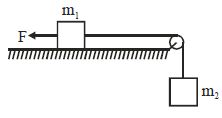
- 8Consider the situation shown in figure. The force $F$ is equal to the $m_2g/2.$ If the area of cross-section of the string is $A$ and its Young's modulus $Y$, find the strain developed in it. The string is light and there is no friction anywhereView Solution
- 9View SolutionThe value of Young's modulus for a perfectly rigid body is ...........
- 10Two persons pull a wire towards themselves. Each person exerts a force of $200 \mathrm{~N}$ on the wire. Young's modulus of the material of wire is $1 \times 10^{11} \mathrm{~N} \mathrm{~m}^{-2}$. Original length of the wire is $2 \mathrm{~m}$ and the area of cross section is $2 \mathrm{~cm}^2$. The wire will extend in length by . . . . . . . .$\mu \mathrm{m}$.View Solution