MCQ
$A$ smooth sphere is moving on a horizontal surface with a velocity vector $(\,2\,\hat i + 2\,\hat j\,)$ $m/s$ immediately before it hit a vertical wall. The wall is parallel to vector $\hat j$ and coefficient of restitution between the sphere and the wall is $e = 1/2$ . The velocity of the sphere after it hits the wall is
  • A
    $\,\hat i - \,\hat j$
  • $ - \,\hat i + 2\,\hat j$
  • C
    $ - \,\hat i - \,\hat j$
  • D
    $2\,\hat i - \,\hat j$

Answer

Correct option: B.
$ - \,\hat i + 2\,\hat j$
b
Initial velocity of the sphere $u=2 \hat{i}+2 \hat{j}$ As the wall is parallel to $y$ axis, thus its velocity componant in $y$ direction remains the same i.e $2 \hat{j}$ but its velocity componant in $x$ direction changes.

Newtons law of collision in $x$ direction: $\quad \frac{-v^{\prime}-0}{v-0}=-e$

$\frac{v^{\prime}-0}{2 \hat{i}-0}=-\frac{1}{2} \quad \Longrightarrow \quad v^{\prime}=-\hat{i}$

$\Longrightarrow$ velocity vector of sphere after hitting the wall $\quad u^{\prime}=-\hat{i}+2 \hat{j}$

Need a full question paper?

Generate a complete, print-ready paper with questions like this in minutes — across 16+ boards, with answer keys.

Start Generating Free

Similar questions

Two uniform circular discs are rotating independently in the same direction around their common axis passing through their centres. The moment of inertia and angular velocity of the first disc are $0.1 \;kg - m ^{2}$ and $10\; rad \,s^{-1}$ respectively while those for the second one are $0.2 \;kg - m ^{2}$ and $5\; rad \,s ^{-1}$ respectively. At some instant they get stuck together and start rotating as a single system about their common axis with some angular speed. The Kinetic energy of the combined system is ...........$J$
If a car is moving in uniform circular motion, then what should be the value of velocity of a car, so that car will not moving away from the circle,
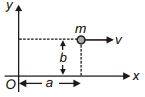
A particle of mass $m$ is moving with constant velocity $v$ parallel to the $x$-axis as shown in the figure. Its angular momentum about origin $O$ is ..........
If $C$ and $V$ represent capacity and voltage respectively then what are the dimensions of $\lambda,$ where $\frac{ C }{ V }=\lambda ?$
A flag is mounted on a car moving due North with velocity of $20 \,\,km/hr$ Strong winds are blowing due East with velocity of $20\,\,km/hr$. The flag will point in direction
On all the six surfaces of a unit cube, equal tensile force of $F$ is applied. The increase in length of each side will be ($Y =$ Young's modulus, $\sigma $= Poission's ratio)
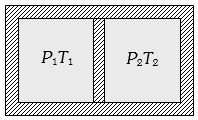
Following figure shows on adiabatic cylindrical container of volume ${V_0}$ divided by an adiabatic smooth piston (area of cross-section = $A$ ) in two equal parts. An ideal gas $({C_P}/{C_V} = \gamma )$ is at pressure $P_1$ and temperature $T_1$ in left part and gas at pressure $P_2$ and temperature $T_2$ in right part. The piston is slowly displaced and released at a position where it can stay in equilibrium. The final pressure of the two parts will be (Suppose $ x$ = displacement of the piston)
Let I1 and I2 be the moments of inertia of two bodies of identical geometrical shape, the first made of aluminium and the second of iron.
  1. I1 < I2
  2. I1 = I2
  3. I1 < I2
  4. Relation between I1 and I2 depends on the actual shapes of the bodies. 
A particle is moving in a circular path. The acceleration and momentum of the particle at a certain moment are $\vec a = (4\hat i + 3\hat j)\ m/s^2$ and $\vec p = (8\hat i - 6\hat j)\ kg-m/s$ . The motion of the particle is
The displacement of a particle executing SHM is given by $x=10 \sin \left(\omega t+\frac{\pi}{3}\right) \mathrm{m}$. The time period of motion is $3.14 \mathrm{~s}$. The velocity of the particle at $\mathrm{t}=0$is_________. $\mathrm{m} / \mathrm{s}$.