MCQ
A soap bubble assumes a spherical surface. Which of the following statement is wrong
  • A
    The soap film consists of two surface layers of molecules back to back
  • B
    The bubble encloses air inside it
  • The pressure of air inside the bubble is less than the atmospheric pressure; that is why the atmospheric pressure has compressed it equally from all sides to give it a spherical shape
  • D
    Because of the elastic property of the film, it will tend to shrink to as small a surface area as possible for the volume it has enclosed
Answer

Correct option: C.
The pressure of air inside the bubble is less than the atmospheric pressure; that is why the atmospheric pressure has compressed it equally from all sides to give it a spherical shape
(c)

Need a full question paper?

Generate a complete, print-ready paper with questions like this in minutes — across 16+ boards, with answer keys.

Start Generating Free

Similar questions

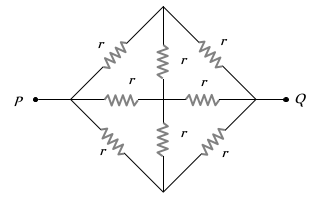
The equivalent resistance between the points $P$ and $Q$ in the network given here is equal to (given $r=\frac{3}{2} \Omega$ )

Image

A car of mass $1250 \mathrm{~kg}$ is moving at $30 \mathrm{~m} / \mathrm{s}$. Its engine delivers $30 \mathrm{~kW}$ while resistive force due to surface is $750 N$. What max acceleration can be given in the car
A body of mass $m$ is moving in a circle of radius $r$ with a constant speed $v$. The force on the body is $\frac{m v^2}{r}$ and is directed towards the centre. What is the work done by this force in moving the body over half the circumference of the circle
One mole of an ideal gas expands at a constant temperature of 300 $K$ from an initial volume of 10 litres to a final volume of 20 litres. The work done in expanding the gas is $(R=8.31 \mathrm{~J} / \mathrm{mole}-K)$
A force $\vec{F}=(5 \hat{i}+3 \hat{j}+2 \hat{k}) N$ is applied over a particle which displaces it from its origin to the point $\vec{r}=(2 \hat{i}-\hat{j}) m$. The work done on the particle in joules is
The stopping potential $\left(V_0\right)$
The frequencies of $X$-rays, $\gamma$-rays and ultraviolet rays are respectively $a, b$ and $c$. Then
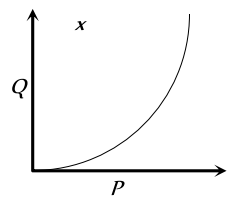
The graph shows the behaviour of a length of wire in the region for which the substance obeys Hook's law. $P$ and $Q$ represent

Image

Sodium and copper have work functions $2.3 \mathrm{eV}$ and $4.5 \mathrm{eV}$ respectively. Then the ratio of their threshold wavelengths is nearest to
The area of cross section of a steel wire $\left(Y=2.0 \times 10^{11}\  N / m ^2\right)$ is $0.1\  cm ^2$. The force required to double its length will be