MCQ
A soap bubble has radius $R$ and thickness $d ( < < R)$ as shown. It colapses into a spherical drop. The ratio of excess pressure in the drop to the excess pressure inside the bubble is 
  • A
    ${\left( {\frac{R}{{3d}}} \right)^{\frac{1}{3}}}$
  • B
    ${\left( {\frac{R}{{6d}}} \right)^{\frac{1}{3}}}$
  • ${\left( {\frac{R}{{24d}}} \right)^{\frac{1}{3}}}$
  • D
    None 

Answer

Correct option: C.
${\left( {\frac{R}{{24d}}} \right)^{\frac{1}{3}}}$
c
Let $r$ be the radius of the water drop formed.

Since the volume of the water forming bubble and drop is same,

$\frac{4}{3} \pi\left(R^{3}-(R-d)^{3}\right)=\frac{4}{3} \pi r^{3}$

$\Longrightarrow r^{3} \approx 3 R^{2} d\left(\text { neglecting } d^{2} \text { and } d^{3}\right)$

Ratio of excess pressure in the drop to the excess pressure inside the bubble is given by,

Ratio $=\frac{2 \sigma / r}{4 \sigma / R}$

Ratio $=\frac{1}{2}\left(\frac{R}{r}\right)$

Substituting the value of $\mathrm{r}$ gives $\left(\frac{R}{24 d}\right)^{1 / 3}$

Need a full question paper?

Generate a complete, print-ready paper with questions like this in minutes — across 16+ boards, with answer keys.

Start Generating Free

Similar questions

Consider three concentric metallic spheres $A, B$ and $C$ of radii $a , b, c$, respectively where $a < b < c$. $A$ and $B$ are connected, whereas $C$ is grounded. The potential of the middle sphere $B$ is raised to $V$, then the charge on the sphere $C$ is
When a metallic surface is illuminated with radiation of wavelength $\lambda$ , the stopping potential is $V.$ If the same surface is illuminated with radiation of wavelength $2\lambda$, the stopping potential is $\frac{V}{4}$. The threshold wavelength for the metallic surface is 
A $0.10\, kg$ block oscillates back and forth along a horizontal surface. Its displacement from the origin is given by: $x = (10\,cm)\cos [(10\,rad/s)\,t + \pi /2\,rad]$. What is the maximum acceleration experienced by the block
$A$ concave mirror is placed on a horizontal table, with its axis directed vertically upwards. Let $O$ be the pole of the mirror and $C$ its centre of curvature. $A$ point object is placed at $C$. It has a real image, also located at $C$ (a condition called auto-collimation). If the mirror is now filled with water, the image will be:
A monochromatic beam of light has a frequency $v = \frac{3}{{2\pi }} \times {10^{12}}\,Hz$ and is propagating along the direction $\frac{{\hat i + \hat j}}{{\sqrt 2 }}$. It is polarized along the $\hat k$ direction. The acceptable form for the magnetic field is
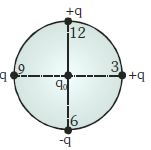
Four charges are placed at the circumference of the dial of a clock as shown in figure. If the clock has only hour hand, then the resultant force on a positive charge $q_0$ placed at the centre, points in the direction which shows the time as 
Which of the following when added as an impurity into silicon produces $n-$ type semiconductor ?
When a $DC$ voltage of $200\, V$ is applied to a coil of self inductance $\frac{{2\sqrt 3 }}{\pi }\,H$, a current of $1\, A$ flows through it. But by replacing $DC$ source with $AC$ source of $200\, V$, the current in the coil is reduced to $0.5\, A$. Then, the frequency of $AC$ supply is......$Hz$
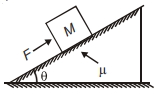
A block (mass $=M kg$ ) is placed on a rough inclined plane. A force $F$ is applied parallel to the inclined (as shown in figure) such that it just starts moving upward. The value of $F$ is
A ball of mass 100 g is projected with velocity $20 m / s$ at $60^{\circ}$ with horizontal. The decrease in kinetic energy of the ball during the motion from point of projection to highest point is :