MCQ
A soap bubble is given negative charge, its radius will:
- AIncrease
- BDecrease
- CRemain unchanged
- DFluctuate
Explanation:
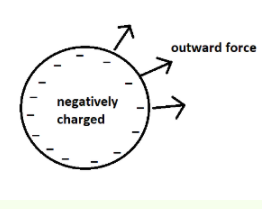
The charge will be distributed uniformly over the surface of the bubble by symmetry.
As we know, they want to step much farther apart, as charges repel, the only path outward, taking with them the soap surface.
At the same point, the rise in the restored force of the soap film (surface tension) would be equal and contrary to the electrostatic force, which will result in a new (larger) radius of equilibrium.
Because of the ionic similarities, this can happen to both positive and negatively charged bubbles.Therefore, when a negative charge is given to the soap bubble, then its radius will increase.
Generate a complete, print-ready paper with questions like this in minutes — across 16+ boards, with answer keys.
The radius of curvature of convex surface of a thin plano-convex lens is 15 cm and refractive index of its material is 1.6. The power of the lens will be
|
(a) + 1D |
(b) -2D |
(c) +3D |
(d) +4D |
A hollow insulated conducting sphere is given a positive charge of 10μC. What will be the electric field at the centre of the sphere if its radius is 2 meters
|
(a) Zero |
(b) 5 |
(c) 20 |
(d) 8 |
The only property possessed by ferromagnetic substance is
|
(a) Hysteresis |
(b) Susceptibility |
|
(c) Directional property |
(d) Attracting magnetic substances |
The thermo e.m.f. of a thermo-couple is 25μV/℃ at room temperature. A galvanometer of 40 ohm resistance, capable of detecting current as low as  , is connected with the thermocouple. The smallest temperature difference that can be detected by this system is
|
(a) 20 ℃ |
(b) 16 ℃ |
(c) 12 ℃ |
(d) 8℃ |