Questions · Page 1 of 7

M.C.Q (1 Marks)

Take a timed test

50 questions · self-marked practice — reveal the answer and mark yourself.

MCQ 11 Mark
If the net electric flux through a closed surface is zero, then we can infer:
  • A
    No net charge is enclosed by the surface.
  • B
    Uniform electric field exists within the surface.
  • C
    Electric potential varies from point to point inside the surface.
  • D
    Charge is present inside the surface.
Answer
  1. No net charge is enclosed by the surface.

Explanation:

  • Net electric flux is highly dependent on the net electric charge enclosed by the surface.
  • In a closed surface, if the net electric flux is zero, then the net electric charge will be also zero.
  • Since electric flux is defined as the rate of flow of electric field in a closed area and if the electric flux is zero, the overall electric charge within the closed boundary will be also zero.
View full question & answer
MCQ 21 Mark
The charge is negative, then the electric lines of forces are:
  • A
    Straight lines converging towards the charge.
  • B
    Concentric circle with charge at the centre.
  • C
    Straight lines radiating away from the charge.
  • D
    Non of these.
Answer
  1. Straight lines converging towards the charge.

Explanation:

Lines of force originate from a positive charge and terminate to a negative charge. Hence, when the charge is negative, then the electric lines  of force are straight lines converging towards the charge.

View full question & answer
MCQ 31 Mark
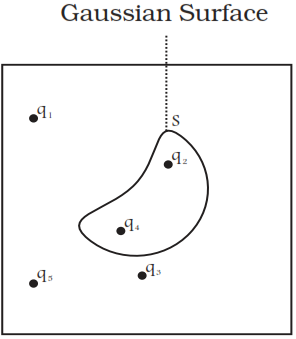
Five charges q1, q2, q3, q4, and q5 are fixed at their positions as shown in. S is a Gaussian surface. The Gauss’s law is given by

$\oint\limits_\text{S}\text{E.ds}=\frac{\text{q}}{\in_0}$

Which of the following statements is correct?

  • A
    E on the LHS of the above equation will have a contribution from q1, q5 and q3 while q on the RHS will have a contribution from q2 and q4 only.
  • B
    E on the LHS of the above equation will have a contribution from all charges while q on the RHS will have a contribution from q2 and q4 only.
  • C
    E on the LHS of the above equation will have a contribution from all charges while q on the RHS will have a contribution from q1, q3 and q5 only.
  • D
    Both E on the LHS and q on the RHS will have contributions from q2 and q4 only.
Answer
  1. E on the LHS of the above equation will have a contribution from all charges while q on the RHS will have a contribution from q2 and q4 only.

Key concept: According to Gauss' law, the term qenclosed on the right side of the equation $\oint\limits\text{E.ds}$ = qenclosed/ϵ0 includes the sum of all charges enclosed  by the surface called (Gaussian surface).

In left side equation, the electric field is due to all the charges present both inside as well as outside the Gaussian surface.

Hence in given question, E on LHS of the above equation will have a contribution from all charges while q on the RHS will have a contribution from q2 and q4 only. Hence option (b) is correct.

View full question & answer
MCQ 41 Mark
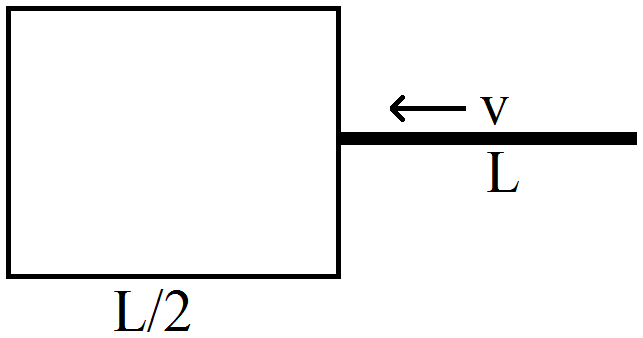
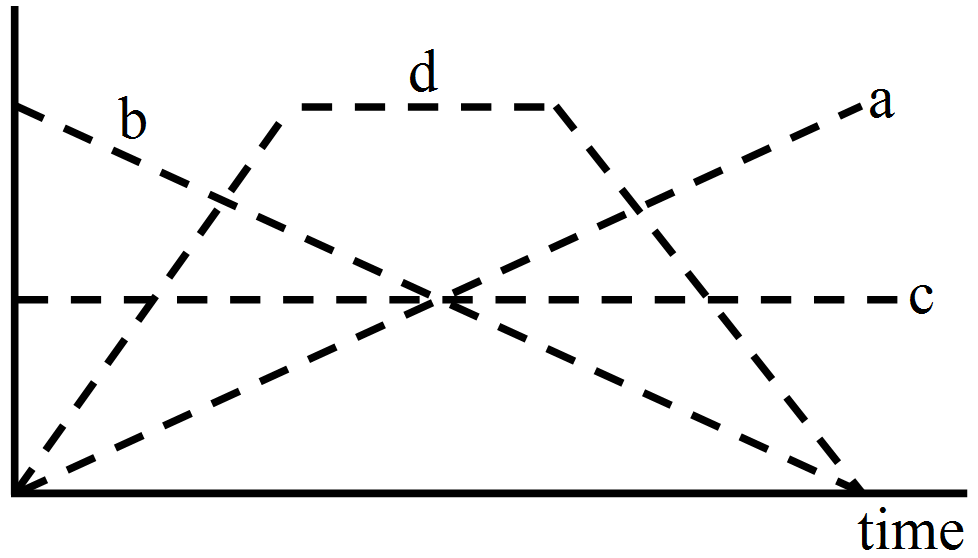
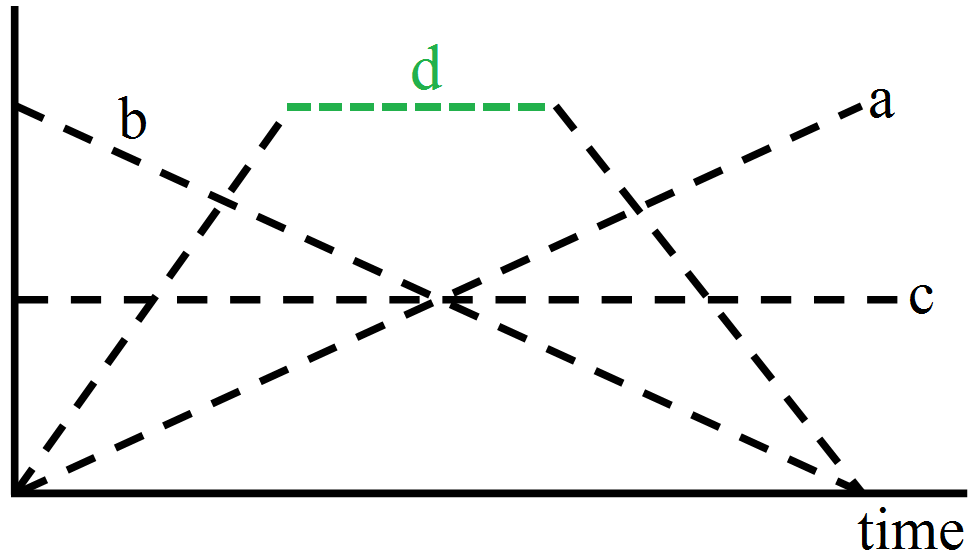
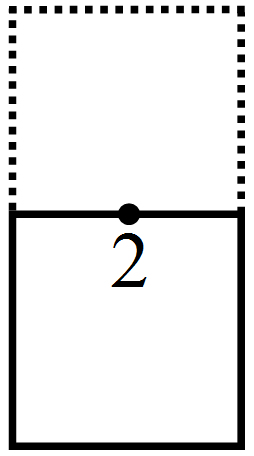
Figure shows an imaginary cube of edge $\frac{\text{L}}{2}.$ A uniformly charged rod of length L moves towards left at a small but constant speed u. At t = 0, the left end just touches the centre of the face of the cube opposite it. Which of the graphs shown in figure represents the flux of the electric field through the cube as the rod goes through it?


    • A
      a
    • B
      b
    • C
      c
    • D
      d
    Answer
    1.  

    Explanation:

    Flux is constant with respect to time.

    View full question & answer
    MCQ 51 Mark
    The surface charge destiny of tin charged disc of radius R is $\sigma$ The value of the electric filed at the centre of the disc is $\frac{\sigma}{2\in_0}$ With reapect to the field the centre the electric field along the axis at distance R from the centre of the disc.
    • A
      Reduces by 70.7%.
    • B
      Reduces by 29.3%.
    • C
      Reduces by 9.7%.
    • D
      Reduces by 14.6%.
    Answer
    1. Reduces by 70.7%.
    View full question & answer
    MCQ 61 Mark
    In a region of space having a uniform electric field E, a hemispherical bowl of radius r is placed. The electric flux $\phi$ through the bowl is:
    • A
      $2\pi\text{R}\text{E}$
    • B
      $4\pi\text{R}^2\text{E}$
    • C
      $2\pi\text{R}^2\text{E}$
    • D
      $\pi\text{R}^2\text{E}$
    Answer
    1. $2\pi\text{R}^2\text{E}$

    Explanation:

    $\phi=\text{E}(\text{ds})\cos\theta=\text{E}(2\pi\text{r}^2)\cos0^{\circ}=2\pi\text{r}^2\text{E}$

    View full question & answer
    MCQ 71 Mark
    6 A particle of charge q and mass m moves rectilinearly under the action of electric field E = A – Bx, where A and B are positive constants and x is distance from the point where particle was initially at rest then the distance travelled by the particle before coming to rest and acceleration of particle at that moment are respectively:
    • A
      $\frac{2\text{A}}{\text{B}},0$
    • B
      $0,-\frac{\text{qA}}{\text{m}}$
    • C
      $\frac{2\text{A}}{\text{B}},-\frac{\text{qA}}{\text{m}}$
    • D
      $\frac{-2\text{A}}{\text{B}},-\frac{\text{qA}}{\text{m}}$
    Answer
    1. $\frac{2\text{A}}{\text{B}},-\frac{\text{qA}}{\text{m}}$
    View full question & answer
    MCQ 81 Mark
    A force ‘F’ is acting between two charges in air. If the space between them be completely filled with a medium K = 4, the force will be:
    • A
      F
    • B
      4F
    • C
      $\frac{\text{F}}{4}$
    • D
      2F
    Answer
    1. $\frac{\text{F}}{4}$

    Explanation:

    By Coulomb's law, the force between two charges (q1​, q2​) in air is given by

    $\text{F}=\frac{\text{q}_1\text{q}_2}{4\pi\in_{0}\text{r}^2}$

    where r= distance between two charges.

    Now the force between two charges (q1​, q2​) in medium with dielectric

    constant K = 4 becomes, $\text{F}=\frac{\text{q}_1\text{q}_2}{4\pi\text{K}\in_{0}\text{r}^2}$

    So, $\text{F}=\frac{\text{F}}{\text{K}}=\frac{\text{F}}{4}$

    View full question & answer
    MCQ 91 Mark
    Two identical blocks are kept on a frictionless horizontal table connected by a spring of stiffness K and of original length $\ell_0$ A total charge Q is distributed on the block such that maximum elongation of sparing at equilibrium is equal to x value of q is:
    • A
      $2\ell_0\sqrt{4\pi\in_0(\ell_0+\text{x})}$
    • B
      $2\text{x}\sqrt{4\pi\in_0\text{k}(\ell_0+\text{x})}$
    • C
      $2(\ell_0+\text{x})\sqrt{4\pi\in_0\text{kx}}$
    • D
      $(\ell_0+\text{x})\sqrt{4\pi\in_0\text{kx}}$
    Answer
    1. $2(\ell_0+\text{x})\sqrt{4\pi\in_0\text{kx}}$
    View full question & answer
    MCQ 101 Mark
    Choose the correct answer.

    $\text{F}=\frac{\text{K.}(\text{q}_1\times\text{q}_2)}{\text{r}^2}$

    This is given by which law?

    • A
      Faraday’s law
    • B
      Newton’s law
    • C
      Coulomb’s law
    • D
      Fleming’s law
    Answer
    1. Coulomb’s law

    Explanation:

    $\text{F}=\frac{\text{K.}(\text{q}_1\times\text{q}_2)}{\text{r}^2}$

    is given by Coulomb’s Law.

    View full question & answer
    MCQ 111 Mark
    The electrostatic force between two point charges q1​ and q2​ at separation 'r' is given by $\text{F}=\frac{\text{K}_\text{q1q2}}{\text{r}^2}.$​​ The constant K:
    • A
      Depends on the system of units only.
    • B
      Depends on the medium between the charges only.
    • C
      Depends on both the system of units and the medium between the charges.
    • D
      Is independent of both the system of units and the medium between the charges.
    Answer
    1. Depends on both the system of units and the medium between the charges.

    Explanation:

    $\text{K}=\frac{1}{4\pi\in_\circ\text{k}}$ and its units is N−m2/ C2

    It depend on system of unit and dielectric constant (k), that's medium between charges

    View full question & answer
    MCQ 121 Mark
    A solid sphere of radius R1 and volume charge density $\text{p}=\frac{\text{p}_{0}}{\text{r}}$ is enclosed by a hollow sphere of radius R2 with negative surface charge destiny $\sigma_2$ such that the total charge in the system is zero $\text{p}_0$ is positive constant and r is the distance from the centre of sphere the ratio $\frac{\text{R}_2}{\text{R}_1}$ is:
    • A
      $\frac{\sigma}{\text{p}_0}$
    • B
      $\sqrt{\frac{2\sigma}{\text{p}_0}}$
    • C
      $\sqrt{\frac{\text{p}_0}{2\sigma}}$
    • D
      $\frac{\text{p}_0}{\sigma}$
    Answer
    1. $\sqrt{\frac{\text{p}_0}{2\sigma}}$
    View full question & answer
    MCQ 131 Mark
    Sometimes you get a mild spark when you touch the metal surface of a car. What might be the reason?
    • A
      Due to magnetic attraction, a spark is created.
    • B
      Due to electrostatic charge residing on the metal as well as on skin, mild spark is observed.
    • C
      Car tries to become neutral by donating electrons.
    • D
      Its the only path to ground.
    Answer
    1. Due to electrostatic charge residing on the metal as well as on skin, mild spark is observed.

    Explanation:

    Negative electric charge often resides on the surface of metal of car. When you touch the car, electrostatic discharge occurs via your body and you get a mild spark.

    View full question & answer
    MCQ 151 Mark
    Let there be a spherically symmetric charge distribution with charge density varying as $\text{p}(\text{r})=\text{p}_0\bigg(\frac{5}{4}-\frac{\text{r}}{\text{R}}\bigg)$ upto r = R and p(r) = 0 for r > R where r is the distance from the origin the electric field at a distance r(r < R) from the origin is given by.
    • A
      $\text{p}{_0}^\text{r}\Big(\frac{5}{3}-\frac{\text{r}}{\text{R}}\Big)$
    • B
      $\frac{4\pi\text{p}{_0}^\text{r}}{3\in_0}\Big(\frac{5}{3}-\frac{\text{r}}{\text{R}}\Big)$
    • C
      $\frac{4\text{p}{_0}^\text{r}}{4\in_0}\Big(\frac{5}{4}-\frac{\text{r}}{\text{R}}\Big)$
    • D
      $\frac{\text{p}{_0}^\text{r}}{3\in_0}\Big(\frac{5}{4}-\frac{\text{r}}{\text{R}}\Big)$
    Answer
    1. $\text{p}{_0}^\text{r}\Big(\frac{5}{3}-\frac{\text{r}}{\text{R}}\Big)$
    View full question & answer
    MCQ 161 Mark
    If $\int_\text{S}\text{E.dS}=0$ over a surface, then:
    • A
      The electric field inside the surface and on it is zero.
    • B
      The electric field inside the surface is necessarily uniform.
    • C
      The number of flux lines entering the surface must be equal to the number of flux lines leaving it.
    • D
      All charges must necessarily be outside the surface.
    Answer
    1. The number of flux lines entering the surface must be equal to the number of flux lines leaving it.
    2. All charges must necessarily be outside the surface.

    Given,

    $\int_\text{s}\text{E.dS}=0$

    It means the algebraic sum of number of flux lines entering the surface and number of flux lines leaving the surface.

    Now, from Gauss' law,

    $\int_\text{S}\text{E.dS}=\frac{\text{q}}{\in_0}$

    Where q is charge enclosed by the surface.

    Now,

    $\int_\text{s}\text{E.dS}=0$

    q = 0 i.e., net charge enclosed by the surface must be zero.

    Hence, all other charges must necessarily be outside the surface.

    View full question & answer
    MCQ 171 Mark
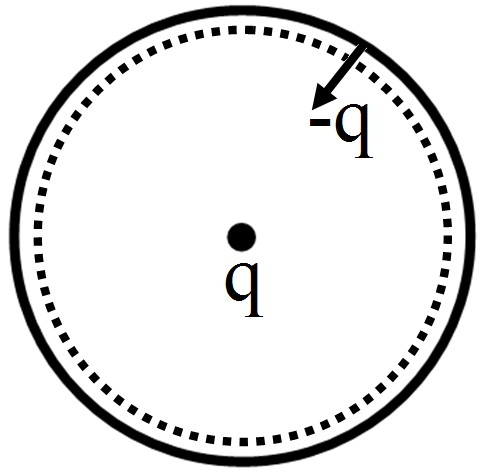
    Consider the situation of the previous problem. The force on the central charge due to the shell is:
    • A
      Towards left.
    • B
      Towards right.
    • C
      Upward.
    • D
      Zero.
    Answer
    1. Towards right.

    Explanation:

    Force on the central charge due to shell is right $\frac{\text{Kq}^2}{\text{r}^2}$ towards.

    View full question & answer
    MCQ 181 Mark
    An electron revolves around the nucleus of hydrogen atom in a circle of radius 5 × 10-11 m. The intensity of electric field at a point in the orbit of the electron is:
    • A
      5.76 × 10¹¹ N/C
    • B
      9.216 × 10⁻⁸ N/C
    • C
      0
    • D
      4 N/C
    Answer
    1. 5.76 × 10¹¹ N/C

    Explanation:

    We know hydrogen atom consist of one proton and one electron

    R = 5 × 10-11m

    We know attractive force $=\frac{\text{k}\text{q}_1(\text{q}_2)}{\text{r}^2}=\frac{9\times10^9\times(1.6\times10^{-19})^2}{(5\times10^{-11})^2}$

    We know F = Eq

    $\therefore\text{E}=\frac{\text{F}}{\text{q}}$

    $\therefore\text{E}=\frac{9\times10^9\times(1.6\times10^{-19})}{(5\times10^{-11})^2}=5.76\times10^{11}\text{N/C.}$​​​​​​​

    View full question & answer
    MCQ 191 Mark
    Two small balls having the same mass and charge and located on the same vertical at heights h1 and h2 are thrown in the same direction along the horizontal at the same velocity v. The first ball touches the ground at a distance l from the initial vertical. At what height H2 will the second ball be at this instant ? The air drag and the effect of the charges induced on the ground should be neglected.
    • A
      $\text{h}_1+\text{h}_2-\text{g}\Big(\frac{\ell}{\text{V}}\Big)^2$
    • B
      $\text{h}_1-\text{h}_2-\text{g}\Big(\frac{\ell}{\text{V}}\Big)^2$
    • C
      $\text{h}_1+\text{h}_2-\text{g}\Big(\frac{\ell}{\text{V}}\Big)^\frac{1}{2}$
    • D
      $\frac{\text{h}_1+\text{h}_2}{-\text{g}}-\text{g}\Big(\frac{\ell}{\text{V}}\Big)^2$
    Answer
    1. $\text{h}_1+\text{h}_2-\text{g}\Big(\frac{\ell}{\text{V}}\Big)^2$
    View full question & answer
    MCQ 201 Mark
    Which of the following quantities do not depend on the choice of zero potential or zero potential energy?
    • A
      Potential at a point.
    • B
      Potential difference between two points.
    • C
      Potential energy of a two-charge system.
    • D
      Change in potential energy of a two-charge system.
    Answer
    1. Potential energy of a two-charge system.
    2. Change in potential energy of a two-charge system.

    Explanation:

    $\text{V}_\text{p}=\frac{\text{KQ}}{\text{r}}-\frac{\text{KQ}}{\text{r}}=0$

    View full question & answer
    MCQ 211 Mark
    Two charges are placed at certain distance apart. A metallic sheet is placed between them. What will happen to the force between the charges?
    • A
      Increases
    • B
      Decreases
    • C
      Remains the same
    • D
      May increase or decrease depending upon the shape of the metallic sheet
    Answer
    1. Decreases

    Explanation:

    Force will decreases because when medium is inserted between then it will reduces the forces by its permitivity. the force becomes

    $\text{Fe}_\text{m}=\frac{\text{Fe}}{\in_\text{r}}$

    View full question & answer
    MCQ 221 Mark
    An attractive force of 9N acts between +5C and −5C at some distance. These charges are allowed to touch each other and are then again placed at their initial position. The force acting between them will be:
    • A
      infinite
    • B
      9×10⁹N
    • C
      1N
    • D
      zero
    Answer
    1. zero

    Explanation:

    According to the question

    $\text{F}=\frac{1}{4\pi\in_0}\frac{(5\times10^{-6})\times(-5\times10^{-6})}{\text{r}^2}$

    On touching them the charge on each will be zero.

    $\therefore\text{F}=\frac{1}{4\pi\in_0}\frac{(0)}{\text{r}^2}=0$

    View full question & answer
    MCQ 231 Mark
    The constant k in Coulomb's law depends upon:
    • A
      Nature of medium
    • B
      System of units
    • C
      Intensity of charge
    • D
      Both (a) and (b)
    Answer
    1. Nature of medium

    Explanation:

    The value of $\text{K}=\frac{1}{4\pi\in_0}=8.854\times10^{-12}\text{C}^2\text{N}^{-1}\text{m}^{-2}$

    Where ε0​ is permittivity of free space.

    View full question & answer
    MCQ 241 Mark
    Number of electrons in 1 Coulomb charge is _________?
    • A
      6.25 × 1021
    • B
      6.25 × 1020
    • C
      6.25 × 1025
    • D
      6.25 × 1023
    Answer
    1. 6.25 × 1021

    Explanation:

    Electron has the charge of 1.602 × 10⁻¹⁹ Coulomb. So, the number of electrons in 1 Coulomb of charge is $\frac{1}{1.602\times10^{-19}}=6.25\times10^{21}$

    This huge number of electrons can be accumulated to form 1C of charge.

    Thus, we can conclude that we need Avogadro’s number of electrons (approximately) to get 100C charges.

    View full question & answer
    MCQ 251 Mark
    +q, +2q, +3q, +4q, ……(up to +20q) charges are situated at coordinates (0, 0), (1, 0), (2, 0), ….. (Up to 20). What is the total charge stored in the system?
    • A
      +20q
    • B
      +210q
    • C
      +420q
    • D
      +190q
    Answer
    1. +210q

    Explanation:

    As charge is additive, total charge will be $(1+2+3+4+…. +20)\times\text{q}=\frac{20\times21}{2}\times\text{q}= 210\text{q}.$ But if the polarities of the charges are different i.e. some of them are positive and some are negative, then the result will be different. We have to add separately the positive charges and the negative charges.

    View full question & answer
    MCQ 261 Mark
    The electric field in a region is directed outward and is proportional to the distance r from the origin. Taking the electric potential at the origin to be zero,
    • A
      It is uniform in the region.
    • B
      It is proportional to r.
    • C
      It is proportional to r2.
  1. D
    It increases as one goes away from the origin.
  2. Answer
    1. It is proportional to r2.

    Explanation:

    $\text{DV}=-\text{E}.\text{dr}$

    Given $(\text{E}\propto\text{r})$

    $(\text{V}-0)=-\text{E}.\text{dr}$ 

    $þ\text{E}\propto\text{r}^2$

    View full question & answer
    MCQ 271 Mark
    What is the unit of surface charge density in the SI unit?
    • A
      C
    • B
      C/ m
    • C
      C/ m2
    • D
      C/ m3
    Answer
    1. C/ m2

    Explanation:

    Surface charge density means how much charge is stored in the unit surface area of a conductor.

    So, it’s unit will be$=\frac{\text{the unit of the charge}}{\text{the unit of area}}$. In SI the unit of charge is Coulomb and the unit of area is m2.

    View full question & answer
    MCQ 281 Mark
    Two small spheres with masses M1​ and M2​ hang on weightless, insulating threads with lengths L1​ and L2​. The two spheres carry a charge of Q1​ and Q2​ respectively. The spheres hang such that they are level with one another and the threads are inclined to the vertical at angles $\theta_1$​ and $\theta_2$. Which of the following conditions is required if$\theta_1​=θ_2​.$
    • A
      M= M2​
    • B
      ∣Q1​∣ = ∣Q2​
    • C
      L1​ = L2​
    • D
      None of these
    Answer
    1. M= M2​

    Explanation:

    $\theta_1​=θ_2​,$​ if their masses are the same because the force of repulsion due to charges is the same.

    The force Mg $\sin\theta$ opposes the force of repulsion. Even if Q1​ and Q2​ are different, the force of repulsion is the same for both as they are mutual.

    View full question & answer
    MCQ 291 Mark
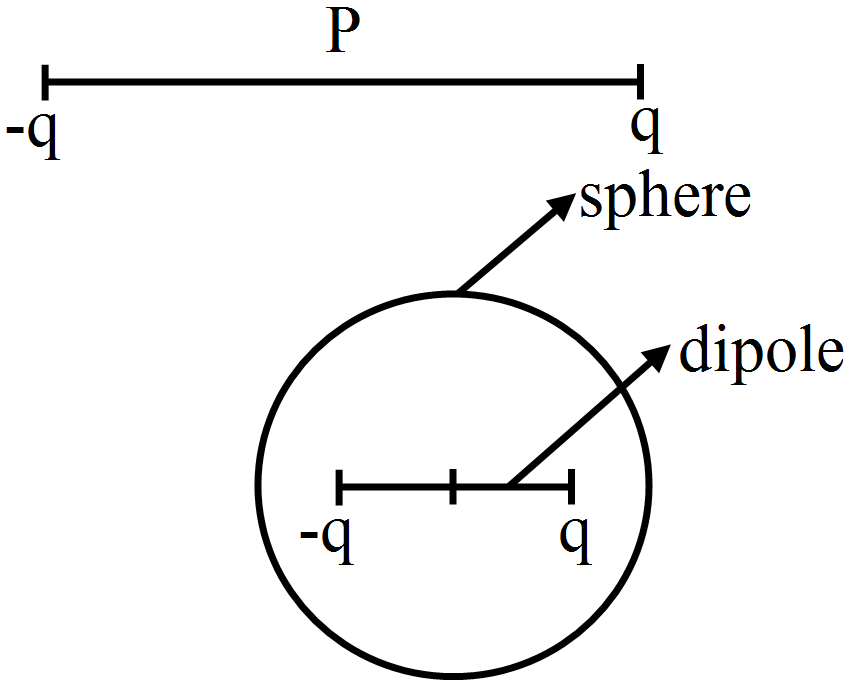
    An electric dipole is placed at the centre of a sphere.
    Mark the correct options:
    • A
      The flux of the electric field through the sphere is zero.
    • B
      The electric field is zero at every point of the sphere.
    • C
      The electric field is not zero anywhere on the sphere.
    • D
      The electric field is zero on a circle on the sphere.
    Answer
    1. The flux of the electric field through the sphere is zero.
    1. The electric field is not zero anywhere on the sphere.

    Explanation:

    $\therefore$ Net charge of electric dipole is always zero.

    $\phi=\frac{\text{q}_{\text{inside}}}{\in_0}$ Here inside = 0

    The flux of the electric field through the sphere is zero. But the electric field is not zero any where on the sphere. Take 'A' point any where on the sphere, and find the electric field on the surface. You will get non zero electric field on the sphere.

    View full question & answer
    MCQ 301 Mark
    Coulomb's Law agrees with________?
    • A
      Newtons 3rd Law of Motion.
    • B
      Newtons 1st Law of Motion.
    • C
      Newtons 2nd Law of Motion.
    • D
      All of the above.
    Answer
    1. Newtons 3rd Law of Motion.

    Explanation:

    Coulomb's law agrees with Newton's 1st, 2nd and 3rd law of motion. Coulomb's law states that $\text{F}=\text{K}\frac{\text{q}_1\text{q}_2}{\text{r}^2}$ here the two charge particle is similar to the objects of the Newton's 1st law. Newton's 3rd law is same as the two similar charge particles repel to each other. Which coincides with Newton's 3rd law every action there is an equal and opposite reaction.

    View full question & answer
    MCQ 311 Mark
    A charge "Q" and "2Q" are 0.05 meters apart and isolated. The ratio of the electrostatic force on the charge Q to the force on charge 2Q is:
    • A
      2 : 1
    • B
      1 : 1
    • C
      1 : 2
    • D
      1 : 4
    Answer
    1. 1 : 1

    Explanation:

    According to Newton's 3rd law, every action has equal and opposite reaction.

    Thus the force exerted by charge on Q due to  2Q is equal but opposite in direction to the force exerted by charge on 2Q due to Q i.e

    FQ​ = F2Q​

    $\Rightarrow\frac{\text{F}_\text{Q}}{\text{F}_\text{2Q}}=1$

    View full question & answer
    MCQ 321 Mark
    Coulomb's Law is true for:
    • A
      Atomic distances (=10-11m)
    • B
      Nuclear distances (=10-15m)
    • C
      Charged as well as uncharged particles
    • D
      All the distances
    Answer
    1. All the distances

    Explanation:

    Coulomb's law is true for all distances whether it is small and large. Hence it is called a long range force.

    Coulomb's force $\text{F}=\frac{\text{q}_1\text{q}_2}{4\pi\in_\circ\text{r}^2}$

    $\Rightarrow\text{F}\propto\frac{1}{\text{r}^2}$

    View full question & answer
    MCQ 331 Mark
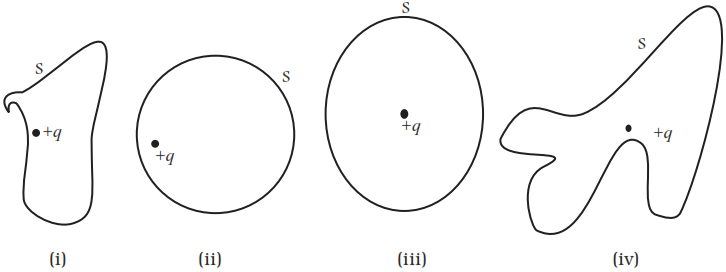
    The Electric flux through the surface:
    • A
      In Fig. 1.3 (iv) is the largest.
    • B
      In Fig. 1.3 (iii) is the least.
    • C
      In Fig. 1.3 (ii) is same as Fig. 1.3 (iii) but is smaller than Fig. 1.3 (iv)
    • D
      Is the same for all the figures.

    Answer
    1. Is the same for all the figures.

    Key concept: According to Gauss' law of electrostatics, the total electric flux out of a closed surface is equal to the charge enclosed divided by the permittivity,

    $\text{i.e.,}\phi=\frac{\text{Q}_\text{enclosed}}{\in_0}$

    Thus, electric flux through a surface doesn't depend on the shape, size or area of a surface but it depends on the amount of charge enclosed by the surface.

    In given figures the charge enclosed are same that means the electric flux through all the surfaces should be the same. Hence option (d) is correct.

    View full question & answer
    MCQ 341 Mark
    If two charges of 1 coulomb each are placed 1km apart in vacuum, the force between them will be:
    • A
      9 × 10³N
    • B
      9 × 10⁻³N
    • C
      1.1 × 10⁻⁴N
    • D
      10-6N
    Answer
    1. 9 × 10³N

    Explanation:

    Q = 1C r = 1000m

    $\text{F}=\frac{\text{KQQ}}{\text{r}^2}=\frac{9\times10^3}{((10)^3)^2}=9\times10^3\text{N}$

    View full question & answer
    MCQ 351 Mark
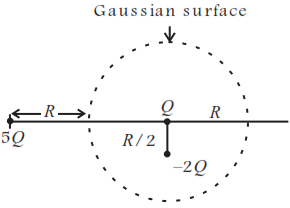
    Refer to the arrangement of charges in Fig. and a Gaussian surface of radius R with Q at the centre. Then:
    • A
      Total flux through the surface of the sphere is $\frac{-\text{Q}}{\in_0}$.
    • B
      Field on the surface of the sphere is $\frac{-\text{Q}}{4\pi\in_0\text{R}^2}$.
    • C
      Flux through the surface of sphere due to 5Q is zero.
    • D
      Field on the surface of sphere due to -2Q is same everywhere.

    Answer
    1. Total flux through the surface of the sphere is $\frac{-\text{Q}}{\in_0}$.
    1. Flux through the surface of sphere due to 5Q is zero.

    Gauss' law states that total electric flux of an enclosed surface is given by $\frac{\text{q}}{\in_0}$.

    Here, q is the net charge enclosed by the Gaussian surface.

    From the figure,

    Net charge inside the surface is = Q - 2Q = -Q.

    Net flux through the surface of the sphere $=\frac{-\text{Q}}{\in_0}$

    Here, charge 5Q lies outside the Gaussian surface, so it will not make no contribution to electric flux through the given surface.

    View full question & answer
    MCQ 361 Mark
    If there were only one type of charge in the universe, then
    • A
      $\oint_\text{s}\text{E.dS}\neq0$ on any surface.
    • B
      $\oint_\text{s}\text{E.dS}=0$ if the charge is outside the surface.
    • C
      $\oint_\text{s}\text{E.dS}$ could not be defined.
    • D
      $\oint_\text{s}\text{E.dS}=\frac{\text{q}}{\in_0}$ if charges of magnitude q were inside the surface.
    Answer
    1. $\oint_\text{s}\text{E.dS}=0$ if the charge is outside the surface.

    1. $\oint_\text{s}\text{E.dS}=\frac{\text{q}}{\in_0}$ if charges of magnitude q were inside the surface.

    According to the Gauss' law

    $\int_\text{s}\text{E.dS}=\frac{\text{q}}{\in_0}$

    Where q is the charge enclosed by the surface. If the charge is outside the surface, then charge.

    If the charge is outside the surface, then charge enclosed by the surface is q = 0, therefore,

    $\int_\text{s}\text{E.dS}=0$

    Electric flux doesn't depend on the nature or type of charge.

    View full question & answer
    MCQ 371 Mark
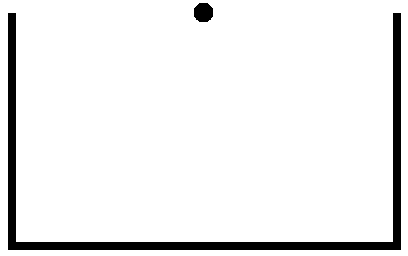
    A charge q is placed at the centre of the open end of a cylindrical vessel (figure). The flux of the electric field through the surface of the vessel is:

    • A
      $\text{Zero}$
    • B
      $\frac{\text{q}}{\in_0}$
    • C
      $\frac{\text{q}}{2\in_0}$
    • D
      $\frac{2\text{q}}{\in_0}$
    Answer
    1. $\frac{\text{q}}{2\in_0}$

    Explanation:

    In the charge 'q' in side closed cylinder, due to charge the flux of the electric field through the surface of the vessel is $\frac{\text{q}}{\in_0}.$ Here A charge q is placed at the centre of the open end of a cylindrical, By symmetricily Half line of flux goes outside & half flux line goes inside. So we can say that the flux of the electric field through the surface of the vessel is $\frac{\text{q}}{2\in_0}.$

    View full question & answer
    MCQ 381 Mark
    The solid angle subtended by the total surface area of a sphere at the centre is:
    • A
      $4\pi$
    • B
      $2\pi$
    • C
      $\pi$
    • D
      $3\pi$
    Answer
    1. $4\pi$

    Explanation:

    A steradian is the solid angle subtended at the center of a sphere of radius r by a section of its surface area of magnitude equal to r2. Since the surface area is $4\pi\text{r}^2$, there are $4\pi$ steradians surrounding a point in space.

    View full question & answer
    MCQ 391 Mark
    The force of repulsion between two point charges is F, when these are 1m apart. Now the point charges are replaced by conducting spheres of radii 5cm having the charge same as that of point charges. The distance between their centres is 1m, then the force of repulsion will:
    • A
      increase
    • B
      decrease
    • C
      remain same
    • D
      become $\frac{10\text{F}}{9}$
       
    Answer
    1. remain same

    Explanation:

    From Coulombs law

    $\text{F}\propto\frac{\text{q}_1\text{q}_2}{\text{r}^2}$

    As the charges and distance are same in either cases, the force between the charges remains constant.

    View full question & answer
    MCQ 401 Mark
    _________ Charge is produced by friction.
    • A
      Stationary
    • B
      No
    • C
      Attractive
    • D
      All
    Answer
    Explanation:
    The stationary charge (i.e static electricity) is produced by friction.
    1. Stationary
    View full question & answer
    MCQ 421 Mark
    Electrostatic field lines ____.
    • A
      Forms any closed loops.
    • B
      Do not form any closed loops.
    • C
      Both a and b.
    • D
      None.
    Answer
    1. Do not form any closed loops.
    View full question & answer
    MCQ 441 Mark
    A charged body has an electric flux F associated with it. Now if the body is place inside a conducting shell then the electric flux outside the shell is:
    • A
      zero
    • B
      Greater than F
    • C
      Less than F
    • D
      Equal to F
    Answer
    1. zero

    Explanation:

    A conducting shell does not allow to escape any flux outside, thus confining all fluxes within it.so,flux outside the shell will be zero.

    [this happens due to electrostatic sheilding by the conducting shell]

    View full question & answer
    MCQ 451 Mark
    An electric dipole is placed in an electric field generated by a point charge.
    Answer
    1. The torque on the dipole due to the field may be zero.

    Explanation:

    In the uniform Electric field the net electric force on the dipole is alwas zero.

    In uniform Electric field the torque on the dipole due to field may be zero.

    T = 0

    Here t Þ Torque

    $\text{T}=2\text{qEl}\sin\text{q }\otimes\neq0$

    View full question & answer
    MCQ 461 Mark
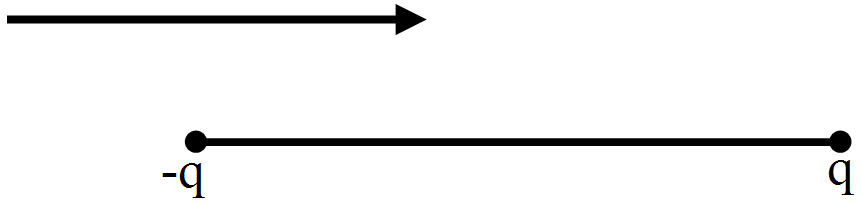
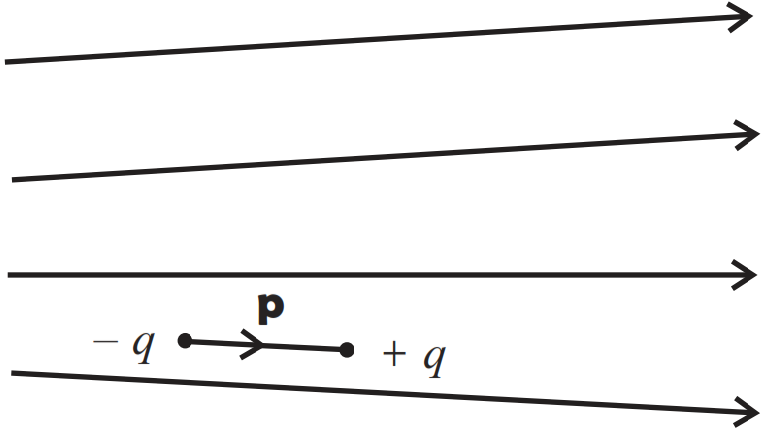
    Figure shows electric field lines in which an electric dipole p is placed as shown. Which of the following statements is correct?

    Answer
    1. The dipole will experience a force towards right.

    We know electric field emerges radially outward from positive point charge.

    In the figure given above, space between field lines is increasing (or density of electric field line is decreasing). In other words, the electric force is decreasing while moving from left to right.

    Thus, the force on charge ‒q is greater than the force on charge +q in turn dipole will experience a force towards left direction.

    View full question & answer
    MCQ 471 Mark
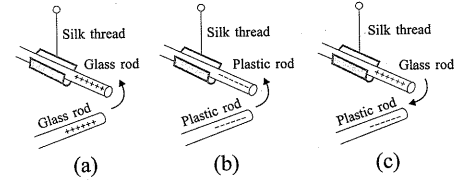
    Which group among the following is insulator?
    • A
      Silver, copper, gold
    • B
      Paper, glass, cotton
    • C
      The human body, wood, iron
    • D
      Glass, copper, paper
    Answer
    1. Paper, glass, cotton

    Explanation:

    Glass, paper, and cotton are good quality insulators. The rest options contain one or more conducting materials. Silver is the best conductor material available in nature. But it is costly, so it can’t be used in the electricity distribution system.

    View full question & answer
    MCQ 481 Mark
    Two point charges 2 C and -6 C attract each other with a force of 12 N. A negative charge of 2 C is added to each of the above charges, now the force between them is:
    • A
      32 N
    • B
      8 N
    • C
      zero
    • D
      4 N
    Answer
    1. zero

    Explanation:

    When -2C is added to 2C and -6C, they become 0C and -8C respectively. Since one of the charges is now zero, the force between them is zero.

    View full question & answer
    MCQ 501 Mark
    Two charges of 10C and -15C are separated in air by 1m.The ratio of force exerted by one on the other is:
    • A
      1 : 2
    • B
      2 : 1
    • C
      1 : 1
    • D
      None of these
    Answer
    1. 1 : 1

    Explanation:

    From Coulomb's law, the forces exerted by one on the other are equal and opposite direction i.e ∣F12​∣ = ∣-F21​

    Thus the required ration will be 1 : 1

    View full question & answer
    Generate Paper FreeAll Electric Charges and Fields topics
    M.C.Q (1 Marks) - Physics STD 12 Science Questions - Vidyadip