MCQ
A sodium cation has a different number of electrons from
  • A
    ${O^{2 - }}$
  • B
    ${F^ - }$
  • $L{i^ - }$
  • D
    $A{l^{3 + }}$

Answer

Correct option: C.
$L{i^ - }$
c
(c) $N{a^ + }\, - \,10$ electron ; $L{i^ - }\, -  4$ electron

Need a full question paper?

Generate a complete, print-ready paper with questions like this in minutes — across 16+ boards, with answer keys.

Start Generating Free

Similar questions

An atom of an element contains 29 electrons and 35 neutrons. The number of protons are:
Match the species given in Column $I$ with the shape given in column $II$ and mark the  correct option:-

Column-$I$ Column-$II$ (Shape)
$(A) \,SF_4$  $(1)$ Tetrahedral
$(B)\, BrF_3$  $(2)$ Pyramidal
$(C)\, BrO_3^-$ $(3)$ Sea-Saw shaped
$(D)\, NH_4^+$ $(4)$ Bent $T-$ shaped


Ethylene reacts with sulphur monochloride to form
$5\,mole$ of $A$, $6\, moles$ of $B$ and excess amount of $C$ are mixed to produce a final product $D$, according to the reaction 
$A + 2B \to I$
$I + C \to B + D$
What is the maximum moles of $D$ can be produced assuming that the products formed can also be reused in the reactions ? .............. $\mathrm{moles}$
Which bonds are formed by a carbon atom with $sp^2$ -hybridisation?
A litre of buffer solution contains $0.1$ mole of each of $NH _3$ and $NH _4 Cl$. On the addition of $0.02\,mole$ of $HCl$ by dissolving gaseous $HCl$, the $pH$ of the solution is found to be $......\times 10^{-3}($ Nearest integer)

$\left[\right.$ Given : $pK _{ b }\left( NH _3\right)=4.745$

$\log 2=0.301$

$\log 3=0.477$

$T =298\,K ]$
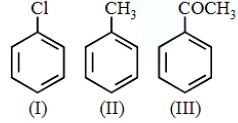
The increasing order of the reactivity of the following compounds towards electrophilic aromatic substitution reaction is
Thiosulphate reacts differently with iodine and bromine in the reactions given below:
$2\text{S}_2\text{O}^{2-}_3+\text{I}\xrightarrow{ \ \ \ \ \ \ \ }\text{S}_4\text{O}^{2-}_6+2\text{I}^{-}$
$\text{S}_2\text{O}^{2-}_3+2\text{Br}_2+5\text{H}_2\text{O}\xrightarrow{ \ \ \ \ \ \ \ }2\text{SO}^{2-}_4+2\text{Br}^{-}+10\text{H}^{+}$
Which of the following statements justifies the above dual behaviour of thiosulphate?
Given below are two statements : One is labelled as Assertion $A$ and the other is labelled as Reason $R$

Assertion $A$ : Thin layer chromatography is an adsorption chromatography.

Reason $R$: A thin layer of silica gel is spread over a glass plate of suitable size in thin layer chromatography which acts as an adsorbent. In the light of the above statements, choose the correct answer from the options given below.

Which is not example of Bronsted Lowry theory