Question
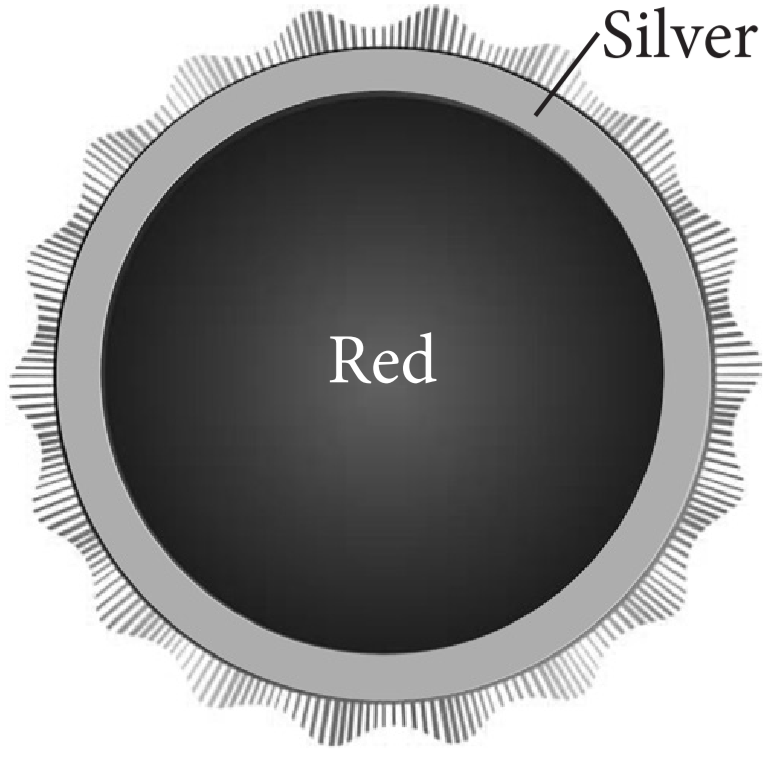
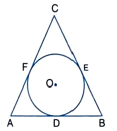
A solar eclipse occurs when the Moon passed between the Earth and the Sun. Following diagram represents the total and partial eclipse.
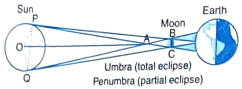
(i) The tangents to the Moon surface from the point $A$ are
(a) $A B$ and $A C$ $\qquad$ (b) $A P$ and $A Q$
(c) $A P$ and $A B$ $\qquad$ (d) $A Q$ and $A C$
(ii) If $\angle P A Q=40^{\circ}$, then the measure of $\angle P O Q$ is
(a) $70^{\circ}$ $\qquad$ (b) $40^{\circ}$ $\qquad$ (c) $50^{\circ}$ $\qquad$ (d) $140^{\circ}$
(iii) If $\angle P O Q=110^{\circ}$, then $\angle Q A O=$
(a) $55^{\circ}$ $\qquad$ (b) $35^{\circ}$ $\qquad$ (c) $70^{\circ}$ $\qquad$ (d) $110^{\circ}$
(iv) If $\angle P O Q=130^{\circ}$, then $\angle O P Q=$
(a) $130^{\circ}$ $\qquad$ (b) $50^{\circ}$ $\qquad$ (c) $65^{\circ}$ $\qquad$ (d) $25^{\circ}$
(i) The tangents to the Moon surface from the point $A$ are
(a) $A B$ and $A C$ $\qquad$ (b) $A P$ and $A Q$
(c) $A P$ and $A B$ $\qquad$ (d) $A Q$ and $A C$
(ii) If $\angle P A Q=40^{\circ}$, then the measure of $\angle P O Q$ is
(a) $70^{\circ}$ $\qquad$ (b) $40^{\circ}$ $\qquad$ (c) $50^{\circ}$ $\qquad$ (d) $140^{\circ}$
(iii) If $\angle P O Q=110^{\circ}$, then $\angle Q A O=$
(a) $55^{\circ}$ $\qquad$ (b) $35^{\circ}$ $\qquad$ (c) $70^{\circ}$ $\qquad$ (d) $110^{\circ}$
(iv) If $\angle P O Q=130^{\circ}$, then $\angle O P Q=$
(a) $130^{\circ}$ $\qquad$ (b) $50^{\circ}$ $\qquad$ (c) $65^{\circ}$ $\qquad$ (d) $25^{\circ}$