Questions

Case study (4 Marks)

🎯

Test yourself on this topic

6 questions · timed · auto-graded

Question 14 Marks
Answer
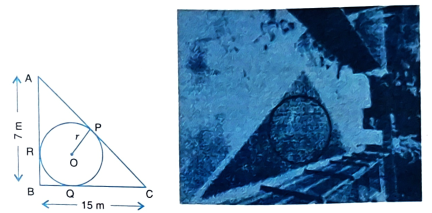
(i) Lengths of tangents drawn from a point to a circle are equal.
$\therefore \quad A P=A R \Rightarrow A R=x \qquad[\because A P=x]$
(ii) In quadrilateral $B Q O R$, we find that
$B Q=Q R$$\qquad$ [Lengths of tangents drawn from $B$ ]
Also, $B Q=O R=r$ and $B R=O Q=r$
$
\therefore \quad B Q=O Q=B R=O R=r
$
Also, $\angle Q B R=90^{\circ}$. Hence, Quad rilateral $B Q O R$ is a square.
(iii) (a) $A P=A R=x$
$
\begin{aligned}
\therefore & & B Q & =B R=7-x \\
& & P C & =Q C \Rightarrow P C=15-(7-x) \Rightarrow P C=8+x
\end{aligned}
$
In right triangle $A B C$, we have
$
A B=7, B C=15 \text { and } A C=A P+P C=x+8+x=8+2 x
$
$
\therefore \quad A C^2=A B^2+B C^2\qquad[Using Pythagoras Theorem]
$
$
\begin{array}{ll}
\Rightarrow & (8+2 x)^2=7^2+15^2 \\
\Rightarrow & 64+32 x+4 x^2=49+225 \Rightarrow 4 x^2+32 x-210=0 \Rightarrow 2 x^2+16 x-105=0 \\
\therefore & x=\frac{-16 \pm \sqrt{16^2-4 \times 2 \times-105}}{4} \Rightarrow x=\frac{-16 \pm \sqrt{1096}}{4}=\frac{-16 \pm 33.10}{2}=4.27
\end{array}
$
(b) We obtain: $x=4.27$
$
\therefore \quad r=B Q=7-x \Rightarrow r=7-4.27=2.73
$
View full question & answer
Question 24 Marks
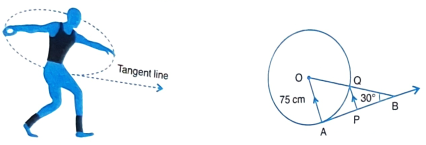
The discus throw is an event in which an athlete attempts to throw a discus. The athlete spins anti-clockwise around one and a half times through a circle, then releases the throw. When released the discus travels along tangent to the circular spin orbit.
Image
In the given figure, $A B$ is one such tangent to a circle of radius 75 cm . Point $O$ is centre of the circle and $\angle A B O=30^{\circ}$. $P Q$ is parallel to $O A$.
Based on above information find the lengths of:
(i) $A B$ $\qquad$ (ii) $O B$ $\qquad$ (iii) $A P$ $\qquad$ (iv) $P Q$
Answer
$A B$ is tangent to the circle at $A$ and $O A$ is radius. Therefore, $\angle O A B=90^{\circ}$
(i) In right triangle $O A B$, we obtain
$
\tan 30^{\circ}=\frac{O A}{A B} \Rightarrow \frac{1}{\sqrt{3}}=\frac{75}{A B} \Rightarrow A B=75 \sqrt{3} cm
$
(ii) Applying Pythagoras theorem in $\triangle O A B$, we obtain
$
\begin{array}{ll}
& O B^2=O A^2+A B^2 \\
\Rightarrow \quad & O B=\sqrt{75^2+(75 \sqrt{3})^2}=\sqrt{75^2(1+3)}=75 \times 2=150 cm \\
\therefore \quad & B Q=O B-O Q=(150-75)=75 cm
\end{array}
$
(iii) $\triangle B A O \sim \triangle B P Q$ by AAA criterion of similarity.
$
\begin{array}{ll}
\therefore & \frac{B A}{B P}=\frac{B O}{B Q}=\frac{O A}{P Q} \\
\Rightarrow & \frac{75 \sqrt{3}}{B P}=\frac{150}{75}=\frac{75}{P Q} \Rightarrow \frac{75 \sqrt{3}}{B P}=2 \text { and } 2=\frac{75}{P Q} \Rightarrow B P=\frac{75}{2} \sqrt{3} \text { and } P Q=37.5 cm \\
\therefore & A P=A B-B P=75 \sqrt{3}-\frac{75}{2} \sqrt{3}=\frac{75}{2} \sqrt{3} cm
\end{array}
$
(iv) $P Q=37.5 cm$.
View full question & answer
Question 34 Marks
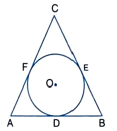
Raghav has been selected by his school to design logo for sports day T-shirts for students and staff. The logo design is as given in the figure and he is working on the fronts and different colours according to the theme. In the given figure, a circle with centre $O$ is inscribed in a $\triangle A B C$, such that it touches the sides $A B, B C$ and $C A$ at points $D, E$ and $F$ respectively. The length of side $A B, B C$ and $C A$ are $12 cm, 8 cm$ and 10 cm respectively.
Image
(i) The length of $A D$ is
(a) 7 cm $\qquad$ (b) 8 cm $\qquad$ (c) 5 cm $\qquad$ (d) 9 cm
(ii) The length of $B E$ is
(a) 8 cm $\qquad$ (b) 5 cm $\qquad$ (c) 2 cm $\qquad$ (d) 9 cm
(iii) CF is of length
(a) 9 cm $\qquad$ (b) 5 cm $\qquad$ (c) 2 cm $\qquad$ d) 3 cm
(iv) If radius of the circle is 4 cm , then area of $\triangle O A B$ is
(a) 20 cm $\qquad$ (b) 36 cm $\qquad$ (c) 24 cm $\qquad$ (d) 48 cm
Answer
Let $s$ be the semi-perimeter of $\triangle A B C$ and $a=B C=8 cm, b=C A=10 cm$ and $c=A B=12 cm$. From example 11 (page 8.13 of main book), we obtain
$
A D=A F=s-a, B E=B D=s-b \text { and } C F=C E=s-c
$
(i) (a): $A D=(s-a)=(15-8) cm =7 cm$
(ii) (b): $B E=(s-b)=(15-10) cm =5 cm$
(iii) (d): $C F=(s-c)=(15-12) cm =3 cm$
(iv) (c): Area of $\triangle O A B=\frac{1}{2}(A B \times O D)=\frac{1}{2}(12 \times 4)=24 cm^2$
View full question & answer
Question 44 Marks
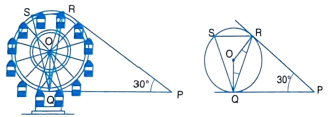
London eye is an amusement ride consisting of a rotating upright big wheel with multiple passenger-carrying components (commonly referred to as passenger cars, cabins, tubs, capsules, gondolas or pods) attached to the rim in such a way that as the wheel turns, they are kept upright usually by gravity. After taking a ride in London eye, Anu came out from the crowd and was observing her friends who were enjoying the ride. She was curious about the different angles and measures that the wheel will form. She makes a figure as given below.
Image
(i) In Fig. the measure of $\angle R O Q$ is
(a) $60^{\circ}$ $\qquad$ (b) $100^{\circ}$ $\qquad$ (c) $150^{\circ}$ $\qquad$ (d) $90^{\circ}$
(ii) In Fig. 8.33, The measure of $\angle R Q P$ is
(a) $75^{\circ}$ $\qquad$ (b) $60^{\circ}$ $\qquad$ (c) $30^{\circ}$ $\qquad$ (d) $90^{\circ}$
(iii) In Fig. 8.33, the measure of $\angle R S Q$ is
(a) $60^{\circ}$ $\qquad$ (b) $75^{\circ}$ $\qquad$ (c) $100^{\circ}$ $\qquad$ (d) $30^{\circ}$
(iv) In Fig. 8.33, the measure of $\angle O R P$ is
(a) $90^{\circ}$ $\qquad$ (b) $70^{\circ}$ $\qquad$ (c) $100^{\circ}$ $\qquad$ (d) $60^{\circ}$
Answer
(i) (c): Clearly, $\angle R P Q+\angle R O Q=180^{\circ}$
$
\Rightarrow \quad 30^{\circ}+\angle R O Q=180^{\circ} \Rightarrow \angle R O Q=150^{\circ}
$
(ii) (a): In $\triangle P Q R$, we have $\angle P R Q=\angle P Q R$ and $\angle Q P R=30^{\circ}$
$
\therefore \quad \angle R Q P+\angle P R Q+\angle Q P R=180^{\circ} \Rightarrow 2 \angle R Q P=180^{\circ}-30^{\circ} \Rightarrow \angle R Q P=75^{\circ}
$
(iii) (b): In $\triangle O Q R$, we find that $\angle O Q R=\angle O R Q=90^{\circ}-75^{\circ}=15^{\circ}$
$
\therefore \quad \angle Q O R=180^{\circ}-15^{\circ}-15^{\circ}=150^{\circ} \Rightarrow \angle R S Q=\frac{1}{2} \angle Q O R=75^{\circ}
$
(iv) (a): The angle between the tangent at a point and the radius is $90^{\circ}$. Therefore, $\angle O R P=90^{\circ}$
View full question & answer
Question 54 Marks
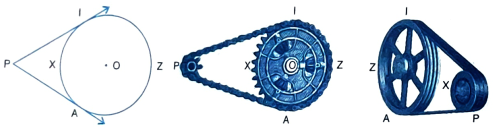
The chain and gears of bicycles or motorcycles or belt around pulleys are some real-life illustrations of tangents to circles.
Image
(i) $P I$ and $P A$ are tangents to the circle from point $P$. If arc $I Z A$ subtends an angle $240^{\circ}$ at the centre of the circle, then $\angle I P A=$
(a) $120^{\circ}$ $\qquad$ (b) $90^{\circ}$ $\qquad$ (c) $60^{\circ}$ $\qquad$ (d) $30^{\circ}$
(ii) If $I P=15 cm$, then $A I=$
(a) 7.5 cm $\qquad$ (b) 15 cm $\qquad$ (c) 30 cm $\qquad$ (d) 18 cm
(iii) If $I P=21 cm$ and measure of $A P$ is $x^2+5$, then $x=$
(a) 4 $\qquad$ (b) 16 $\qquad$ (c) $\sqrt{26}$ $\qquad$ (d) $\sqrt{30}$
(iv) $\angle O I P+\angle A P O=$
(a) $90^{\circ}$ $\qquad$ (b) $60^{\circ}$ $\qquad$ (c) $120^{\circ}$ $\qquad$ (d) $150^{\circ}$
Answer
(i) (c) (ii) (b) (iii) (a) (iv) (c)
View full question & answer
Question 64 Marks
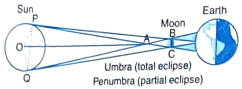
A solar eclipse occurs when the Moon passed between the Earth and the Sun. Following diagram represents the total and partial eclipse.
Image
(i) The tangents to the Moon surface from the point $A$ are
(a) $A B$ and $A C$ $\qquad$ (b) $A P$ and $A Q$
(c) $A P$ and $A B$ $\qquad$ (d) $A Q$ and $A C$
(ii) If $\angle P A Q=40^{\circ}$, then the measure of $\angle P O Q$ is
(a) $70^{\circ}$ $\qquad$ (b) $40^{\circ}$ $\qquad$ (c) $50^{\circ}$ $\qquad$ (d) $140^{\circ}$
(iii) If $\angle P O Q=110^{\circ}$, then $\angle Q A O=$
(a) $55^{\circ}$ $\qquad$ (b) $35^{\circ}$ $\qquad$ (c) $70^{\circ}$ $\qquad$ (d) $110^{\circ}$
(iv) If $\angle P O Q=130^{\circ}$, then $\angle O P Q=$
(a) $130^{\circ}$ $\qquad$ (b) $50^{\circ}$ $\qquad$ (c) $65^{\circ}$ $\qquad$ (d) $25^{\circ}$
Answer
(i) (a) (ii) (d) (iii) (b) (iv) (d)
View full question & answer
Case study (4 Marks) - Maths STD 10 Questions - Vidyadip