Question
A solid aluminium sphere and a solid copper sphere of twice the radius are heated to the same temperature and are allowed to cool under identical surrounding temperatures. Assume that the emissivity of both the spheres is the same. Find the ratio of:
  1. The rate of heat loss from the aluminium sphere to the rate of heat loss from the copper sphere.
  2. The rate of fall of temperature of the aluminium sphere to the rate of fall of temperature of the copper sphere. The specific heat capacity of aluminium $= 900Jkg^{-1^\circ }C^{-1}$ and that of copper $= 390Jkg^{-1^\circ }C^{-1}$. The density of copper $= 3.4$ times the density of aluminium.
Answer

$E \rightarrow $ Energy radiated per unit area per unit time Rate of heat flow $\rightarrow $ Energy radiated
  1. Per time $=\text{E}\times\text{A}$
So, $\text{E}_\text{Al}=\frac{\text{e}\sigma\text{T}^4\times\text{A}}{\text{e}\sigma\text{T}^4\times\text{A}}$
$=\frac{4\pi\text{r}^2}{4\pi(2\text{r})^2}$
$=\frac{1}{4}$ $\big[\therefore1:4\big]$
  1. Emissivity of both are same
$=\frac{\text{m}_1\text{S}_1\text{dT}_1}{\text{m}_2\text{S}_2\text{dT}_2}=1$
$\Rightarrow\frac{\text{dT}_1}{\text{dT}_2}=\frac{\text{m}_2\text{S}_2}{\text{m}_1\text{S}_1}$
$=\frac{\text{s}_14\pi\text{r}_1^3\times\text{S}_2}{\text{s}_24\pi\text{r}_2^3\times\text{S}_1}$
$=\frac{1\times\pi\times900}{3.4\times8\pi\times390}$
$=1:2:9$

Need a full question paper?

Generate a complete, print-ready paper with questions like this in minutes — across 16+ boards, with answer keys.

Start Generating Free

Similar questions

$4 \times 10^{23}$ tritium atoms are contained in a vessel. The half$-$life of decay tritium nuclei is $12.3y$. Find:
  1. The activity of the sample.
  2. The number of decay in the next $10$ hours.
  3. The number of decays in the next $6.15y$.
A $12pF$ capacitor is connected to a $50V$ battery. How much electrostatic energy is stored in the capacitor?
How many time constants will elapse before the energy stored in the capacitor reaches half of its equilibrium value in a charging RC circuit?
The current in a conductor and the potential difference across its ends are measured by an ammeter and a voltmeter. The meters draw negligible currents. The ammeter is accurate but the voltmeter has a zero error (that is, it does not read zero when no potential difference is applied). Calculate the zero error if the readings for two different conditions are 1.75A, 14.4V and 2.75A, 22.4V.
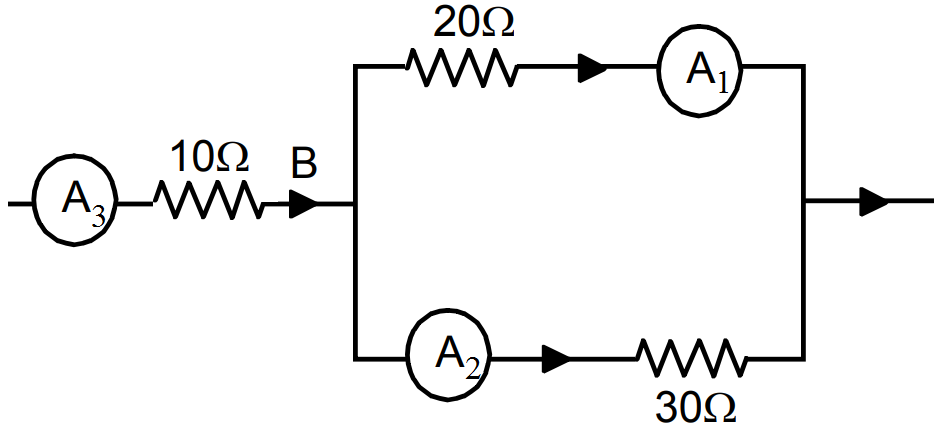
If the reading of the ammeter$, A_1$ in the figure. is $2.4A,$ what will be the readings of ammeters $A_2$ and $A_3$? Neglect the resistances of the ammeters.
Define resistivity of a conductor. Plot a graph showing the variation of resistivity with temperature for a metallic conductor. How does one explain such a behaviour, using the mathematical expression of the resistivity of a material?
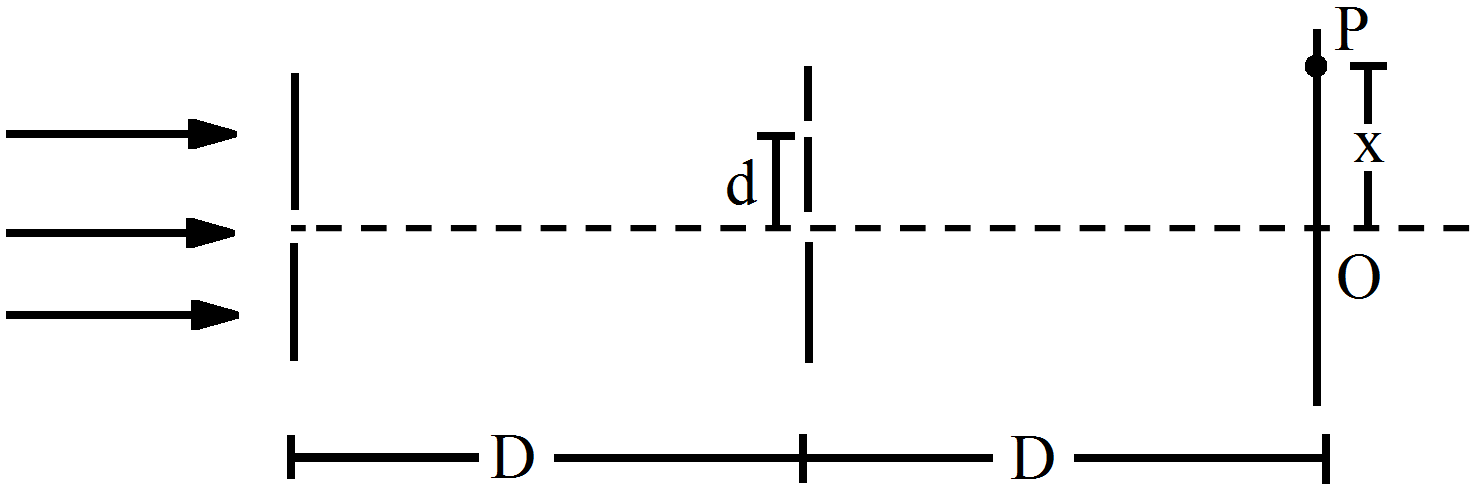
Consider the arrangement shown in figure (17-E4). The distance D is large compared to the separation d between the slits.
  1. Find the minimum value of d so that there is a dark fringe at 0.
  2. Suppose d has this value. Find the distance x at which the next bright fringe is formed.
  3. Find the fringe-width.
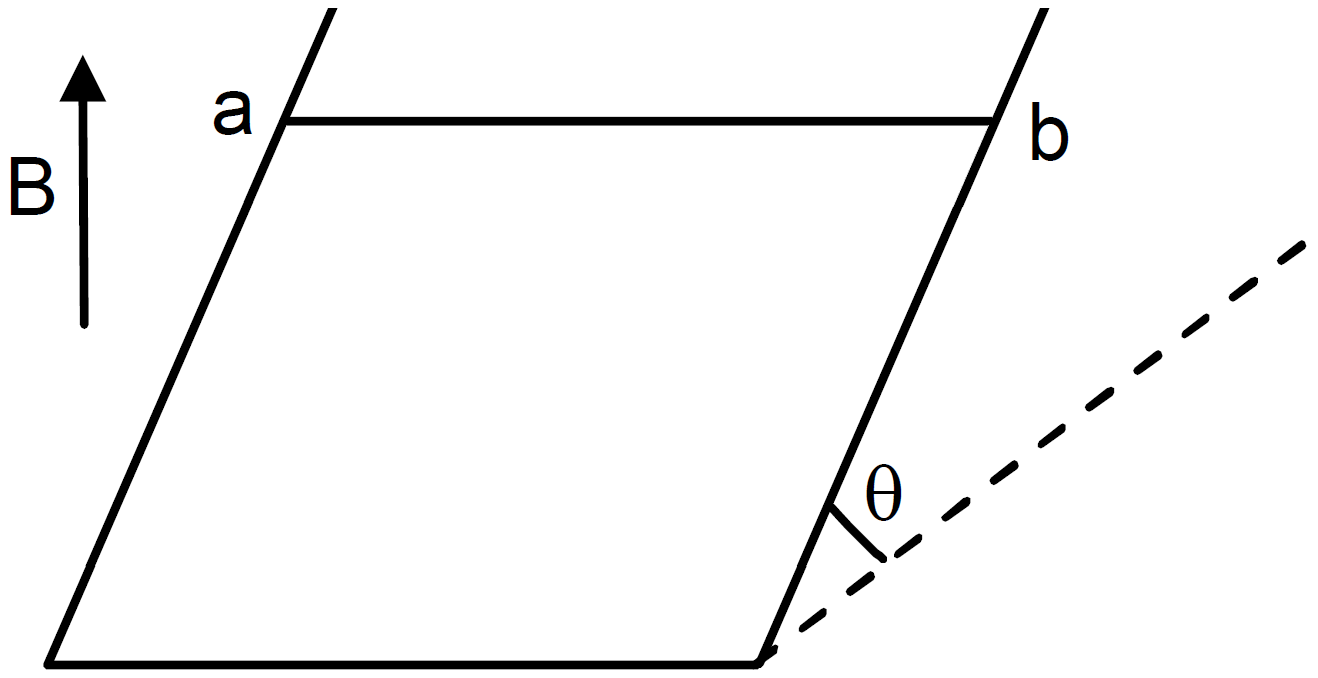
A wire ab of length l, mass m and resistance R slides on a smooth, thick pair of metallic rails joined at the bottom as shown in figure. The plane of the rails makes an angle θ with the horizontal. A vertical magnetic field B exists in the region. If the wire slides on the rails at a constant speed v, show that $\text{B}=\sqrt{\frac{\text{mgR}\sin\theta}{\text{vl}^2\cos^2\theta}}$
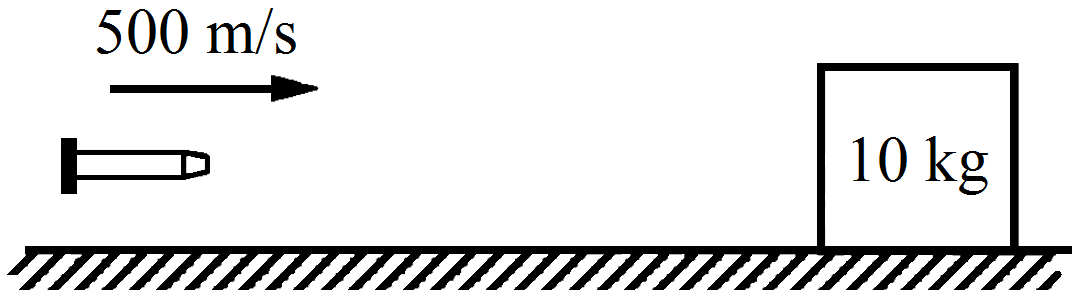
A bullet of mass $20g$ travelling horizontally with a speed of $500m/s$ passes through a wooden block of mass $10.0\ kg$ initially at rest on a level surface. The bullet emerges with a speed of $100m/s$ and the block slides $20\ cm$ on the surface before coming to rest. Find the friction coefficient between the block and the surface.
The temperatures of equal masses of three different liquids $A, B$ and $C$ are $12^\circ C, 19^\circ C$ and $28^\circ C$ respectively. The temperature when $A$ and $B$ are mixed is $16^\circ C,$ and when $B$ and $C$ are mixed, it is $23^\circ C$. What will be the temperature when $A$ and $C$ are mixed?