Question 15 Marks
Steam at $120^\circ C$ is continuously passed through a $50\ cm$ long rubber tube of inner and outer radii $1.0\ cm$ and $1.2\ cm.$ The room temperature is $30^\circ C.$ Calculate the rate of heat flow through the walls of the tube. Thermal conductivity of rubber $= 0.15Js^{-1}m^{-1\ \circ}C^{-1}.$
Answer
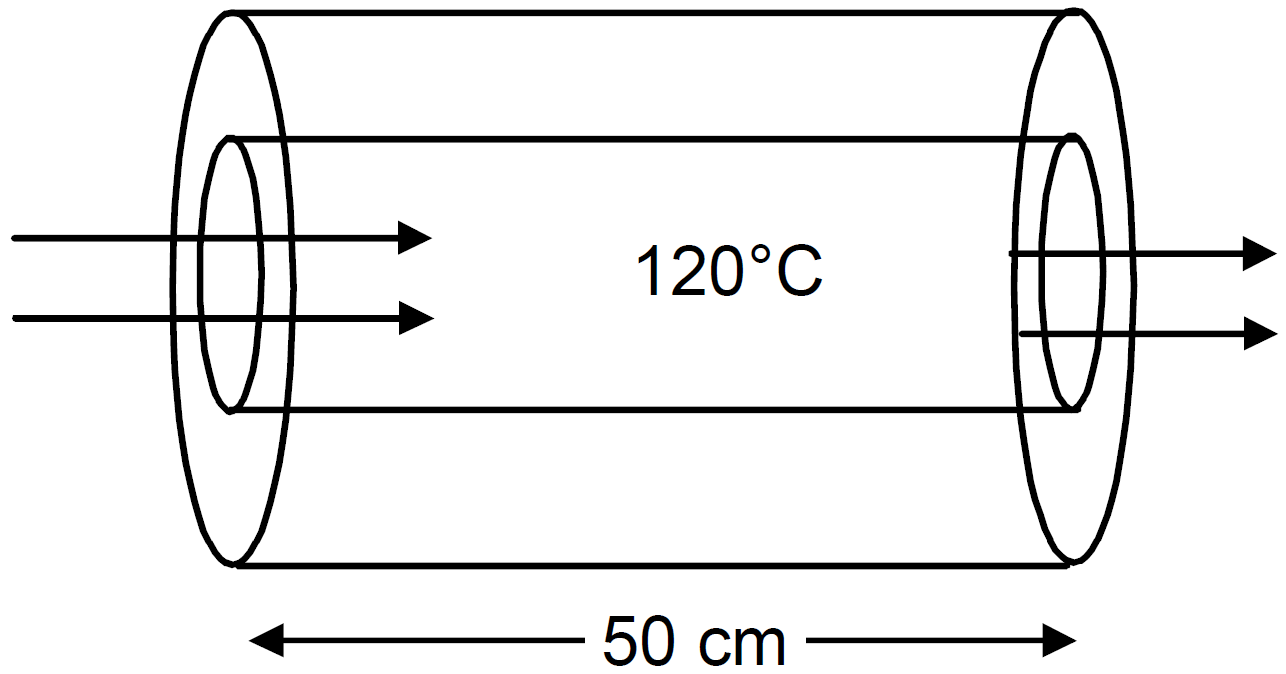 Given, $\text{K}_\text{rubber}=0.15\text{J/m-s-}^\circ\text{C},\ \text{T}_2-\text{T}_1=90^\circ\text{C}$
We know for radial conduction in a Cylinder
$\frac{\text{Q}}{\text{t}}=\frac{2\pi\text{Kl}(\text{T}_2-\text{T}_1)}{\text{ln}\Big(\frac{\text{R}_2}{\text{R}_1}\Big)}$
$=\frac{2\times3.14\times15\times10^{-2}\times50\times10^{-1}\times90}{\text{ln}\Big(\frac{1.2}{1}\Big)}$
$=232.5\approx233\text{J/s}.$ View full question & answer→Question 25 Marks
Seven rods $\ce{A, B, C, D, E, F}$ and $\ce{G}$ are joined as shown in figure. All the rods have equal cross$-$sectional area $A$ and length $l.$ The thermal conductivities of the rods are $\ce{K_A = K_c = K_0, K_B = K_D = 2K_0, K_{E }= 3K_{0,} K_F = 4K_0,}$ and $K_G = 5K_0.$ The rod $E$ is kept at a constant temperature $T_2$ and the rod $\ce{G}$ is kept at a constant temperature $\ce{T_2(T_2 > T_1).}$
- Show that the rod $\ce{F}$ has a uniform temperature $\text{T}=\frac{(\text{T}_1+2\text{T}_2)}{3}.$
- Find the rate of heat flowing from the source which maintains the temperature $\ce{T_2.}$
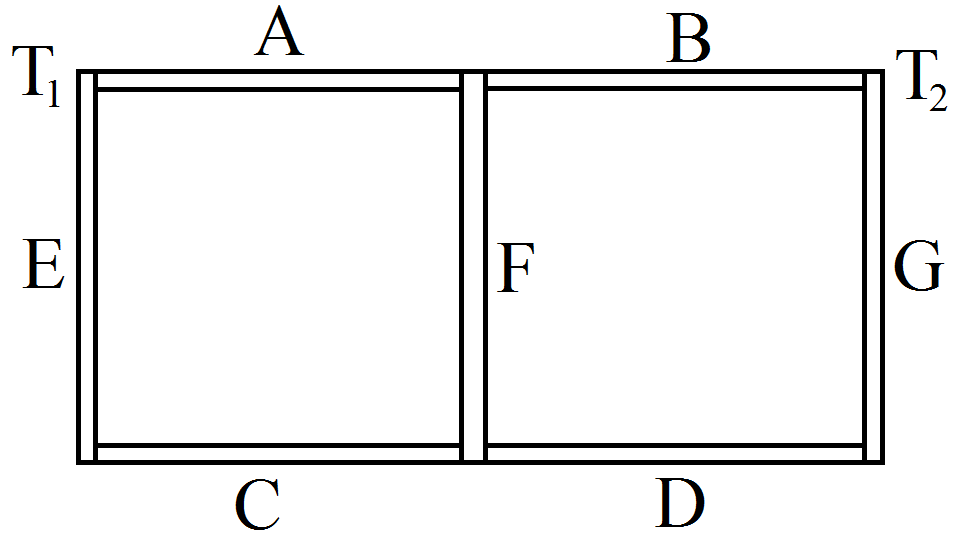
AnswerThe temp at the both ends of bar $F$ is same.
Rate of Heat flow to right = Rate of heat flow through left,
$\Rightarrow\Big(\frac{\text{Q}}{\text{t}}\Big)_\text{A}+\Big(\frac{\text{Q}}{\text{t}}\Big)_\text{C}=\Big(\frac{\text{Q}}{\text{t}}\Big)_\text{B}+\Big(\frac{\text{Q}}{\text{t}}\Big)_\text{D}$
$\Rightarrow\frac{\text{K}_\text{A}(\text{T}_1-\text{T})\text{A}}{\text{l}}+\frac{\text{K}_\text{C}(\text{T}_1-\text{T})\text{A}}{\text{l}}=\frac{\text{K}_\text{B}(\text{T}-\text{T}_2)\text{A}}{\text{l}}+\frac{\text{K}_\text{D}(\text{T}-\text{T}_2)\text{A}}{\text{l}}$
$\Rightarrow2\text{K}_0(\text{T}_1-\text{T})=2\times2\text{K}_0(\text{T}-\text{T}_2)$
$\Rightarrow\text{T}_1-\text{T}=2\text{T}-2\text{T}_2$
$\Rightarrow\text{T}=\frac{\text{T}_1+2\text{T}_2}{3}$
View full question & answer→Question 35 Marks
A calorimeter contains $50g$ of water at $50^\circ C$. The temperature falls to $45^\circ C$ in $10$ minutes. When the calorimeter contains $100g$ of water·at $50^\circ 0$, it takes $18$ minutes for the temperature to become $45^\circ C$. Find the water equivalent of the calorimeter.
AnswerLet the water eq. of calorimeter $= m$
$\frac{(\text{m}+50\times10^{-3})\times4200\times5}{10}=$ Rate of heat flow
$\frac{(\text{m}+50\times10^{-3})\times4200\times5}{18}=$ Rate of flow
$\Rightarrow\frac{(\text{m}+50\times10^{-3})\times4200\times5}{10}=\frac{(\text{m}+50\times10^{-3})\times4200\times5}{18}$
$\Rightarrow(\text{m}+50\times10^{-3})18=10\text{m}+1000\times10^{-3}$
$\Rightarrow18\text{m}+18\times50\times10^{-3}=10\text{m}+1000\times10^{-3}$
$\Rightarrow8\text{m}=100\times10^{-3}\text{kg}$
$\Rightarrow\text{m}=12.5\times10^{-3}\text{kg}=12.5\text{g}$
View full question & answer→Question 45 Marks
An icebox almost completely filled with ice at $0^\circ C$ is dipped into a large volume of water at $20^\circ C.$ The box has walls of surface area $2400\ cm^2,$ thickness $2.0mm$ and thermal conductivity $0.06\text{Wm}^{-1}{^{\circ}}\text{C}^{-1}.$ Calculate the rate at which the ice melts in the box. Latent heat of fusion of ice $= 3.4\times10^5\text{Jkg}^{-1}.$
Answer$\text{A}=2400\text{cm}^2=2400\times10^{-4}\text{m}^2$
$\ell=2\text{mm}=2\times10^{-3}\text{m}$
$\text{K}=0.06\text{w/m-}^\circ\text{C}$
$\theta_1=20^\circ\text{C}$
$\theta_2=0^\circ\text{C}$
$\frac{\text{Q}}{\text{t}}=\frac{\text{KA}(\theta_1-\theta_2)}{\ell}$
$=\frac{0.06\times2400\times10^{-4}\times20}{2\times10^{-3}}$
$=24\times6\times10^{-1}\times10$
$=24\times6=144\text{J/sec}.$
Rate in which ice melts $=\frac{\text{mL}_\text{f}}{\text{t}}$
$\Rightarrow\frac{\Delta\text{Q}}{\Delta\text{t}}=\Big(\frac{\text{m}}{\text{t}}\Big)\text{L}_\text{f}$
$\Rightarrow144=\Big(\frac{\text{m}}{\text{t}}\Big)\times3.4\times10^5$
$\Rightarrow\frac{\text{m}}{\text{t}}=\frac{144}{3.4\times10^{5}}\text{kg/s}$
$\Rightarrow\frac{\text{m}}{\text{t}}=\frac{144\times60\times60}{3.4\times10^5}\text{kg/h}$
$\Rightarrow\frac{\text{m}}{\text{t}}=1.52\text{kg/h}$
View full question & answer→Question 55 Marks
A solid aluminium sphere and a solid copper sphere of twice the radius are heated to the same temperature and are allowed to cool under identical surrounding temperatures. Assume that the emissivity of both the spheres is the same. Find the ratio of:
- The rate of heat loss from the aluminium sphere to the rate of heat loss from the copper sphere.
- The rate of fall of temperature of the aluminium sphere to the rate of fall of temperature of the copper sphere. The specific heat capacity of aluminium $= 900Jkg^{-1^\circ }C^{-1}$ and that of copper $= 390Jkg^{-1^\circ }C^{-1}$. The density of copper $= 3.4$ times the density of aluminium.
Answer$E \rightarrow $ Energy radiated per unit area per unit time Rate of heat flow $\rightarrow $ Energy radiated
- Per time $=\text{E}\times\text{A}$
So, $\text{E}_\text{Al}=\frac{\text{e}\sigma\text{T}^4\times\text{A}}{\text{e}\sigma\text{T}^4\times\text{A}}$
$=\frac{4\pi\text{r}^2}{4\pi(2\text{r})^2}$
$=\frac{1}{4}$ $\big[\therefore1:4\big]$
- Emissivity of both are same
$=\frac{\text{m}_1\text{S}_1\text{dT}_1}{\text{m}_2\text{S}_2\text{dT}_2}=1$
$\Rightarrow\frac{\text{dT}_1}{\text{dT}_2}=\frac{\text{m}_2\text{S}_2}{\text{m}_1\text{S}_1}$
$=\frac{\text{s}_14\pi\text{r}_1^3\times\text{S}_2}{\text{s}_24\pi\text{r}_2^3\times\text{S}_1}$
$=\frac{1\times\pi\times900}{3.4\times8\pi\times390}$
$=1:2:9$ View full question & answer→Question 65 Marks
Why does blowing over a spoonful of hot tea cools it? Does evaporation play a role? Does radiation play a role?
AnswerHere, major role is played by convection. When we blow air over a spoonful of hot tea, the air coming from our mouth has less temperature than the air above the tea. Since hot air has less density, it rises up and cool air goes down. In this way, the tea cools down.
We know that any hot body radiates.
So, the spoonful of tea will also radiate and as the temperature of the surrounding is less then the tea, the tea will cool down with time. Evaporation is also involved in this. On blowing over the hot tea, rate of evaporation increases and the cools down.
View full question & answer→Question 75 Marks
A pitcher with $1\ mm$ thick porous walls contains $10\ kg$ of water. Water comes to its outer surface and evaporates at the rate of $0.1gs^{-1}.$ The surface area of the pitcher $($one side$)= 200\ cm^2.$ The room temperature $= 42^\circ C,$ latent heat of vaporization $ =2.27\times10^6\text{Jkg}^{-1},$ and the thermal conductivity of the porous walls $=0.80\text{Js}^{-1}\text{m}^{-1}{^{\circ}}\text{C}^{-1}.$ Calculate the temperature of water in the pitcher when it attains a constant value.
Answer$\ell=1\text{mm}=10^{-3}\text{m},\ \text{m}=10\text{kg}$
$\text{A}=200\text{cm}^2=2\times10^{-2}\text{m}^2$
$\text{L}_\text{vap}=2.27\times10^6\text{J/kg}$
$\text{K}=0.80\text{J/m-s-}^\circ\text{C}$
$\text{dQ}=2.27\times10^6\times10,$
$\frac{\text{dQ}}{\text{dt}}=\frac{2.27\times10^7}{10^5}$
$=2.27\times10^2\text{J/s}$
Again we know
$\frac{\text{dQ}}{\text{dt}}=\frac{0.80\times2\times10^{-2}\times(42-\text{T})}{1\times10^{-3}}$
So, $\frac{8\times2\times10^{-3}(42-\text{T})}{10^{-3}}=2.27\times10^2$
$\Rightarrow16\times42-16\text{T}$
$\Rightarrow\text{T}=27.8\approx28^\circ\text{C}$
View full question & answer→Question 85 Marks
Find the rate of heat flow through a cross section of the rod shown in figure, $\big(\theta_2>\theta_1\big).$ Thermal conductivity of the material of the rod is K.
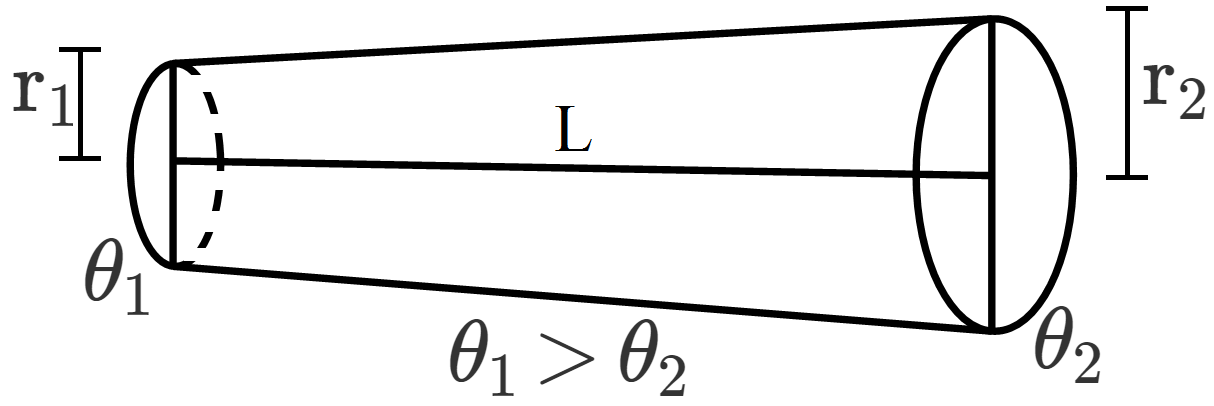
Answer$\phi=\frac{\text{r}_2-\text{r}_1}{\text{L}}=\frac{(\text{y}-\text{r}_1)}{\text{x}}$
$\Rightarrow\text{x}\text{r}_2-\text{x}\text{r}_1=\text{yL}-\text{r}_1\text{L}$
Differentiating wr to ‘x’
$\Rightarrow\text{r}+2\text{r}_1=\frac{\text{Ldy}}{\text{dx}}-0$
$\Rightarrow\frac{\text{dy}}{\text{dx}}=\frac{\text{r}_2-\text{r}_1}{\text{L}}$
$\Rightarrow\text{dx}=\frac{\text{dyL}}{(\text{r}_2-\text{r}_1)}\ \dots(1)$
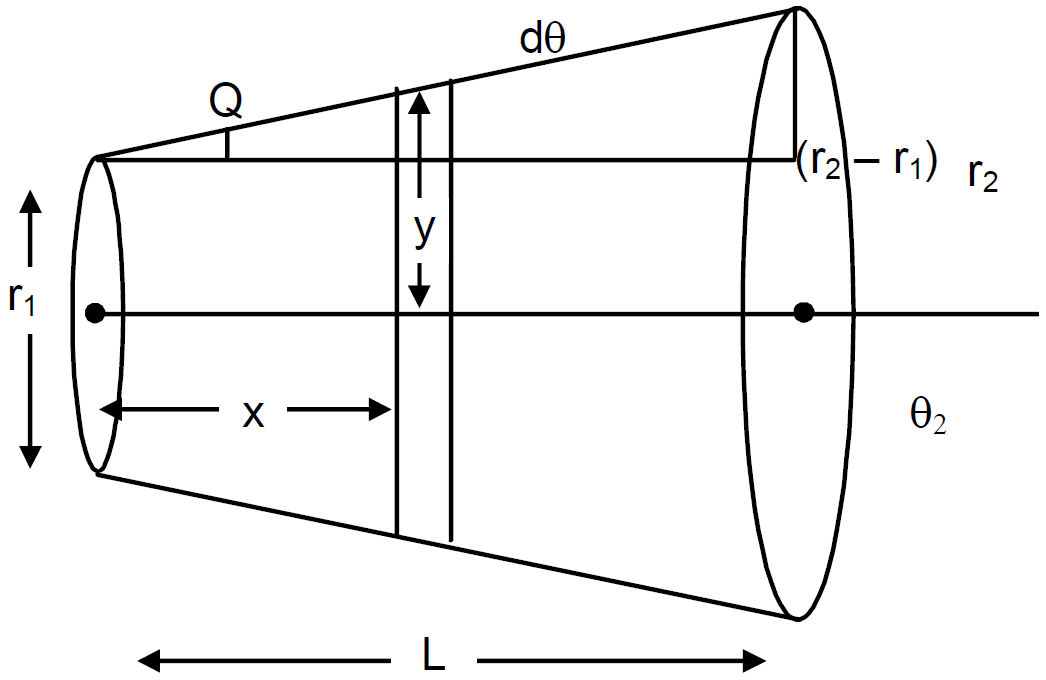
Now $\frac{\text{Q}}{\text{T}}=\frac{\text{K}\pi\text{y}^2\text{d}\theta}{\text{dx}}$
$\Rightarrow\frac{\theta\text{dx}}{\text{T}}=\text{K}\pi\text{y}^2\text{d}\theta$
$\Rightarrow\frac{\theta\text{Ldy}}{\text{r}_2\text{r}_1}=\text{K}\pi\text{y}^2\text{d}\theta$ from(1)
$\Rightarrow\text{d}\theta\frac{\text{QLdy}}{(\text{r}_2-\text{r}_1)\text{K}\pi\text{y}^2}$
Integrating both side
$\Rightarrow\int\limits_{\theta_1}^{\theta_2}\text{d}\theta=\frac{\text{QL}}{(\text{r}_2-\text{r}_1)\text{K}\pi}\int\limits^{\text{r}_2}_{\text{r}_1}\frac{\text{dy}}{\text{y}}$
$\Rightarrow(\theta_2-\theta_1)=\frac{\text{QL}}{(\text{r}_2-\text{r}_1)}\times\Big[\frac{-1}{\text{y}}\Big]^{\text{r}_2}_{\text{r}_1}$
$\Rightarrow(\theta_2-\theta_1)=\frac{\text{QL}}{(\text{r}_2-\text{r}_1)\text{K}\pi}\times\Big[\frac{1}{\text{r}_1}-\frac{1}{\text{r}_2}\Big]$
$\Rightarrow(\theta_2-\theta_1)=\frac{\text{QL}}{(\text{r}_2-\text{r}_1)\text{K}\pi}\times\Big[\frac{\text{r}_2-\text{r}_1}{\text{r}_1+\text{r}_2}\Big]$
$\Rightarrow\text{Q}=\frac{\text{K}\pi\text{r}_1\text{r}_2(\theta_2-\theta_1)}{\text{L}}$ View full question & answer→Question 95 Marks
A calorimeter of negligible heat capacity contains $100cc$ of water at $40^\circ C.$ The water cools to $35^\circ C$ in $5$ minutes. The water is now replaced by $K-$oil of equal volume at $40^\circ C.$ Find the time taken for the temperature to become $35^\circ C$ under similar conditions. Specific heat capacities of water and $K-$oil are $4200\ Jkg^{-1}K^{-1}$ and $2100\ Jkg^{-1}K^{-1}$ respectively. Density of $K-$oil $= 800\ kgm^3.$
Answer$\text{v}=100\text{cc}$
$\triangle\theta=5^\circ\text{C}$
$\text{t}=5\text{ min}$
For water
$\frac{\text{mS}\triangle\theta}{\text{dt}}=\frac{\text{KA}}{\text{l}}\triangle\theta$
$\Rightarrow\frac{100\times10^{-3}\times1000\times4200}{5}=\frac{\text{KA}}{\text{l}}$
For Kerosene
$\frac{\text{ms}}{\text{at}}=\frac{\text{KA}}{\text{l}}$
$\Rightarrow\frac{100\times10^{-3}\times800\times2100}{\text{t}}=\frac{\text{KA}}{\text{l}}$
$\Rightarrow\frac{100\times10^{-3}\times800\times2100}{\text{t}}=\frac{100\times10^{-3}\times1000\times4200}{5}$
$\Rightarrow\text{T}=\frac{5\times800\times2100}{1000\times4200}=2\text{ min}$
View full question & answer→Question 105 Marks
Two identical metal balls one at $\text{T}_1=300\text{K}$ and the other at $\text{T}_2=600\text{K}$ are kept at a distance of 1m in vacuum. Will the temperatures equalise by radiation? Will the rate of heat gained by the colder sphere be proportional to $\text{T}_2^4-\text{T}_1^4$ as may be expected from the Stefan's law?
AnswerYes, the temperature of the balls can be equalised by radiation. This is because both the spheres will emit radiations in all the directions at different rates.
The ball kept at the temperature of 300K will gain some thermal energy by the radiation emitted by the ball kept at the temperature of 600K. Also, it losses energy by radiation.
Similarly, the ball kept at the temperature of 600K will gain some thermal energy by the radiation emitted by the ball kept at the temperature of 600K. Also, it losses energy by radiation.
A time comes when the temperature of both the bodies becomes equal.
Yes, the rate of heat gained by the colder sphere is proportional to $\text{T}_2^4-\text{T}_1^4$
View full question & answer→Question 115 Marks
Two bodies of masses $m_1$ and $m_2$ and specific heat capacities $s_1$ and $s_2$ are connected by a rod of length $l,$ cross$-$sectional area $A,$ thermal conductivity $K$ and negligible heat capacity. The whole system is thermally insulated. At time $t = 0,$ the temperature of the first body is $T_1$ and the temperature of the second body is $T_2 (T_2 > T_1).$ Find the temperature difference between the two bodies at time $t.$
Answer$\frac{\text{Q}}{\text{t}}=\frac{\text{KA}(\text{T}_1-\text{T}_2)}{\text{L}}$
Rise in Temp. in $\text{T}_2\Rightarrow\frac{\text{KA}(\text{T}_1-\text{T}_2)}{\text{Lm}_1\text{s}_1}$ Fall in Temp in $\text{T}_1\Rightarrow\frac{\text{KA}(\text{T}_1-\text{T}_2)}{\text{Lm}_2\text{s}_2}$
Final Temp. $\text{T}_1=\text{T}_1-\frac{\text{KA}(\text{T}_1-\text{T}_2)}{\text{Lm}_1\text{s}_1}$ Final Temp. $\text{T}_2=\text{T}_2+\frac{\text{KA}(\text{T}_1-\text{T}_2)}{\text{Lm}_1\text{s}_1}$
$\Rightarrow\frac{\triangle\text{T}}{\text{dt}}=\text{T}_1-\frac{\text{KA}(\text{T}_1-\text{T}_2)}{\text{Lm}_1\text{s}_1}-\text{T}_2-\frac{\text{KA}(\text{T}_1-\text{T}_2)}{\text{Lm}_2\text{s}_2}\\ =(\text{T}_1-\text{T}_2)-\Big[\frac{\text{KA}(\text{T}_1-\text{T}_2)}{\text{Lm}_1\text{s}_1}+\frac{\text{KA}(\text{T}_1-\text{T}_2)}{\text{Lm}_2\text{s}_2}\Big]$
$\Rightarrow\frac{\text{dT}}{\text{dt}}=\frac{\text{KA}(\text{T}_1-\text{T}_2)}{\text{L}}\Big(\frac{1}{\text{m}_1\text{s}_1}+\frac{1}{\text{m}_2\text{s}_2}\Big)$
$\Rightarrow\frac{\text{dT}}{(\text{T}_1-\text{T}_2)}=\frac{\text{KA}}{\text{L}}\Big(\frac{\text{m}_2\text{s}_2+\text{m}_1\text{s}_2}{\text{m}_1\text{s}_1\text{m}_2\text{s}_2}\Big)\text{dt}$
$\Rightarrow\text{ln}\triangle\text{t}=-\frac{\text{KA}}{\text{L}}\Big(\frac{\text{m}_2\text{s}_2+\text{m}_1\text{s}_2}{\text{m}_1\text{s}_1\text{m}_2\text{s}_2}\Big)\text{t}+\text{C}$
At time $\text{t}=0,\ \text{T}=\text{T}_0,\ \triangle\text{T}=\triangle\text{T}_0$ $\Rightarrow\text{C}=\text{ln}\triangle\text{T}_0$
$\Rightarrow\text{ln}\frac{\triangle\text{T}}{\triangle\text{T}_0}=-\frac{\text{KA}}{\text{L}}\Big(\frac{\text{m}_2\text{s}_2+\text{m}_1\text{s}_2}{\text{m}_1\text{s}_1\text{m}_2\text{s}_2}\Big)\text{t}$
$\Rightarrow\frac{\triangle\text{T}}{\triangle\text{T}_0}=\text{e}^{\frac{\text{KA}}{\text{L}}\Big(\frac{\text{m}_2\text{s}_2+\text{m}_1\text{s}_2}{\text{m}_1\text{s}_1\text{m}_2\text{s}_2}\Big)\text{t}}$
$\Rightarrow\triangle\text{T}=\triangle\text{T}_0\text{e}^{\frac{\text{KA}}{\text{L}}\Big(\frac{\text{m}_2\text{s}_2+\text{m}_1\text{s}_2}{\text{m}_1\text{s}_1\text{m}_2\text{s}_2}\Big)\text{t}}\\=(\text{T}_2-\text{T}_1)\text{e}^{\frac{\text{KA}}{\text{L}}\Big(\frac{\text{m}_2\text{s}_2+\text{m}_1\text{s}_2}{\text{m}_1\text{s}_1\text{m}_2\text{s}_2}\Big)\text{t}}$
View full question & answer→Question 125 Marks
The left end of a copper rod $($length $= 20\ cm$ area of cross section $= 0.20\ cm)$ is maintained at $20^\circ C$ and the right end is maintained at $80^\circ C.$ Neglecting any loss of heat through radiation, find,
- The temperature at a point $11\ cm$ from the left end
- The heat current through the rod. Thermal conductivity of copper $=385\text{Wm}^{-1}{^{\circ}}\text{C}^{-1}.$
Answer$\ell=20\text{cm}=20\times10^{-2}\text{m}$ $\text{A}=0.2\text{cm}^2=0.2\times10^{-4}\text{m}^2$ $\theta_1=\text{80}^\circ\text{C},\ \theta_2-20^\circ\text{C},\ \text{K}=385$
- $\frac{\text{Q}}{\text{t}}=\frac{\text{KA}(\theta_1-\theta_2)}{\ell}$
$=\frac{385\times0.2\times10^{-4}(80-20)}{20\times10^{-2}}$
$=385\times6\times10^{-4}\times10$
$=2310\times10^{-3}=2.31$
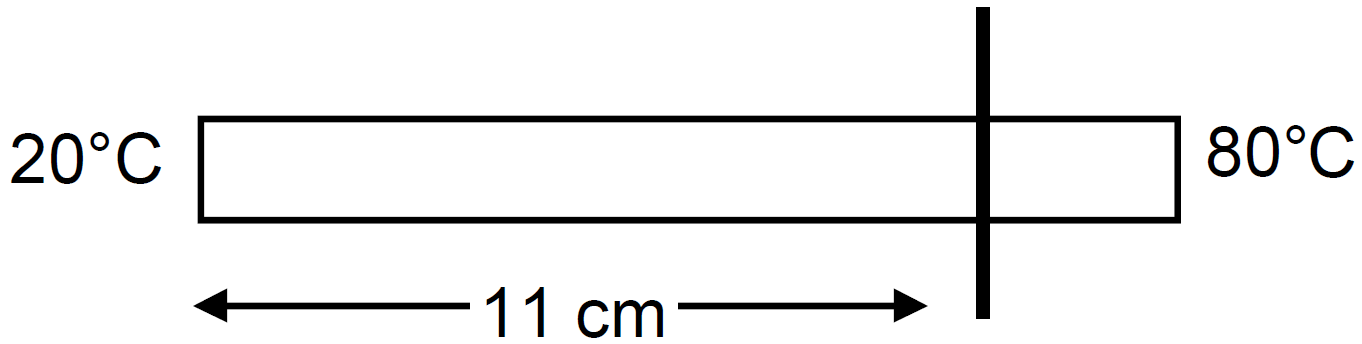
- Let the temp of the $11\ cm$ point be $\theta$
$\frac{\triangle\theta}{\triangle\text{l}}=\frac{\text{Q}}{\text{tKA}}$
$\Rightarrow\frac{\triangle\theta}{\triangle\text{l}}=\frac{2.31}{385\times0.2\times10^{-4}}$
$\Rightarrow\frac{\theta-20}{11\times10^{-2}}=\frac{2.31}{385\times0.2\times10^{-4}}$
$\Rightarrow\theta-20=\frac{2.31\times10^4}{385\times0.2}\times11\times10^{-2}=33$
$\Rightarrow\theta=33+20=53^\circ\text{C}$ View full question & answer→Question 135 Marks
Water at $50^\circ C$ is filled in a closed cylindrical vessel of height $10\ cm$ and cross sectional area $10\ cm^2.$ The walls of the vessel are adiabatic but the flat parts are made of $1mm$ thick aluminium $(\text{K}=200\ \text{Js}^{-1}\text{m}^{-1}{^{\circ}}\text{C}^{-1}).$ Assume that the outside temperature is $20^\circ C.$ The density of water is $1000\ kgm^{-3},$ and the specific heat capacity of water $= 4200\ \text{Jkg}^{-1}{^{\circ}}\text{C}^{-1}.$ Estimate the time taken for the temperature to fall by $1.0^\circ C.$ Make any simplifying assumptions you need but specify them.
Answer$\text{A}=10\text{cm}^2,\ \text{h}=10\text{cm}$
$\frac{\triangle\text{Q}}{\triangle\text{t}}=\frac{\text{KA}(\theta_1-\theta_2)}{\ell}$
$=\frac{200\times10^{-3}\times30}{1\times10^{-3}}$
$=6000$
Since heat goes out from both surfaces. Hence net heat coming out.
$=\frac{\triangle\text{Q}}{\triangle\text{t}}=6000\times2=12000,$ $\Big[\frac{\triangle\text{Q}}{\triangle\text{t}}=\text{Ms}\frac{\triangle\theta}{\theta\text{t}}\Big]$
$\Rightarrow6000\times2=10^{-3}\times10^{-1}1000\times4200\times\frac{\triangle\theta}{\triangle\text{t}}$
$\Rightarrow\frac{\triangle\theta}{\triangle\text{t}}=\frac{72000}{420}$
$=28.57$
So, in $1\ Sec. 28.57^\circ C$ is dropped
Hence for drop of $1^\circ\text{C}\frac{1}{28.57}\text{sec}.$
$=0.0.35\ \text{sec}.$ is required.
View full question & answer→Question 145 Marks
A metal block of heat capacity $80J^\circ C^{-1}$ placed in a room at $20^\circ C$ is heated electrically. The heater is switched off when the temperature reaches $30^\circ C.$ The temperature of the block rises at the rate of $2^\circ Cs^{-1}$ just after the heater is switched on and falls at the rate of $0.2^\circ Cs^{-1}$ just after the heater is switched off. Assume Newton's law of cooling to hold.
- Find the power of the heater.
- Find the power radiated by the block just after the heater is switched off.
- Find the power radiated by the block when the temperature of the block is $25^\circ C.$
- Assuming that the power radiated at $25^\circ C$ represents the average value in the heating process, find the time for which the heater was kept on.
AnswerGiven: Heat capacity $= m \times s = 80J/^\circ C\ \Big(\frac{\text{d}\theta}{\text{dt}}\Big)_\text{increase}=2^\circ\text{C/s}$ $\Big(\frac{\text{d}\theta}{\text{dt}}\Big)_\text{decrease}=0.2^\circ\text{C/s}$
- Power of heater $=\text{mS}\Big(\frac{\text{d}\theta}{\text{dt}}\Big)_\text{increasing}=80\times2=160\text{W}$
- Power radiated $=\text{mS}\Big(\frac{\text{d}\theta}{\text{dt}}\Big)_\text{decreasing}=80\times0.2=16\text{W}$
- Now $\text{mS}\Big(\frac{\text{d}\theta}{\text{dt}}\Big)_\text{decreasing}=\text{K}(\text{T}-\text{T}_0)$
$\Rightarrow16=\text{K}(30-20)$
$\Rightarrow\text{K}=\frac{16}{10}=1.6$
Now, $\frac{\text{d}\theta}{\text{dt}}=\text{K}(\text{T}-\text{T}_0)$
$=1.6\times(30-25)=1.6\times5$
$=8\text{W}$
- $\text{P.t}=\text{H}$
$\Rightarrow8\times\text{t}$ View full question & answer→Question 155 Marks
A hollow tube has a length $l_1$ inner radius $R_1$ and outer radius $R_2$. The material has a thermal conductivity $K$. Find the heat flowing through the walls of the tube if.
- The flat ends are maintained at temperatures $T_1$ and $T_2(T_2 > T_1)$
- The inside of the tube is maintained at temperature $T_1$ and the outside is maintained at $T_2.$
Answer$\text{T}_1>\text{T}_2$
$\text{A}=\pi\big(\text{R}_2^2-\text{R}_1^2\big)$
So. $\text{Q}=\frac{\text{KA}(\text{T}_2-\text{T}_1)}{\text{l}}$
$=\frac{\text{KA}\big(\text{R}_2^2-\text{R}_1^2\big)(\text{T}_2-\text{T}_1)}{\text{l}}$
Considering a concentric cylindrical shell of radius ‘r’ and thickness ‘dr’. The radial heat flow through the shell
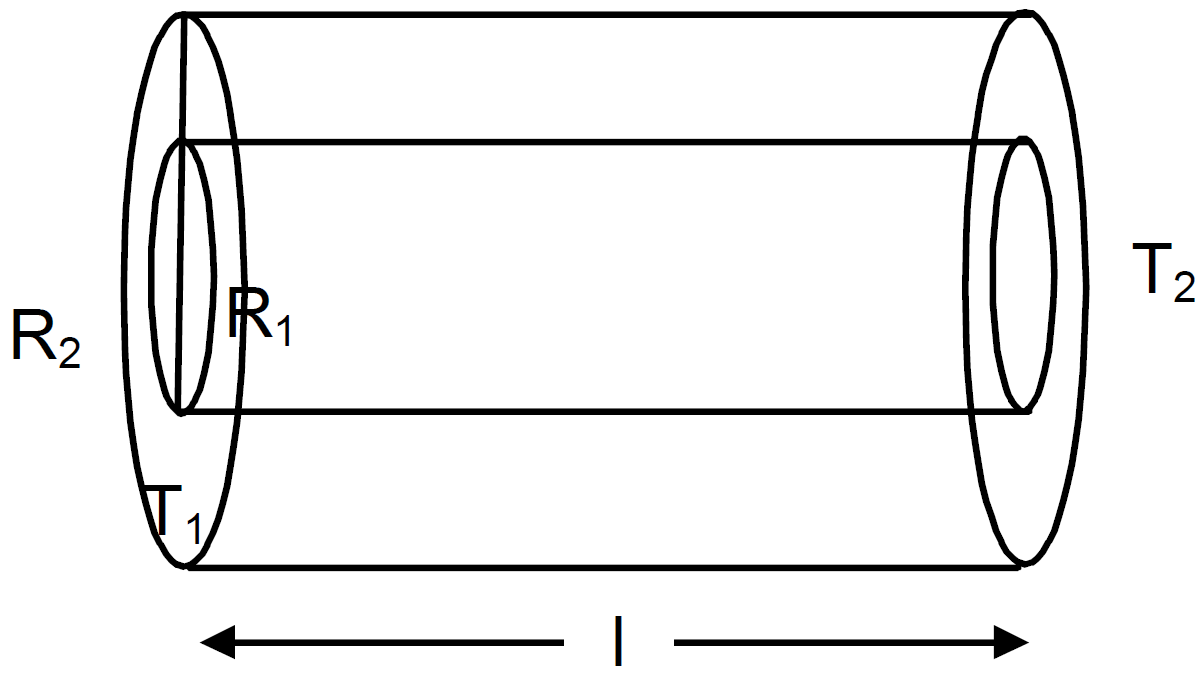
$\text{H}=\frac{\text{dQ}}{\text{dt}}=-\text{KA}\frac{\text{d}\theta}{\text{dt}}$ [(-)ve because as r - increases $\theta$ decreases]
$\text{A}=2\pi\text{rl},\ \text{H}=-2\pi\text{rl}\text{K}\frac{\text{d}\theta}{\text{dt}}$
$\Rightarrow\int\limits_{\text{R}_1}^{\text{R}_2}\frac{\text{dr}}{\text{r}}$
$=-\frac{2\pi\text{LK}}{\text{H}}\int\limits^{\text{T}_2}_{\text{T}_1}\text{d}\theta$
Integrating and simplifying we get
$\text{H}=\frac{\text{dQ}}{\text{dt}}$
$=\frac{2\pi\text{KL}(\text{T}_2-\text{T}_1)}{\text{Loge}\Big(\frac{\text{R}_2}{\text{R}_1}\Big)}$
$=\frac{2\pi\text{KL}(\text{T}_2-\text{T}_1)}{\text{ln}\Big(\frac{\text{R}_2}{\text{R}_1}\Big)}$ View full question & answer→Question 165 Marks
Figure, shows two adiabatic vessels, each containing a mass m of water at different temperatures. The ends of a metal rod of length L, area of cross section A and thermal conductivity K, are inserted in the water as shown in the figure. Find the time taken for the difference between the temperatures in the vessels to become half of the original value. The specific heat capacity of water is s. Neglect the heat capacity of the rod and the container and any loss of heat to the atmosphere.
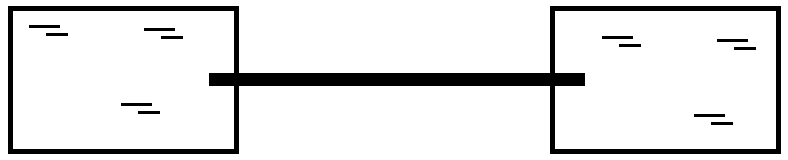
Answer$\frac{\text{Q}}{\text{t}}=\frac{\text{KA}(\text{T}_1-\text{T}_2)}{\text{L}}$
Rise in Temp. in $\text{T}_2\Rightarrow\frac{\text{KA}(\text{T}_1-\text{T}_2)}{\text{Lms}}$ Fall in Temp in $\text{T}_1=\frac{\text{KA}(\text{T}_1-\text{T}_2)}{\text{Lms}}$
Final Temp. $\text{T}_1\Rightarrow\text{T}_1-\frac{\text{KA}(\text{T}_1-\text{T}_2)}{\text{Lms}}$ Final Temp $\text{T}_2=\text{T}_2+\frac{\text{KA}(\text{T}_1-\text{T}_2)}{\text{Lms}}$
Final $\frac{\triangle\text{T}}{\text{dt}}=\text{T}_1-\frac{\text{KA}(\text{T}_1-\text{T}_2)}{\text{Lms}}-\text{T}_2-\frac{\text{KA}(\text{T}_1-\text{T}_2)}{\text{Lms}}$
$=(\text{T}_1-\text{T}_2)-\frac{2\text{KA}(\text{T}_1-\text{T}_2)}{\text{Lms}}=\frac{\text{dT}}{\text{dt}}$
$=-\frac{2\text{KA}(\text{T}_1-\text{T}_2)}{\text{Lms}}$
$\Rightarrow\int\limits^{(\text{T}_1-\text{T}_2)}_{(\text{T}_1-\text{T}_2)}\frac{\text{dt}}{(\text{T}_1-\text{T}_2)}=\frac{-2\text{KA}}{\text{Lms}}\text{dt}$
$\Rightarrow\text{ln}\frac{\frac{(\text{T}_1-\text{T}_2)}{2}}{(\text{T}_1-\text{T}_2)}=\frac{-2\text{KAt}}{\text{Lms}}$
$\Rightarrow\text{ln}\Big(\frac{1}{2}\Big)=\frac{-2\text{KAt}}{\text{Lms}}$
$\Rightarrow\text{ln}_2=\frac{2\text{KAt}}{\text{Lms}}$
$\Rightarrow\text{t}=\text{ln}_2\frac{\text{lms}}{2\text{KA}}$
View full question & answer→Question 175 Marks
A hot body placed in a surrounding of temperature $\theta_0$ obeys Newton's law of cooling $\frac{\text{d}\theta}{\text{dt}}=-\text{k}(\theta-\theta_0).$ Its temperature at $t = 0$ is $\theta_1.$ The specific heat capacity of the body is s and its mass is m. Find,
- The maximum heat that the body can lose.
- The time starting from $t = 0$ in which it will lose $90\%$ of this maximum heat.
Answer$\frac{\text{d}\theta}{\text{dt}}=-\text{K}(\text{T}-\text{T}_0)$ Temp. at t = 0 is $\theta_1$
- Max. Heat that the body can loose $\triangle\text{Q}_\text{m}=\text{ms}(\theta_1-\theta_2)$
$\big(\therefore\text{as},\ \triangle\text{t}=\theta_1-\theta_0\big)$
- If the body loses $90\%$ of the max heat the decrease in its temp. will be
$\frac{\triangle\text{Q}_\text{m}\times9}{10\text{ms}}=\frac{(\theta_1-\theta_0)\times9}{10}$
If it takes time $t_1$, for this process, the temp. at $t_1$
$=\theta_1-(\theta_1-\theta_0)\frac{9}{10}$
$=\frac{10\theta_1-9\theta_1-9\theta_0}{10}$
$=\frac{\theta_1-9\theta_0}{10}\times1\ \dots(1)$
Now, $\frac{\text{d}\theta}{\text{dt}}=-\text{K}(\theta-\theta_1)$
Let $\theta=\theta_1$ at $\text{t}=0;$ and $\theta$ be temp. at time t
$\int\limits^\theta_{\theta_1}\frac{\text{d}\theta}{\theta_1-\theta}=-\text{K}\int\limits_0^\text{t}\text{dt}$
$\text{ln}\frac{\theta-\theta_0}{\theta_1-\theta_0}=-\text{Kt}$
$\theta-\theta_0=(\theta_1-\theta_0)\text{e}^{-\text{Kt}}\ \dots(2)$
Putting value in the Eq. $(1)$ and Eq. $(2)$
$\frac{\theta_1-9\theta_0}{10}-\theta_0=(\theta_1-\theta_0)\text{e}^{-\text{Kt}}$
$\Rightarrow\text{t}_1=\frac{\text{ln}10}{\text{k}}$ View full question & answer→Question 185 Marks
A rod of negligible heat cafacity has length $20\ cm,$ area of cross section $1.0\ cm$ and thermal conductivity $200\ Wm^{-1^\circ }C^{-1}.$ The temperature of one end is maintained at $0^\circ C$ and that of the other end is slowly and linearly varied from $0^\circ C$ to $60^\circ C$ in $10$ minutes. Assuming no loss of heat through the sides, find the total heat transmitted through the rod in these $10$ minutes.
Answer$\frac{\text{d}\theta}{\text{dt}}=\frac{60}{10\times60}=0.1^\circ\text{C/sec}$
$\frac{\text{dQ}}{\text{dt}}=\frac{\text{Ka}}{\text{d}}(\theta_1-\theta_2)$
$=\frac{\text{KA}\times0.1}{\text{d}}+\frac{\text{KA}\times0.2}{\text{d}}+_{\dots}+\frac{\text{KA}\times60}{\text{d}}$
$=\frac{\text{KA}}{\text{d}}(0.1+0.2+_{\dots}+60)$
$=\frac{\text{KB}}{\text{d}}\times\frac{600}{2}\times(2\times0.1+599\times0.1)$
$\Big[\therefore\text{a}+2\text{a}+_{\dots}+\ \text{na}=\frac{\text{n}}{2}\big\{2\text{a}+(\text{n}-1)\text{a}\big\}\Big]$
$=\frac{200\times1\times10^{-4}}{20\times10^{-2}}\times300\times(0.2+59.9)$
$=\frac{200\times10^{-2}\times300\times60.1}{20}$
$=3\times10\times60.1$
$=1803\text{w}\approx1800\text{w}$
View full question & answer→Question 195 Marks
The two rods shown in figure, have identical geometrical dimensions. They are in contact with two heat baths at temperatures $100^\circ C$ and $0^\circ C.$ The temperature of the junction is $70^\circ C.$ Find the temperature of the junction if the rods are interchanged.
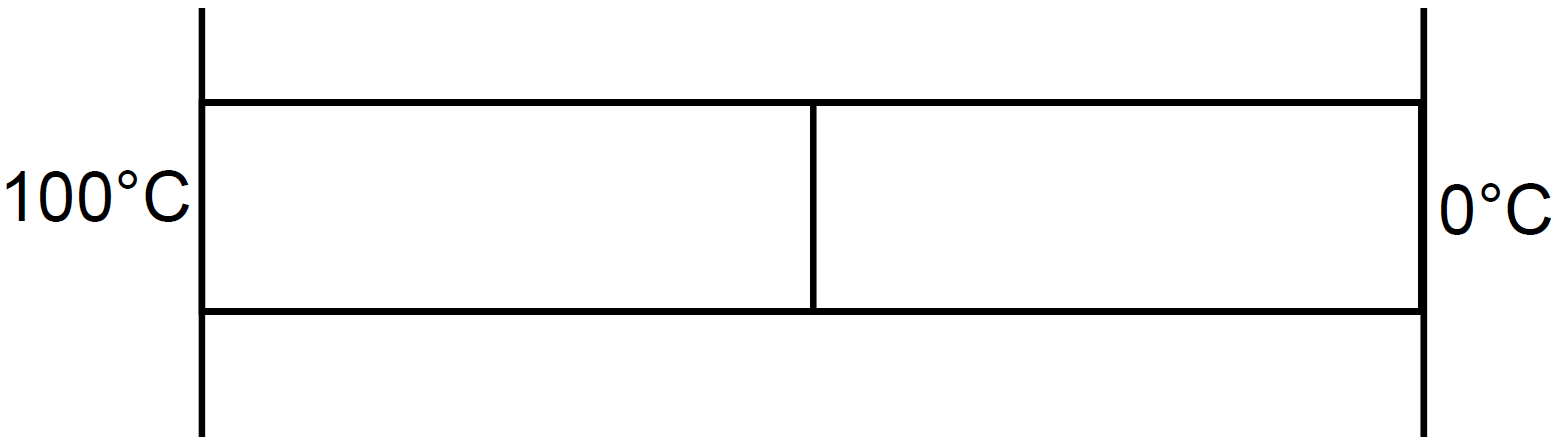
AnswerNow, $\frac{\text{Q}}{\text{t}} $ remains same in both cases
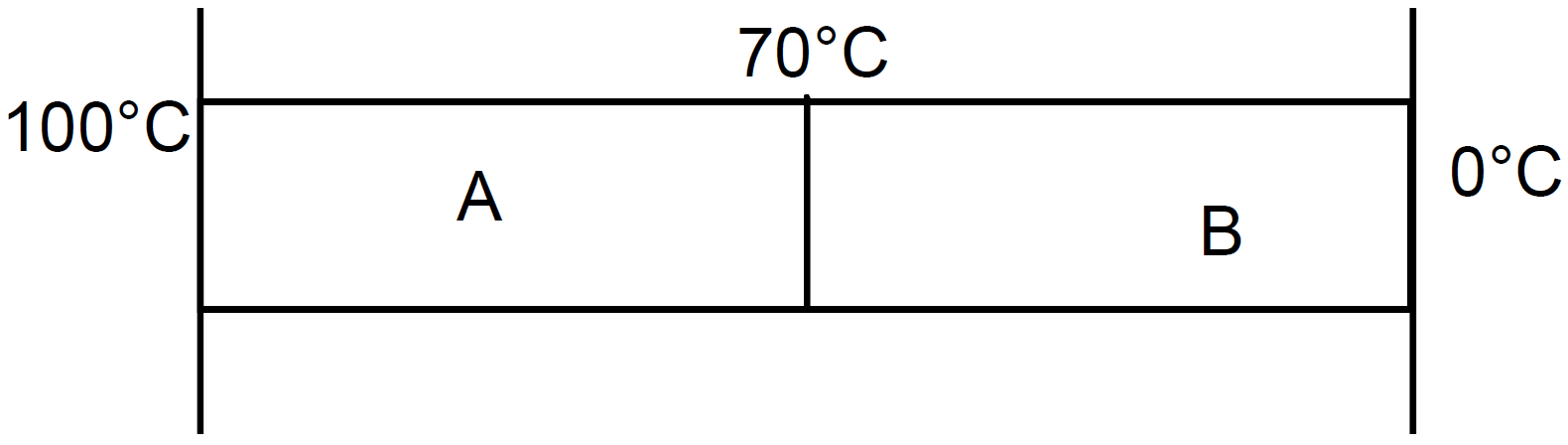
In case $I: \frac{\text{K}_\text{A}\text{XA}\times(100-70)}{\ell}=\frac{\text{K}_\text{B}\times\text{A}\times(70-0)}{\ell}$
$\Rightarrow30\text{K}_\text{A}=70\text{K}_\text{B}$
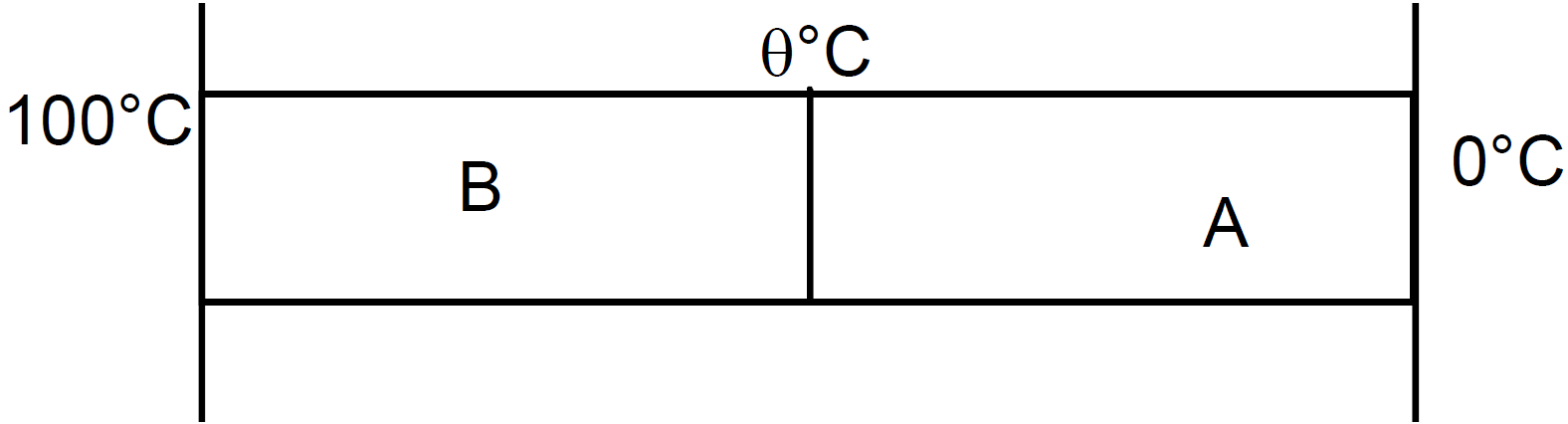
In case $II: \frac{\text{K}_\text{B}\text{XA}\times(100-70)}{\ell}=\frac{\text{K}_\text{A}\times\text{A}\times(\theta-0)}{\ell}$
$\Rightarrow100\text{K}_\text{B}-\text{K}_\text{B}\theta=\text{K}_\text{A}\theta$
$\Rightarrow100\text{K}_\text{B}-\text{K}_\text{B}\theta=\frac{70}{30}\text{K}_\text{B}\theta$
$\Rightarrow100=\frac{7}{3}\theta+\theta$
$\Rightarrow\theta=\frac{300}{10}=30^\circ\text{C}$ View full question & answer→MCQ 205 Marks
A metal ball of mass $1\ kg $is heated by means of a $20W$ heater in a room at $20^\circ C$. The temperature of the ball becomes steady at $50^\circ C.$
- A
Find the rate of loss of heat to the surrounding when the ball is at $50^\circ C.$
- B
Assuming Newton's law of cooling, calculate the rate of loss of heat to the surrounding when the ball is at $30^\circ C.$
- C
Assume that the temperature of the ball rises uniformly from $20^\circ$ c to $30^\circ C$ in $5$ minutes. Find the total loss of heat to the surrounding during this period.
- D
Calculate the specific heat capacity of the metal.
AnswerIn steady state condition as no heat is absorbed, the rate of loss of heat by conduction is equal to that of the supplied.
i.e., $H = P m = 1\ Kg$, Power of Heater $= 20W$, Room Temp. $= 20^\circ C$
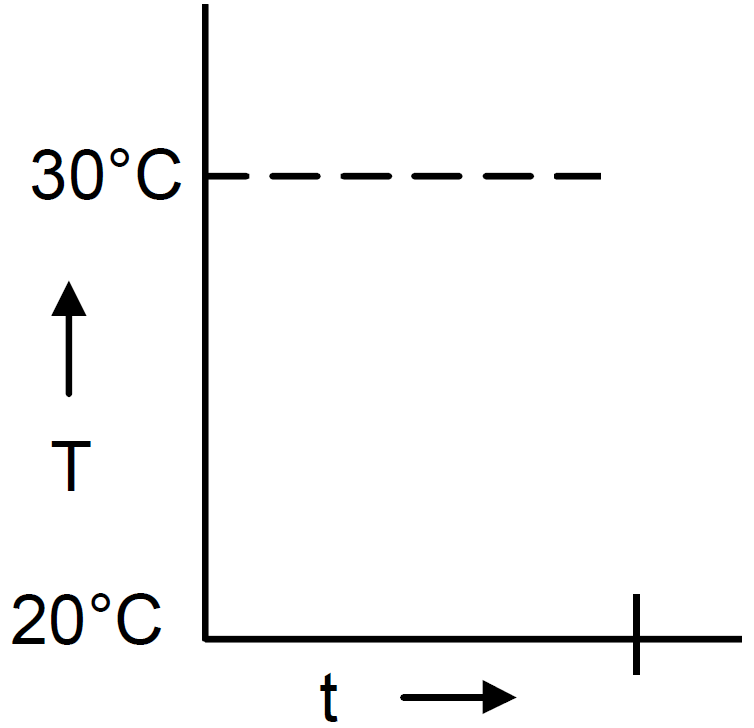
- $\text{H}=\frac{\text{d}\theta}{\text{dt}}$
$\text{P}=20\text{ Watt}$
- By Newton’s law of cooling
$\frac{-\text{d}\theta}{\text{dt}}=\text{K}(\theta-\theta_0)$
$-20=\text{K}(50-20)$
$\Rightarrow\text{K}=\frac{2}{3}$
Again, $\frac{-\text{d}\theta}{\text{dt}}=\text{K}(\theta-\theta_0)$
$=\frac{2}{3}\times(30-20)$
$=\frac{20}{3}\text{w}$
- $\Big(\frac{\text{dQ}}{\text{dt}}\Big)_{20}=0,\ \Big(\frac{\text{dQ}}{\text{dt}}\Big)_{30}=\frac{20}{3},\ \Big(\frac{\text{dQ}}{\text{dt}}\Big)_\text{avg}=\frac{10}{3}$
$\text{T}=5\text{ min}=300$
Heat liberated $=\frac{10}{3}\times300=1000\text{J}$
Net Heat absorbed $=$ Heat supplied $-$ Heat Radiated
$= 6000 - 1000 = 5000J$
Now, $\text{m}\triangle\theta'=5000$
$\Rightarrow\text{S}=\frac{5000}{\text{m}\triangle\theta}$
$=\frac{5000}{1\times10}$
$=5000\text{Jkg}^{-1}{^{\circ}}\text{C}^{-1}$ View full question & answer→Question 215 Marks
A hollow metallic sphere of radius $20\ cm$ surrounds a concentric metallic sphere of radius $5\ cm.$ The space between the two spheres is filled with a nonmetallic material. The inner and outer spheres are maintained at $50^\circ C$ and $10^\circ C$ respectively and it is found that $100J$ of heat passes from the inner sphere to the outer sphere per second. Find the thermal conductivity of the material between the spheres.
Answer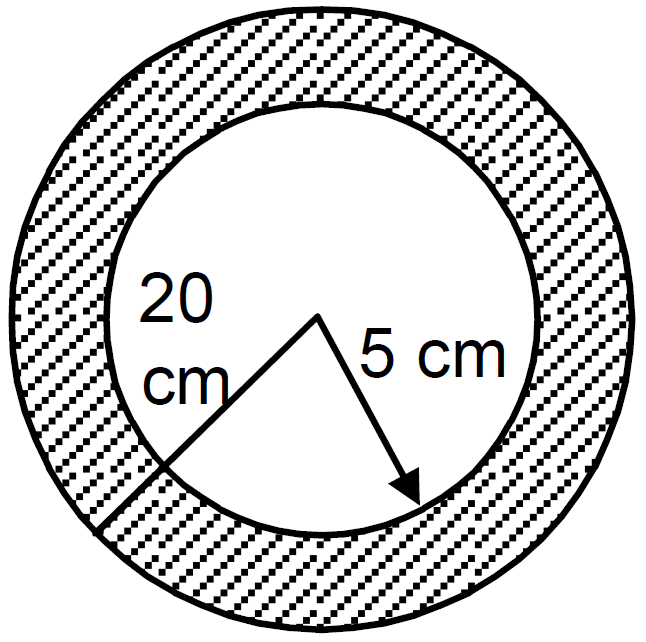
$\text{a}=\text{r}_1=5\text{cm}=0.05\text{m}$
$\text{b}=\text{r}_2=20\text{cm}=0.2\text{m}$
$\theta_1=\text{T}_1=50^\circ\text{C},\ \theta_2=\text{T}_2=10^\circ\text{C}$
Now, considering a small strip of thickness $‘dr\ ’$ at a distance $‘r\ ’$
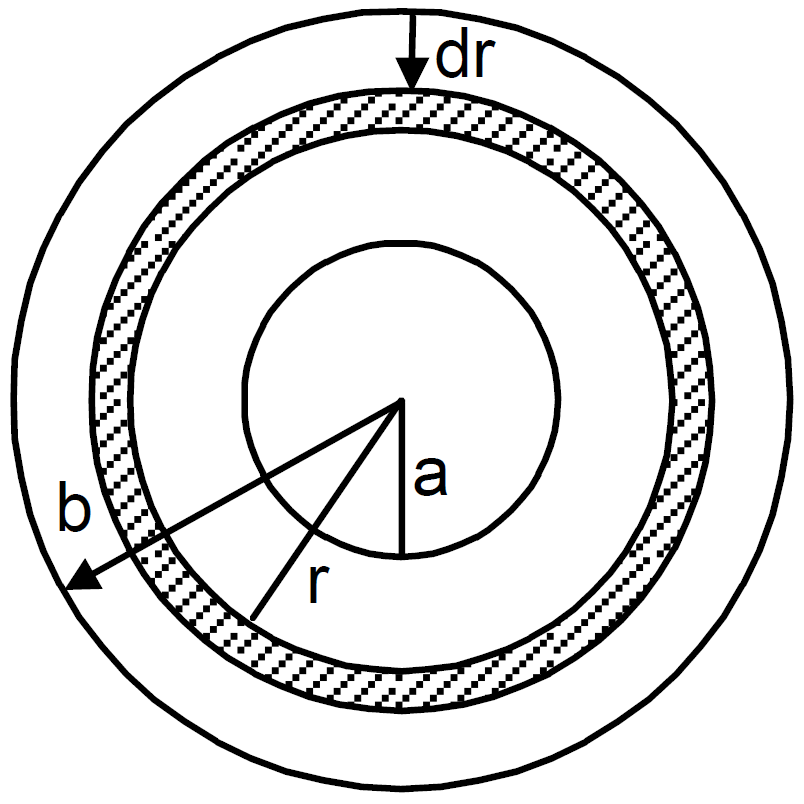
$\text{A}=4\pi\text{r}^2$
$\text{H}=-4\pi\text{r}^2\text{K}\frac{\text{d}\theta}{\text{dr}} [(-)ve$ because with increase of $r, \theta$ decreases$]$
$=\int\limits_\text{a}^\text{b}\frac{\text{dr}}{\text{r}^2}=\frac{-4\pi\text{K}}{\text{H}}\int\limits^{\theta_2}_{\theta_1}\text{d}\theta$ On integration
$\text{H}=\frac{\text{dQ}}{\text{dt}}=\text{K}\frac{4\pi\text{ab}(\theta_1-\theta_2)}{(\text{b}-\text{a})}$
Putting the values we get
$\frac{\text{K}\times4\times3.14\times5\times20\times40\times10^{-3}}{15\times10^{-2}}=100$
$\Rightarrow\text{K}=\frac{15}{4\times3.14\times4\times10^{-1}}$
$=2.985\approx3\text{w/m-}^\circ\text{C}$ View full question & answer→Question 225 Marks
A metal rod of cross sectional area $1.0\ cm^2$ is being heated at one end. At one time, the temperature gradient is $5.0^\circ C/cm^{-1}$ at cross section A and is $2.5^\circ C/cm^{-1}$ at cross section $B$. Calculate the rate at which the temperature is increasing in the part $AB$ of the rod. The heat capacity of the part $AB = 0.40J^\circ C^{-1}$, thermal conductivity of the material of the rod $= 200Wm^{-1^\circ }C^{-1}$. Neglect any loss of heat to the atmosphere.
AnswerThe rate of heat flow per sec.
$=\frac{\text{dQ}_\text{A}}{\text{dt}}=\text{KA}\frac{\text{d}\theta}{\text{dt}}$
The rate of heat flow per sec.
$=\frac{\text{dQ}_\text{A}}{\text{dt}}=\text{KA}\frac{\text{d}\theta}{\text{dt}}$
The rate of heat flow per sec.
$=\frac{\text{dQ}_\text{B}}{\text{dt}}=\text{KA}\frac{\text{d}\theta_\text{B}}{\text{dt}}$
This part of heat is absorbed by the red.
$=\frac{\text{Q}}{\text{t}}=\frac{\text{ms}\triangle\theta}{\text{dt}}$
Where $\frac{\text{d}\theta}{\text{dt}}$ = Rate of net temp. variation
$\Rightarrow\frac{\text{msd}\theta}{\text{dt}}=\text{KA}\frac{\text{d}\theta_\text{A}}{\text{dt}}-\text{KA}\frac{\text{d}\theta_\text{B}}{\text{dt}}$
$\Rightarrow\text{ms}\frac{\text{d}\theta}{\text{dt}}=\text{KA}\Big(\frac{\text{d}\theta_\text{A}}{\text{dt}}-\frac{\text{d}\theta_\text{B}}{\text{dt}}\Big)$
$\Rightarrow0.4\times\frac{\text{d}\theta}{\text{dt}}=200\times1\times10^{-4}(5-2.5)^\circ\text{C/cm}$
$\Rightarrow0.4\times\frac{\text{d}\theta}{\text{dt}}=200\times10^{-4}\times2.5$
$\Rightarrow\frac{\text{d}\theta}{\text{dt}}=\frac{200\times2.5\times10^{-4}}{0.4\times10^{-2}}\ {^\circ\text{C/m}}=1250\times10^{-2}=12.5^\circ\text{C/m}$
View full question & answer→Question 235 Marks
A spherical tungsten piece of radius $1.0\ cm$ is suspended in an evacuated chamber maintained at $300K.$ The piece is maintained at $1000K$ by heating it electrically. Find the rate at which the electrical energy must be supplied. The emissivity of tungsten is $0.30$ and the Stefan constant $\sigma$ is $6.0 \times 10^{-8}Wm^{-2}K^{-4}.$
Answer$\text{r}=1\text{cm}=1\times10^{-3}\text{m}$
$\text{A}=4\pi(10^{-2})^2$
$=4\pi\times10^{-4}\text{m}^2$
$\text{E}=0.3,\ \sigma=6\times10^{-8}$
$\frac{\text{E}}{\text{t}}=\text{A}\sigma\text{e}\big(\text{T}^4_1-\text{T}^4_2)$
$=0.3\times6\times10^{-8}\times4\pi\times10^{-4}\times\big[(100)^4-(300)^4\big]$
$=0.3\times6\times4\pi\times10^{-12}\times\big[1-0.0081\big]\times10^{-12}$
$=0.3\times6\times4\times3.14\times9919\times10^{-4}$
$=4\times10\times3.14\times9919\times10^{-5}$
$=22.4\approx22\text{W}$
View full question & answer→Question 245 Marks
A body cools down from $50^\circ C$ to $45^\circ C$ in $5$ minutes and to $40^\circ C$ in another $8$ minutes. Find the temperature of the surrounding.
Answer$50^\circ\text{C},\ 45^\circ\text{C},\ 40^\circ\text{C}$
Let the surrounding temperature be $'T\ ’^\circ C$
Avg. $\text{t}=\frac{50+45}{2}=47.5$
Avg. temp. diff. from surrounding $\text{T}=47.5-\text{T}$
Rate of fall of temp $=\frac{50-45}{5}=1^\circ\text{C/mm}$
From Newton’s Law $1^\circ\text{C/mm}=\text{bA}\times\text{t}$
$\Rightarrow\text{bA}=\frac{1}{\text{t}}$
$=\frac{1}{47.5-\text{T}}\ \dots(1)$
In second case,
Avg, temp $=\frac{40+45}{2}=42.5$
Avg. temp. diff. from surrounding $\text{t}'=42.5-\text{t}$
Rate of fall of temp $=\frac{45-40}{8}=\frac{5}{8}\ ^\circ\text{C/mm}$
From Newton’s Law $\frac{5}{\text{B}}=\text{bAt}'$
$\Rightarrow\frac{5}{8}=\frac{1}{(47.5-\text{T})}\times(42.5-\text{T})$
By $C D [$Componendo Dividendo method$]$
We find, $\text{T}=34.1^\circ\text{C}$
View full question & answer→Question 255 Marks
A steel frame $(\text{K}=45\text{Wm}^{-1}{^{\circ}}\text{C}^{-1})$of total length $60\ cm$ and cross sectional area $0.20\ cm^2,$ forms three sides of a square. The free ends are maintained at $20^\circ C$ and $40^\circ C.$ Find the rate of heat flow through a cross section of the frame.
Answer
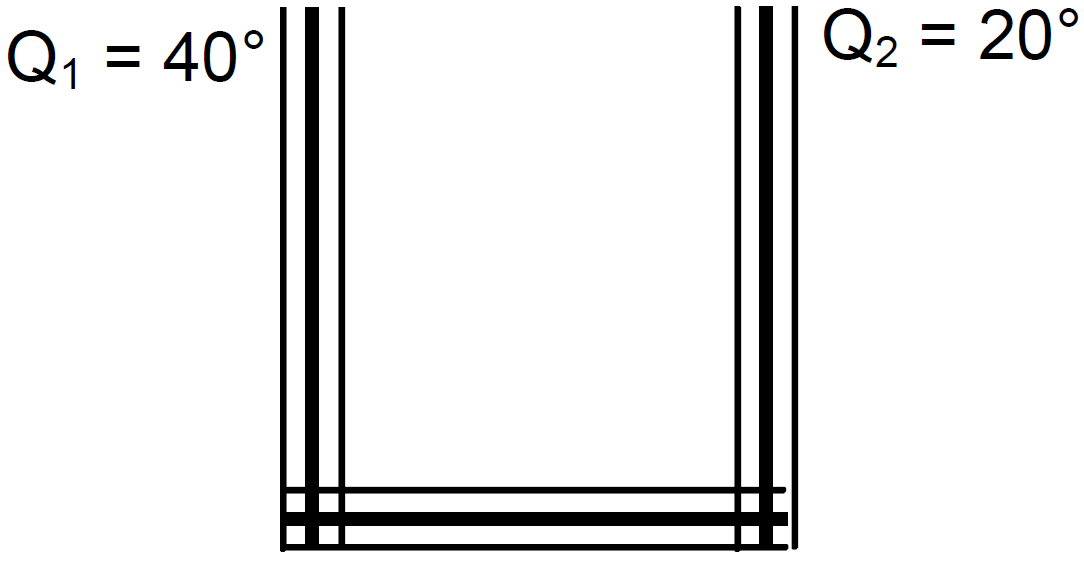 $\text{K}=45\text{w/m-}^\circ\text{C}$
$\ell=60\text{cm}=60\times10^{-2}\text{m}$
$\text{A}=0.2\text{cm}^2=0.2\times10^{-4}\text{m}^2$
Rate of heat flow,
$=\frac{\text{KA}(\theta_1-\theta_2)}{\ell}$
$=\frac{45\times0.2\times10^{-4}\times20}{60\times10^{-2}}$
$=30\times10^{-3}=0.03\text{w}$ View full question & answer→Question 265 Marks
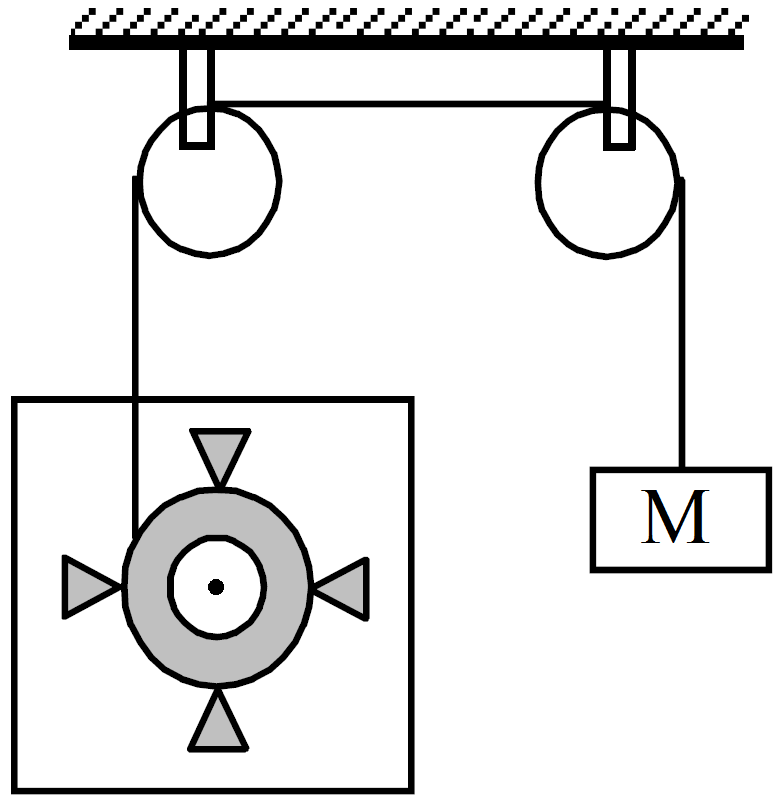
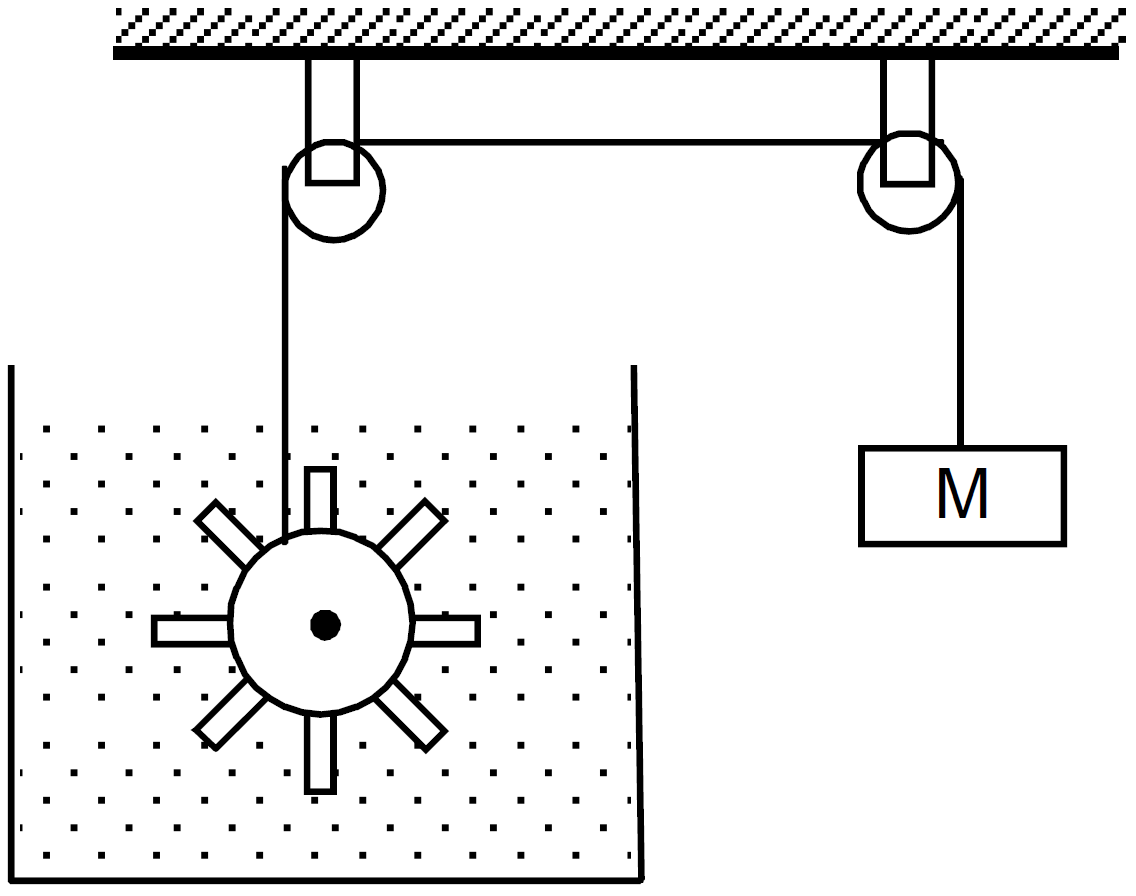
Figure, shows water in a container having $2.0\ mm$ thick walls made of a material of thermal conductivity $0.50\text{Wm}^{-1}{^{\circ}}\text{C}^{-1}.$ The container is kept in a melting$-$ice bath at $0^\circ C.$ The total surface area in contact with water is $0.05m^2.$ A wheel is clamped inside the water and is coupled to a block of mass $M$ as shown in the figure. As the block goes down, the wheel rotates. It is found that after some time a steady state is reached in which the block goes down with a constant speed of $10\ cms^{-1}$ and the temperature of the water remains constant at $1.0^\circ C.$ Find the mass $M$ of the block. Assume that the heat flows out of the water only through the walls in contact. Take $g = 10\ ms^{-2}.$
Answer
 Given $\theta_1=1^\circ\text{C},\ \theta_2=0^\circ\text{C}$
$\text{K}=0.50\text{w/m-}^\circ\text{C},\ \text{d}=2\text{mm}=2\times10^{-3}\text{m}$
$\text{A}=5\times10^{-2}\text{m}^2,\ \text{v}=10\text{cm/s}=0.1\text{m/s}$
Power $=$ Force $\times$ Velocity $= Mg \times v$
Again Power $=\frac{\text{dQ}}{\text{dt}}=\frac{\text{KA}(\theta_1-\theta_2)}{\text{d}}$
So, Mgv $=\frac{\text{KA}(\theta_1-\theta_2)}{\text{d}}$
$\Rightarrow\text{M}=\frac{\text{KA}(\theta_1-\theta_2)}{\text{dvg}}$
$=\frac{5\times10^{-1}\times5\times^{-2}\times1}{2\times10^{-3}\times10^{-1}\times10}$
$=12.5\text{kg}.$ View full question & answer→Question 275 Marks
A spherical ball of surface area $20\ cm^2$ absorbs any radiation that falls on it. It is suspended in a closed box maintained at $57^\circ C.$
- Find the amount of radiation falling on the ball per second.
- Find the net rate of heat flow to or from the ball at an instant when its temperature is $200^\circ C.$ Stefan constant $= 6.0 \times 10^{-8}Wm^{-2}K^{-4}.$
Answer
- $\text{A}=20\text{cm}^2=20\times10^{-4}\text{m}^2,$
$\text{T}=57^\circ\text{C}=330\text{K}$
$\text{E}=\text{A}\sigma\text{T}^4$
$=20\times10^{-4}\times6\times10^{-8}\times(330)^4\times10^4$
$=1.42\text{J}$
- $\frac{\text{E}}{\text{t}}=\text{A}\sigma\text{e}\big({\text{T}_1^4}{}-\text{T}_2^4\big),$
$\text{A}=20\text{cm}^2=20\times10^{-4}\text{m}^2$
$\sigma=6\times10^{-8},$
$\text{T}_1=473\text{K},\ \text{T}_2=330\text{K}$
$=20\times10^{-4}\times6\times10^{-8}\times1\big[(473)^4-(330)^4\big]$
$=20\times6\times\big[5.005\times10^{-10}-1.185\times10^{10}\big]$
$=20\times6\times3.82\times10^{-2}$
$=4.58\text{w}$ From the ball. View full question & answer→Question 285 Marks
A composite slab is prepared by pasting two plates of thicknesses $L_1$ and $L_2$ and thermal conductivities $K_1$ and $K_2.$ The slabs have equal cross$-$sectional area. Find the equivalent conductivity of the composite slab.
Answer
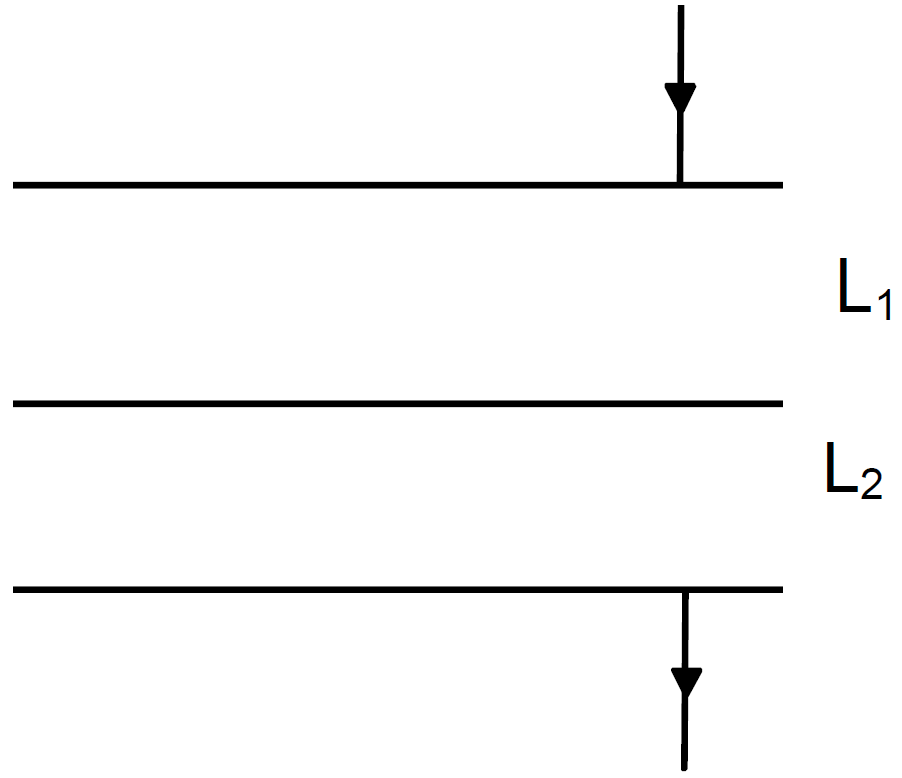 Here the thermal conductivities are in series,
$\therefore\frac{\frac{\text{K}_1\text{A}(\theta_1-\theta_2)}{\text{l}_1}\times\frac{\text{K}_2\text{A}(\theta_1-\theta_2)}{\text{l}_2}}{\frac{\text{K}_1\text{A}(\theta_1-\theta_2)}{\text{l}_1}+\frac{\text{K}_2\text{A}(\theta_1-\theta_2)}{\text{l}_2}}=\frac{\text{KA}(\theta_1-\theta_2)}{\text{l}_1+\text{l}_2}$
$\Rightarrow\frac{\frac{\text{K}_1}{\text{l}_1}\times\frac{\text{K}_2}{\text{l}_2}}{\frac{\text{K}_1}{\text{l}_1}+\frac{\text{K}_2}{\text{l}_2}}=\frac{\text{K}}{\text{l}_1+\text{l}_2}$
$\Rightarrow\frac{\text{K}_1+\text{K}_2}{\text{K}_1\text{l}_2+\text{K}_2\text{l}_1}=\frac{\text{K}}{\text{l}_1+\text{l}_2}$
$\Rightarrow\text{K}=\frac{(\text{K}_1\text{K}_2)(\text{l}_1+\text{l}_2)}{\text{K}_1\text{l}_2+\text{K}_2\text{l}_1}$ View full question & answer→Question 295 Marks
A room has a window fitted with a single $1.0m \times 2.0m$ glass of thickness $2 \ mm.$
- Calculate the rate of heat flow through the closed window when the temperature inside the room is $32^\circ C$ and that outside is $40^\circ C.$
- The glass is now replaced by two glasspanes, each having a thickness of $1 \ mm$ and separated by a distance of $1 \ mm.$ Calculate the rate of heat flow under the same conditions of temperature. Thermal conductivity of window glass $= 1.0Js^{-1}m^{-1^\circ }C^{-1}$ and that of air $= 0.025Js^{-1}m^{-1^\circ }C^{-1}.$
Answer
- $\frac{\text{Q}}{\text{t}}=\frac{\text{KA}(\theta_1-\theta_2)}{\ell}$
$=\frac{1\times2\times1(40-32)}{2\times10^{-3}}$
$=8000\text{J/sec}.$
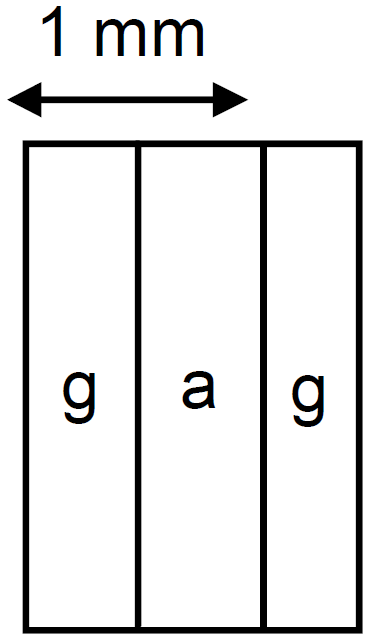
- Resistance of glass $=\frac{\ell}{\text{ak}_\text{g}}+\frac{\ell}{\text{ak}_\text{g}}$
Resistance of air $=\frac{\ell}{\text{ak}_\text{a}}$
Net resistance $=\frac{\ell}{\text{ak}_\text{g}}+\frac{\ell}{\text{ak}_\text{g}}+\frac{\ell}{\text{ak}_\text{a}}$
$=\frac{\ell}{\text{a}}\Big(\frac{2}{\text{k}_\text{g}}+\frac{1}{\text{k}_\text{a}}\Big)$
$=\frac{\ell}{\text{a}}\Big(\frac{2\text{k}_\text{a}+\text{k}_\text{g}}{\text{k}_\text{g}\text{k}_\text{a}}\Big)$
$=\frac{1\times10^{-3}}{2}\Big(\frac{2\times0.025+1}{0.025}\Big)$
$=\frac{1\times10^{-3}\times1.05}{0.05}$
$\frac{\text{Q}}{\text{t}}=\frac{\theta_1-\theta_2}{\text{R}}$
$=\frac{8\times0.05}{1\times10^{-3}\times1.05}$
$=380.9\approx381\text{W}$ View full question & answer→Question 305 Marks
A spherical ball $A$ of surface area $20\ cm^2$ is kept at the centre of a hollow spherical shell $B$ of area $80\ cm^2.$ The surface of $A$ and the inner surface of $B$ emit as blackbodies. Both $A$ and $B$ are at $300K.$
- How much is the radiation energy emitted per second by the ball $A?$
- How much is the radiation energy emitted per second by the inner surface of $B$
- How much of the energy emitted by the inner surface of $B$ falls back on this surface itself?
Answer
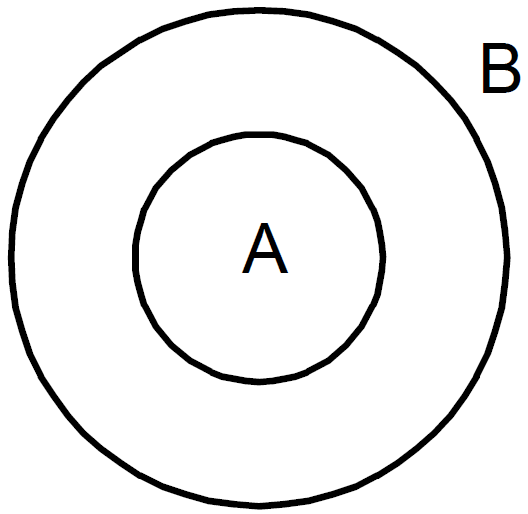 $\text{A}_\text{A}=20\text{cm}^2,\ \text{A}_\text{B}=80\text{cm}^2$
$(\text{mS})_\text{A}=40\text{J}^\circ\text{C},\ \text{(mS)}_\text{B}=82\text{J}^\circ\text{C},$
$\text{T}_\text{A}=100^\circ\text{C},\ \text{T}_\text{B}=20^\circ\text{C}$
$K_B$ is low thus it is a poor conducter and $K_A$is high.
Thus $A$ will absorb no heat and conduct all
$\Big(\frac{\text{E}}{\text{t}}\Big)_\text{A}=\sigma\text{A}_\text{A}\big[(373)^4-(293)^4\big]$
$\Rightarrow(\text{mS})_\text{A}\Big(\frac{\text{d}\theta}{\text{dt}}\Big)=\sigma\text{A}_\text{A}\big[(373)^4-(293)^4\big]$
$\Rightarrow\Big(\frac{\text{d}\theta}{\text{dt}}\Big)_\text{A}=\frac{\sigma\text{A}_\text{a}\big[(373)^4-(293)^4\big]}{(\text{mS})_\text{A}}$
$=\frac{6\times10^{-8}\big[(373)^4(293)^4\big]}{42}$
$=0.03^\circ\text{C/S}$
Similarly $\Big(\frac{\text{d}\theta}{\text{dt}}\Big)_\text{B}$
$=0.043^\circ\text{C/S}$ View full question & answer→Question 315 Marks
A hole of radius $r_1$ is made centrally in a uniform circular disc of thickness $d$ and radius $r_2.$ The inner surface $($a cylinder of length $d$ and radius $r_1)$ is maintained at a temperature $\theta_1$ and the outer surface $($a cylinder of length $d$ and radius $r_2)$ is maintained at a temperature $\theta_2(\theta_1>\theta_2).$ The thermal conductivity of the material of the disc is $K.$ Calculate the heat flowing per unit time through the disc.
Answer
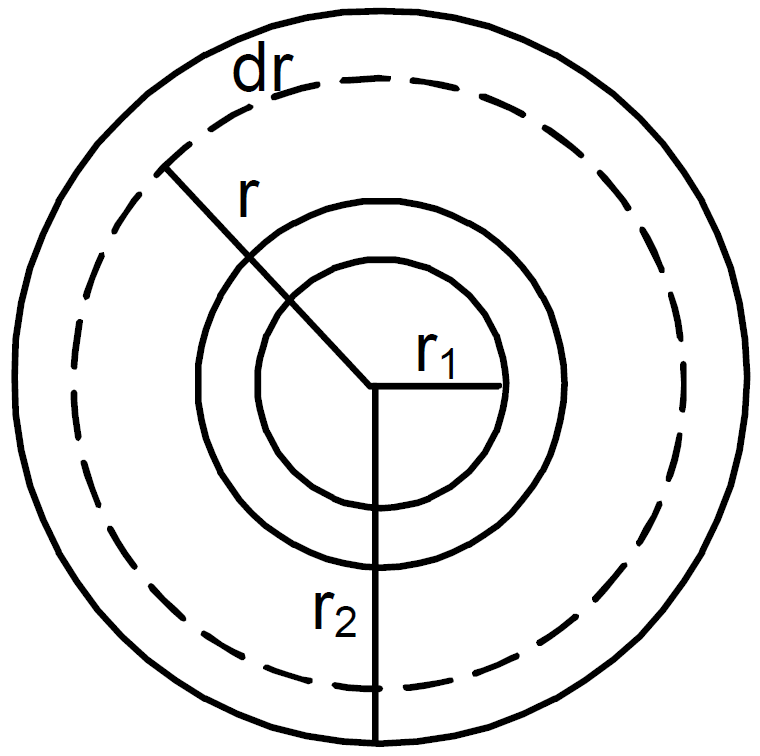 $\frac{\text{dQ}}{\text{dt}} =$ Rate of flow of heat
Let us consider a strip at a distance $r$ from the center of thickness $dr.$
$\frac{\text{dQ}}{\text{dt}}=\frac{\text{K}\times2\pi\text{r}\text{d}\times\text{d}\theta}{\text{dr}}$ $\big[\text{d}\theta=$ Temperature diff across the thickness dr$\big]$
$\Rightarrow\text{C}=\frac{\text{K}\times2\pi\text{r}\text{d}\times\text{d}\theta}{\text{dr}}$ $\Big[\text{C}=\frac{\text{d}\theta}{\text{dr}}\Big]$
$\Rightarrow\text{C}\int\limits^{\text{r}_2}_{\text{r}_1}\frac{\text{dr}}{\text{r}}=\text{K}2\pi\text{d}\int\limits_{\theta_1}^{\theta_2}\text{d}\theta$
$\Rightarrow\text{C}\Big[\log\Big]^{\text{r}_2}_{\text{r}_1}=\text{K}2\pi\text{d}(\theta_2-\theta_1)$
$\Rightarrow\text{C}(\log\text{r}_2-\log\text{r}_1)=\text{K}2\pi\text{d}(\theta_2-\theta_1)$
$\Rightarrow\text{C}\log\Big(\frac{\text{r}_2}{\text{r}_1}\Big)=\text{K}2\pi\text{d}(\theta_2-\theta_1)$
$\Rightarrow\text{C}=\frac{\text{K}2\pi\text{d}(\theta_2-\theta_1)}{\log\Big(\frac{\text{r}_2}{\text{r}_1}\Big)}$ View full question & answer→Question 325 Marks
Three rods of lengths $20\ cm$ each and area of cross section $1\ cm^2$ are joined to form a triangle $ABC$. The conductivities of the rods are $\text{K}_\text{AB}=50\text{Js}^{-1}\text{m}^{-1}{^{\circ}}\text{C}^{-1},\ \text{K}_\text{BC}=200\text{Js}^{-1}\text{m}^{-1}{^{\circ}}\text{C}^{-1}$ and $\text{K}_\text{AC}=400\text{Js}^{-1}\text{m}^{-1}{^{\circ}\text{C}}^{-1}.$ The junctions $A, B$ and $C$ are maintained at $40^\circ C, 80^\circ C$ and $80^\circ C$ respectively. Find the rate of heat flowing through the rods $AB, AC$ and $BC$.
Answer
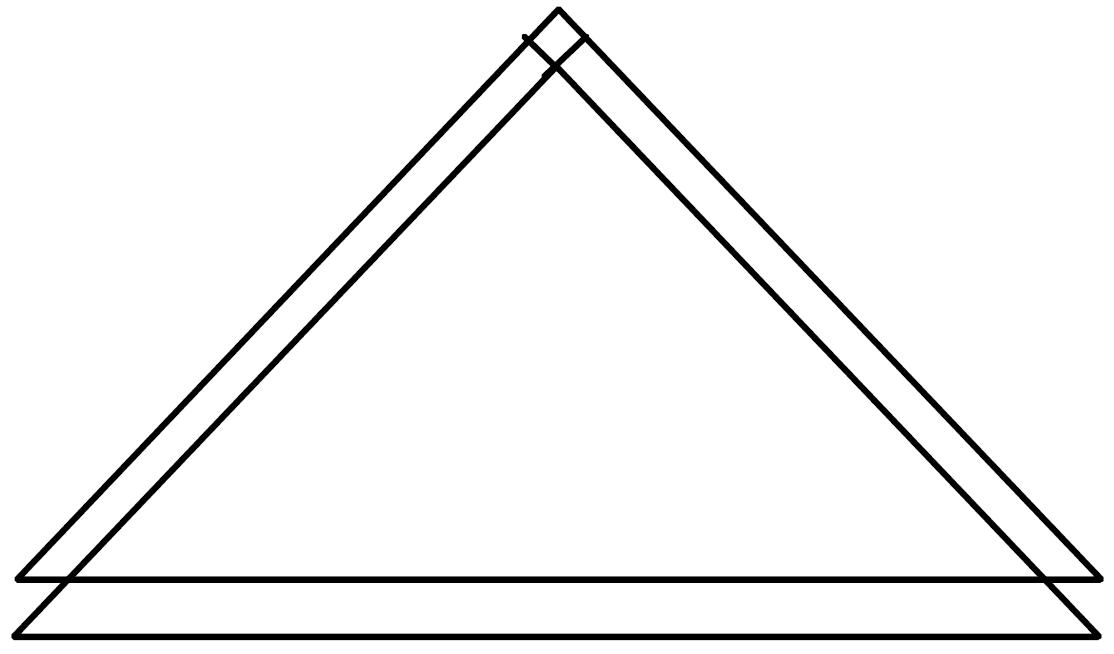
$\text{K}_{\text{AB}}=50\text{j/m-s-}^\circ\text{C},\ \theta_\text{A}=40^\circ\text{C}$
$\text{K}_\text{BC}=200\text{j/m-s-}^\circ\text{C},\ \theta_\text{B}=80^\circ\text{C}$
$\text{K}_\text{AC}=400\text{j/m-s-}^\circ\text{C},\ \theta_\text{C}=80^\circ\text{C}$
Length $=20\text{cm}=20\times10^{-2}\text{m}$
$\text{A}=1\text{cm}^2=1\times10^{-4}\text{m}^2$
- $\frac{\text{Q}_\text{AB}}{\text{t}}=\frac{\text{K}_\text{AB}\times\text{A}(\theta_\text{B}-\theta_\text{A})}{\text{l}}=\frac{50\times1\times10^{-4}\times40}{20\times10^{-2}}=1\text{W}.$
- $\frac{\text{Q}_\text{AC}}{\text{t}}=\frac{\text{K}_\text{AC}\times\text{A}(\theta_\text{C}-\theta_\text{A})}{\text{l}}=\frac{400\times1\times10^{-4}\times40}{20\times10^{-2}}=800\times10^{-2}=8$
- $\frac{\text{Q}_\text{BC}}{\text{t}}=\frac{\text{K}_\text{BC}\times\text{A}(\theta_\text{B}-\theta_\text{C})}{\text{l}}=\frac{200\times1\times10^{-4}\times0}{20\times10^{-2}}=0$
View full question & answer→Question 335 Marks
A cubical block of mass $1.0\ kg$ and edge $5.0\ cm$ is heated to $227^\circ C.$ It is kept in an evacuated chamber maintained at $27^\circ C$. Assuming that the block emits radiation like a blackbody, find the rate at which the temperature of the block will decrease. Specific heat capacity of the material of the block is $400\ J\ kg^{-1}K^{-1}.$
Answer
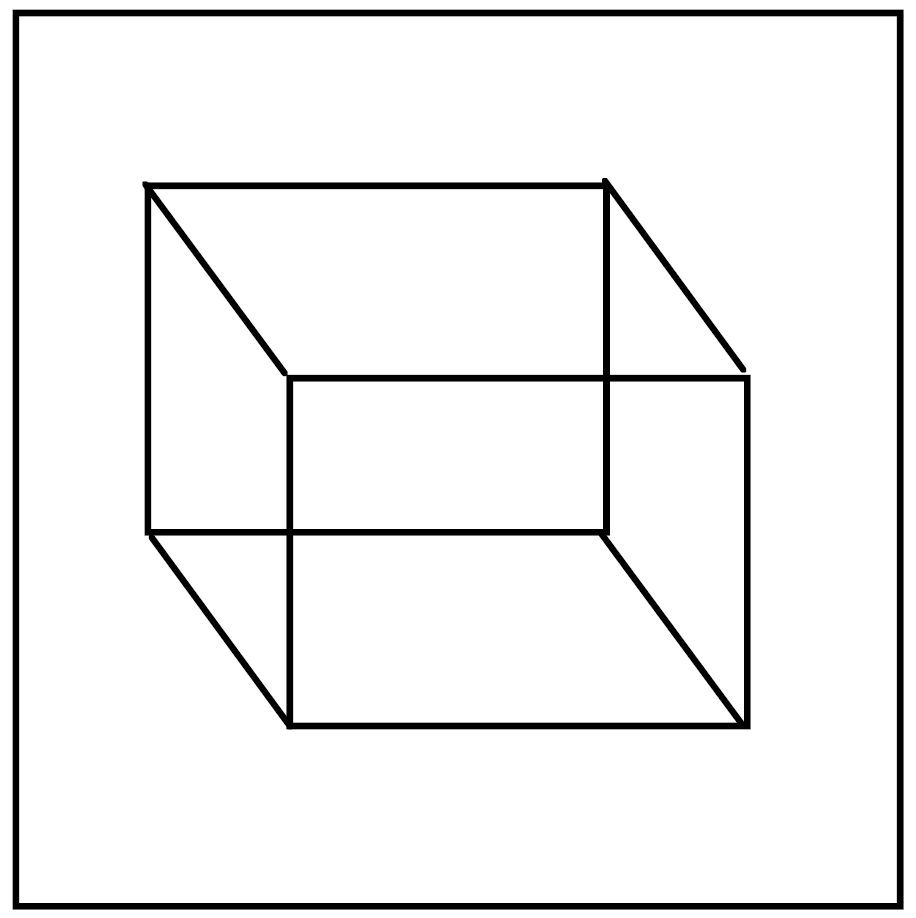 Since the Cube can be assumed as black body
$\text{e}=\ell$
$\sigma=6\times10^{-8}\text{w/m}^2\text{-k}^4$
$\text{A}=6\times25\times10^{-4}\text{m}^2$
$\text{m}=1\text{kg}$
$\text{s}=400\text{J/kg-}^\circ\text{K}$
$\text{T}_1=227^\circ\text{C}=500\text{K}$
$\text{T}_2=27^\circ\text{C}=300\text{K}$
$\Rightarrow\text{ms}\frac{\text{d}\theta}{\text{dt}}=\text{e}\sigma\text{A}\big(\text{T}_1^4-\text{T}_2^4\big)$
$\Rightarrow\frac{\text{d}\theta}{\text{dt}}=\frac{\text{e}\sigma\text{A}\big(\text{T}_1^4-\text{T}_2^4\big)}{\text{ms}}$
$=\frac{1\times6\times10^{-8}\times6\times25\times10^{-4}\times\big[(500)^4-(300)^4\big]}{1\times400}$
$=\frac{36\times25\times544}{}400\times10^{-4}$
$=0.1224^\circ\text{C/s}\approx0.12^\circ\text{C/s}.$ View full question & answer→