MCQ
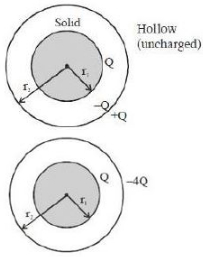
A solid conducting sphere, having a charge $Q$, is surrounded by an uncharged conducting hollow spherical shell. Let the potential difference between the surface of the solid sphere and that of the outer surface of the hollow shell be $V$. If the shell is now given a charge of $-4\, Q$, the new potential difference between the same two surface is......$V$
  • A
    $2$
  • B
    $-2$
  • C
    $4$
  • $1$

Answer

Correct option: D.
$1$
d
As given in the first condition:

Both conducting spheres are shown.

${V_{in}} - {V_{{\text{out }}}} = \left( {\frac{{{\text{kQ}}}}{{{r_1}}}} \right) - \left( {\frac{{{\text{kQ}}}}{{{{\text{r}}_2}}}} \right)$

$ = {\text{kQ}}\left( {\frac{1}{{{{\text{r}}_1}}} - \frac{1}{{{{\text{r}}_2}}}} \right) = V$

In the second condition:

Shell is now given charge $-4 Q$ 

${V_{in}} - {V_{out}} = \left( {\frac{{kQ}}{{{r_1}}} - \frac{{4kQ}}{{{r_2}}}} \right) - \left( {\frac{{kQ}}{{{r_2}}} - \frac{{4kQ}}{{{r_2}}}} \right)$

$ = \frac{{kQ}}{{{r_1}}} - \frac{{kQ}}{{{r_2}}}$

$=\mathrm{kQ}\left(\frac{1}{\mathrm{r}_{1}}-\frac{1}{\mathrm{r}_{2}}\right)=\mathrm{V}$

Hence, we also obtain that potential difference does not depend on charge of outer sphere.

$\therefore $ $P.d.$ remains same.
Need a full question paper?

Generate a complete, print-ready paper with questions like this in minutes — across 16+ boards, with answer keys.

Start Generating Free

Similar questions

The width of fringe is $2\,mm$ on the screen in a double slits experiment for the light of wavelength of $400\,nm$. The width of the fringe for the light of wavelength $600\,nm$ will be $..............\,mm$
Column $I$ describe some situations in which a small object moves. Column $II$ describes some characteristics of these motions. Match the situation in Column $I$ with the characteristics in Column $II$ and indicate your answer by darkening appropriate bubbles in the $4 \times 4$ matrix given in the $ORS$.
Column $I$ Column $II$
$(A)$ The object moves on the $\mathrm{x}$-axis under a conservative force in such a way that its "speed" and "position" satisfy $v=c_1 \sqrt{c_2-x^2}$, where $\mathrm{c}_1$ and $\mathrm{c}_2$ are positive constants. $(p)$ The object executes a simple harmonic motion.
$(B)$ The object moves on the $\mathrm{x}$-axis in such a way that its velocity and its displacement from the origin satisfy $\mathrm{v}=-\mathrm{kx}$, where $\mathrm{k}$ is a positive constant. $(q)$ The object does not change its direction.
$(C)$ The object is attached to one end of a massless spring of a given spring constant. The other end of the spring is attached to the ceiling of an elevator. Initially everything is at rest. The elevator starts going upwards with a constant acceleration a. The motion of the object is observed from the elevator during the period it maintains this acceleration. $(r)$ The kinetic energy of the object keeps on decreasing.
$(D)$ The object is projected from the earth's surface vertically upwards with a speed $2 \sqrt{\mathrm{GM}_e / R_e}$, where, $M_e$ is the mass of the earth and $R_e$ is the radius of the earth. Neglect forces from objects other than the earth. $(s)$ The object can change its direction only once.
A body takes time $t$ to reach the bottom of an inclined plane of angle $\theta$ with the horizontal. If the plane is made rough, time taken now is $2t$. The coefficient of friction of the rough surface is
A projectile is fired with $KE$ of $1\,kJ$. If the range is maximum, .......... $J$ is its $KE$ at the highest point.
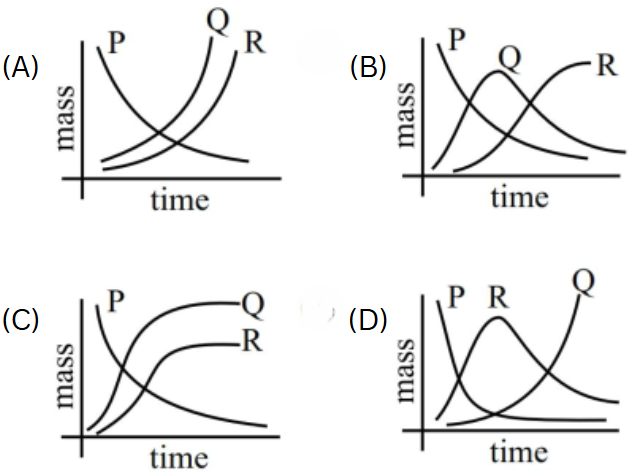
A radioactive material P first decays into Q and then Q decays to non-radioactive material R. Which of the following figure represents time dependent mass of P, Q and R ?
Image
A parallel beam of white light falls on a convex lens. Images of blue, yellow and red light are formed on other side of the lens at a distance of $0.20 m, 0.205 m$ and $0.214 m$ respectively. The dispersive power of the material of the lens will be
If the temperature of the sun (black body) is doubled, the rate of energy received on earth will be increased by a factor of
In finding out refractive index of glass slab the following observations were made through travelling microscope $50$ vernier scale division $=$ $49 \mathrm{MSD} ; 20$ divisions on main scale in each $\mathrm{cm}$ For mark on paper

$\mathrm{MSR}=8.45 \mathrm{~cm}, \mathrm{VC}=26$

For mark on paper seen through slab

$\mathrm{MSR}=7.12 \mathrm{~cm}, \mathrm{VC}=41$

For powder particle on the top surface of the glass slab

$\mathrm{MSR}=4.05 \mathrm{~cm}, \mathrm{VC}=1$

$(\mathrm{MSR}=$ Main Scale Reading, $\mathrm{VC}=$ Vernier Coincidence)

Refractive index of the glass slab is:

Two coherent sources of intensity ratio $\alpha$ interfere. The value of $\frac{{{I_{max}} - {I_{min}}}}{{{I_{max}} + {I_{min}}}}$ is
If the amplitude ratio of two sources producing interference is $3 : 5$, the ratio of intensities at maxima and minima is