Question
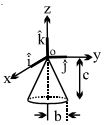
$A$ solid cone hangs from $a$ frictionless pivot at the origin $O$, as shown. If $\hat i$ , $\hat j$ and $\hat k$ are unit vectors, and $a, b$, and $c$ are positive constants, which of the following forces $F$ applied to the rim of the cone at a point $P$ results in a torque $\tau$ on the cone with a negative component $\tau_Z$ 
Answer

Torque $T=\vec{r} \times \vec{F}$

For $F=a \hat{k}$ where $P$ is $(0, b,-c)$

$T=(b \hat{j}-c \hat{k}) \times(a \hat{k})=a b \hat{i}$

For $F=-a \hat{k}$ where $P$ is $(0,-b,-c)$

$T=(-b \hat{j}-c \hat{k}) \times(-a \hat{k})=a c \hat{i}$

For $F=a \hat{j}$ where $P$ is $(-b, 0,-c)$

$T=(-b \hat{i}-c \hat{k}) \times(a \hat{j})=-a b \hat{k}+a c \hat{i}$

Therefore it has negative $z$ component.

Need a full question paper?

Generate a complete, print-ready paper with questions like this in minutes — across 16+ boards, with answer keys.

Start Generating Free

Similar questions

In determining the temperature of a distant star, one makes use of
$Assertion :$ At a given temperature the specific heat of a gas at constant pressure. is always greater than its specific heat at constant volume

$Reason :$ When a gas is heated at constant volume some extra heat is needed compared to that at constant pressure for doing work in expansion.

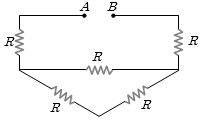
What is the equivalent resistance between $A$ and $B$ in the figure below if $R = 3\,\Omega $
The physical quantity which has dimensional formula as that of $\frac{{{\rm{Energy}}}}{{{\rm{Mass}} \times {\rm{Length}}}}$ is
A satellite of $10^3 \mathrm{~kg}$ mass is revolving in circular orbit of radius $2 \mathrm{R}$. If $\frac{10^4 \mathrm{R}}{6} \mathrm{~J}$ energy is supplied to the satellite, it would revolve in a new circular orbit of radius:

(use $\mathrm{g}=10 \mathrm{~m} / \mathrm{s}^2, \mathrm{R}=$ radius of earth)

In our solar system, there is one sun and
Two conductors have the same resistances at $0^{\circ} \mathrm{C}$ but their temperature coefficients of resistance are $\alpha_1$ and $\alpha_2$. The respective temperature coefficients for their series and parallel combinations are :
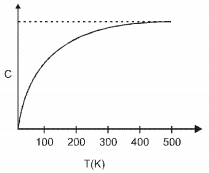
The figure below shows the variation of specific heat capacity $(C)$ of a solid as a function of temperature $(T)$. The temperature is increased continuously from $0$ to $500 \ K$ at a constant rate. Ignoring any volume change, the following statement$(s)$ is (are) correct to a reasonable approximation.$Image$

$(A)$ the rate at which heat is absorbed in the range $0-100 \ K$ varies linearly with temperature $T$.

$(B)$ heat absorbed in increasing the temperature from $0-100 \ K$ is less than the heat required for increasing the temperature from $400-500 \ K$.

$(C)$ there is no change in the rate of heat absorbtion in the range $400-500 \ K$.

$(D)$ the rate of heat absorption increases in the range $200-300 \ K$.

A stream-lined body falls through air from a height $h$ on the surface of liquid. Let $d$ and $D$ denote the densities of the materials of the body and the liquid respectively. If  $D > d$, then the time after which the body will be instantaneously at rest, is
Two concentric shells have masses $M$ and $m$ and their raddi are $R$ and $r$ respectively where $R > r$, if $x$ be the distance from the common centre, then what is the gravitational potential at a point for which $r < x < R$