Question
In determining the temperature of a distant star, one makes use of

Answer

(c)The temperature of stars can be determined by Wiens displacement law which is ${\lambda _m}.T = {\rm{constant}}{\rm{.}}$

Need a full question paper?

Generate a complete, print-ready paper with questions like this in minutes — across 16+ boards, with answer keys.
Start Generating Free

Similar questions

An achromatic prism is made by combining two prisms ${P_1}({\mu _v} = 1.523,\,{\mu _r} = 1.515)$ and ${P_2}({\mu _v} = 1.666,\,{\mu _r} = 1.650)$; where $\mu $ represents the refractive index. If the angle of the prism ${P_1}$ is $10^o $, then the angle of the prism $P_2$ will be.....$^o$
A Carnot engine operates between ${227^o}C$ and ${27^o}C.$ Efficiency of the engine will be
A pendulum of length $2 \; m$ consists of a wooden bob of mass $50 \; g$. A bullet of mass $75 \; g$ is fired towards the stationary bob with a speed $v$. The bullet emerges out of the bob with a speed $\frac{v}{3}$ and the bob just completes the vertical circle. The value of $v$ is $\dots \; ms ^{-1}$. (if $g =10 \; m / s ^{2}$ )
An electric dipole is put in north-south direction in a sphere filled with water. Which statement is correct
The internal resistance of a primary cell is $4\, ohm$. It generates a current of $0.2\, amp$ in an external resistance of $21\, ohm$. The rate at which chemical energy is consumed in providing the current is .............. $J/s$
If $13.6\; eV$ energy is required to ionize the hydrogen atom, then the energy required to remove an electron from $n=2$ is
Which one of the following reactions will not result in the formation of carbon-carbon bond?
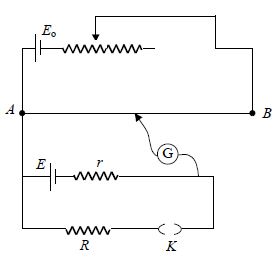
The given figure represents an arrangement of potentiometer for the calculation of internal resistance $(r)$ of the unknown battery $(E)$. The balance length is $70.0\, cm$ with the key opened and $60.0\,cm$ with the key closed. $R$ is $132.40 \Omega $. The internal resistance $(r)$ of the unknown cell will be.......$\Omega$ (Given $E_o > E$) :-
Three charges each of magnitude $q$ are placed at the corners of an equilateral triangle, the electrostatic force on the charge placed at the center is (each side of triangle is $L$)
At nodes in stationary waves