MCQ
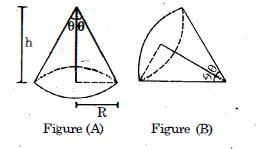
A solid cone is placed on a horizontal surface has height $h$, radius $R$ and apex angle $\theta$ as show.If gravitational potential energy of the cone does not change as position of the cone is changed from figure $(A)$ to figure $(B)$, then,
  • A
    $\theta  = {\sin ^{ - 1}}\left( {\frac{2}{3}} \right)$
  • B
    $\theta  = \frac{\pi }{4}$
  • C
    $\frac{h}{R} = 1$
  • $\frac{h}{R} = 2\sqrt 2$

Answer

Correct option: D.
$\frac{h}{R} = 2\sqrt 2$
d
Solid Cone

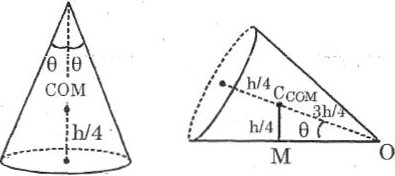
In $\triangle O C M$

$\sin \theta=\frac{h / 4}{3 h / 4}=\frac{1}{3}$

$\therefore \quad \tan \theta=\frac{1}{2 \sqrt{2}}=\frac{R}{h}$

$\therefore \quad \frac{\mathrm{h}}{\mathrm{R}}=2 \sqrt{2}$

Need a full question paper?

Generate a complete, print-ready paper with questions like this in minutes — across 16+ boards, with answer keys.

Start Generating Free

Similar questions

A wound watch spring has $...........$ energy.
The motion of a particle executing $S.H.M.$ is given by $x = 0.01\sin 100\pi (t + .05)$, where $x$ is in metres and time is in seconds. The time period is ..... $\sec$
Excess pressure of one soap bubble is four times more than the other. Then the ratio of volume of first bubble to another one is
A particle is moving along a curve. Then
A ball projected from ground at an angle of $45^o$ just clears a wall in front. If point of projection is $4\,m$ from the foot of wall and ball strikes the ground at a distance of $6\,m$ on the other side of the wall, the height of the walI is  ........ $ m$
Vector$\overrightarrow A $ makes equal angles with $x, y$ and $z$ axis. Value of its components (in terms of magnitude of $\overrightarrow A $) will be
A spherically symmetric gravitational system of particles has a mass density

$\rho=\left\{\begin{array}{l}\rho_0 \text { for } r \leq R \\ 0 \text { for } r>R\end{array}\right.$

where $\rho_0$ is a constant. A test mass can undergo circular motion under the influence of the gravitational field of particles. Its speed $V$ as a function of distance $\mathrm{r}(0<\mathrm{r}<\infty)$ from the centre of the system is represented by

A block of mass $M$ is hanging over a smooth and light pulley through a light string. The other end of the string is pulled by a constant force $F$. The kinetic energy of the block increases by $20\,J$ in $1\, s$.
A wheel completes $2000$ revolutions to cover the $9.5\, km$. distance. then the diameter of the wheel is
Two gases-argon (atomic radius $0.07 \;\mathrm{nm}$,atomic weight $40$ ) and xenon (atomic radius $0.1\; \mathrm{nm},$ atomic weight $140$ ) have the same number density and are at the same temperature. The raito of their respective mean free times is closest to