Question
A solid, consisting of a right circular cone, standing on a hemisphere, is placed upright, in a right circular cylinder, full of water, and touches the bottom. Find the volume of water left in the cylinder, having given that the radius of the cylinder is 3 cm and its height is 6 cm; the radius of the hemisphere is 2 cm and the height of the cone is 4 cm. Give your answer to the nearest cubic centimeter.
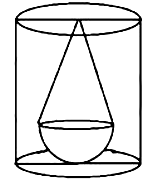

Answer


Radius of cylinder $= 3 cm$
Height of cylinder $= 6 cm$
Radius of hemisphere $= 2 cm$
Height of cone $= 4 cm$
Volume of water in the cylinder when it is full $=$
$\pi r ^2 h =\pi \times 3 \times 3 \times 6=54 \pi cm ^3$
Volume of water displaced = volume of cone + volume ofhemisphere
$=\frac{1}{3} \pi r ^2 h +\frac{2}{3} \pi r ^3$
$=\frac{1}{3} \pi r ^2( h +2 r )$
$=\frac{1}{3} \pi \times 2 \times 2(4+2 \times 2)$
$=\frac{1}{3} \pi \times 4 \times 8$
$=\frac{32}{3} \pi cm ^3$
Therefore, volume of water which is left
$=54 \pi-\frac{32}{3} \pi$
$=\frac{130}{3} \pi cm ^3$
$=\frac{130}{3} \times \frac{22}{7} cm ^3$
$=\frac{2860}{21} cm ^3$
$=136.19 cm ^3$
$=136 cm ^3$

Need a full question paper?

Generate a complete, print-ready paper with questions like this in minutes — across 16+ boards, with answer keys.

Start Generating Free

Similar questions

Gagan invested Rs.80% of his savings in 10% Rs.100 shares at 20% premium and the rest of his savings in 20% Rs.50 shares at Rs.20% discount. If his incomes from these shares is Rs.5,600 calculate:
(i) His investment in shares on the whole
(ii) The number of shares of first kind that he bought
(iii) Percentage return, on the shares bought on the whole.
The mean of the folowing is $62.8 $ and the sum of all the frequencies is $50.$ find the missing frequency $f_1$ and $f_2$
Class $0-20 $ $20-40$ $40-60$ $60-80$ $80-100$ $100-120$
Freq $5$ $f_{1}$ $10$ $f_{2}$ $7$ $8$
ABCD is a cyclic quadrilateral. Sides AB and DC produced meet at point E; whereas sides BC and AD produced meet at point F. If ∠DCF : ∠F : ∠E = 3 : 5 : 4, Find the angles of the cyclic quadrilateral ABCD.
Using a graph paper, plot the points $A (6,4)$ and $B (0,4)$.
(a) Reflect A and B in the origin to get the image $A ^{\prime}$ and $B ^{\prime}$.
(b) Write the co-ordinates of $A ^{\prime}$ and $B ^{\prime}$.
(c) State the geometrical name for the figure $ABA ^{\prime} B ^{\prime}$.
(d) Find its perimeter.
If A and B are complementary angles, prove that:$\frac{\sin A+\sin B}{\sin A-\sin B}+\frac{\cos B-\cos A}{\cos B+\cos A}=\frac{2}{2 \sin ^2 A-1}$
Prove that$\cot ^2 A-\cot ^2 B=\frac{\cos ^2 A-\cos ^2 B}{\sin ^2 A \sin ^2 B}=\operatorname{cosec}^2 A-\operatorname{cosec} e^2 B$
Prove that the angles bisectors of the angles formed by producing opposite sides of a cyclic quadrilateral (provided they are not parallel) intersect at right triangle.
If $x=\frac{2 a b}{a+b}$ find the value of $\frac{x+a}{x-a}+\frac{x+b}{x-b}$
Let $A=\left|\begin{array}{ll}3 & 2 \\ 0 & 5\end{array}\right|$ and $B=\left|\begin{array}{ll}1 & 0 \\ 1 & 2\end{array}\right|$, find $(i) \ (A+B)(A-B) \  (ii) \ A^2-B^2$. Is $(i)$ equal to $(ii)$ ?