Question 15 Marks
A test tube consists of a hemisphere and a cylinder of the same radius. The volume of the water required to fill the whole tube is $\frac{5159}{6} m ^3$ and $\frac{4235}{6} cm ^3$ of water is required to fill the tube toa level which is $4\ cm$ below the top of the tune. Find the radius of the tube and the length of its cylindrical part.
Answer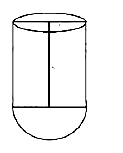
Volume of water filled in the test tube$=\frac{5159}{6} cm ^3$
Volume of water filled up to $4 cm =\frac{4235}{6} cm ^3$
Let r be the radius and h be the height of test tube
$\therefore \frac{2}{3} \pi r^3+\pi r^h g=\frac{5159}{6}$
$\Rightarrow \pi r^2\left(\frac{2}{3} r+h\right)=\frac{5159}{6}$
$\Rightarrow \frac{\pi r^2}{3}(2 r+3 h)=\frac{5159}{6}$
$\Rightarrow \pi r^2(2 r+3 h)=\frac{5159}{2} \ldots .......(1)$
And
$\frac{2}{3} \pi r^3+\pi r^2(h-4)=\frac{4235}{6}$
$\Rightarrow \pi r^2\left(\frac{2}{3} r+h-4\right)=\frac{4235}{6}$
$\Rightarrow \pi \frac{r^2}{3}(2 r+3 h-12)=\frac{4235}{6}$
$\Rightarrow \pi r^2(2 r+3 h-12)=\frac{4235}{2} \ldots.........(2)$
Dividing (1) by (2)
$\frac{2 r+3 h}{2 r+3 h-12}=\frac{5259}{4235}......(3)$
Subtracting (2) from (1)
$\pi r^2(12)=\frac{5159}{2}-\frac{4235}{2}=\frac{924}{2}$
$\Rightarrow 12 \times \frac{22}{7} \times r^2=\frac{924}{2}$
$\Rightarrow r^2=\frac{924 \times 7}{2 \times 12 \times 22}=\frac{7 \times 7}{2 \times 2}$
$\Rightarrow r^2=\frac{49}{44}$
$\Rightarrow r=\frac{7}{2}=3.5 cm $
Subtracting the value of r in (3)
$ \frac{2 \times \frac{7}{2}+3 h}{2 \times \frac{7}{2}+3 h-12}=\frac{5159}{4235}$
$\Rightarrow \frac{7+3 h}{7-3 h-12}=\frac{5159}{4235}$
$\Rightarrow \frac{7+3 h}{7+3 h-12}=\frac{469}{385}$
$\Rightarrow 2695++1155 h =1407 h -233455$
$\Rightarrow 252 h =5040$
$\Rightarrow h =20$
Hence, height $= 20\ cm$ and radius $= 3.5\ cm$ View full question & answer→Question 25 Marks
A solid, consisting of a right circular cone, standing on a hemisphere, is placed upright, in a right circular cylinder, full of water, and touches the bottom. Find the volume of water left in the cylinder, having given that the radius of the cylinder is 3 cm and its height is 6 cm; the radius of the hemisphere is 2 cm and the height of the cone is 4 cm. Give your answer to the nearest cubic centimeter.
Answer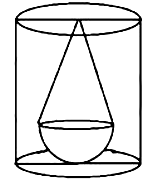
Radius of cylinder $= 3 cm$
Height of cylinder $= 6 cm$
Radius of hemisphere $= 2 cm$
Height of cone $= 4 cm$
Volume of water in the cylinder when it is full $=$
$\pi r ^2 h =\pi \times 3 \times 3 \times 6=54 \pi cm ^3$
Volume of water displaced = volume of cone + volume ofhemisphere
$=\frac{1}{3} \pi r ^2 h +\frac{2}{3} \pi r ^3$
$=\frac{1}{3} \pi r ^2( h +2 r )$
$=\frac{1}{3} \pi \times 2 \times 2(4+2 \times 2)$
$=\frac{1}{3} \pi \times 4 \times 8$
$=\frac{32}{3} \pi cm ^3$
Therefore, volume of water which is left
$=54 \pi-\frac{32}{3} \pi$
$=\frac{130}{3} \pi cm ^3$
$=\frac{130}{3} \times \frac{22}{7} cm ^3$
$=\frac{2860}{21} cm ^3$
$=136.19 cm ^3$
$=136 cm ^3$ View full question & answer→Question 35 Marks
From a solid cylinder whose height is $16\ cm$ and radius is $12\ cm,$ a conical cavity of height $8\ cm$ and of base radius $6\ cm$ is hollowed out. Find the volume and total surface area of the remaining solid.
Answer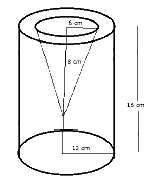
Radius of solid cylinder $(R) = 12\ cm$
and Height $(H) = 16\ cm$
$\therefore \text { Volume }=\pi R ^2 H$
$=\frac{22}{7} \times 12 \times 12 \times 16 $
$ =\frac{50688}{7} cm ^3$
Radius of cone $(r) = 6\ cm,$ and height $(h) = 8\ cm.$
$\therefore \text { Volume }=\frac{1}{3} \pi r ^2 h$
$ =\frac{1}{3} \times \frac{22}{7} \times 6 \times 6 \times 8 $
$=\frac{2112}{7} cm ^3$
$(1)$ Volume of remaining solid
$=\frac{50688}{7}-\frac{2112}{7}$
$=\frac{48567}{7} $
$ =6939.43^2 cm ^3$
$(2)$ Slant height of cone $I =\sqrt{ h ^2+ r ^2}$
$=\sqrt{6^2+8^2}$
$=\sqrt{36+64}$
$ =\sqrt{100} $
$ =10 cm $
Therefore, total surface area of remaining solid = curved surface area of cylinder + curvedsurface area of cone + base area of cylinder + area of circular ring on upper side of cylinder
$=2 \pi RH +\pi rl +\pi R ^2+\pi\left( R ^2- r ^2\right) $
$=\left(2 \times \frac{22}{7} \times 12 \times 16\right)+\left(\frac{22}{7} \times 6 \times 10\right)+\left(\frac{22}{7} \times 12 \times 12\right)+\left(\frac{22}{7}\left(12^2-6^2\right)\right)$
$=\frac{8448}{7}+\frac{1320}{7}+\frac{3168}{7}+\frac{22}{7}(144-36) $
$=\frac{8448}{7}+\frac{1320}{7}+\frac{3168}{7}+\frac{2376}{7}$
$=\frac{15312}{7}$
$ =2187.43 cm ^2$
View full question & answer→Question 45 Marks
An open cylindrical vessel of internal diameter 7 cm and height 8 cm stands on a horizontaltable. Inside this is placed a solid metallic right circular cone, the diameter of whose base is $3 \frac{1}{2}$ cm and height 8 cm. Find the volume of water required to fill the vessel.
If this cone is replaced by another cone, whose height is $1 \frac{3}{4}$ cm and the radius of whose base is2 cm, find the drop in the water level.
AnswerDiameter of the base of the cylinder $=7 cm$
Therefore, radius of the cylinder $=\frac{7}{2} cm$
Volume of the cylinder $\pi r^2 h=\frac{22}{7} \times \frac{7}{2} \times \frac{7}{2} \times 8=308 cm ^3$
Diameter of the base of the cone $=\frac{7}{2} cm$
Therefore, radius of the cone $=\frac{7}{4} cm$
Volume of the cone $=\frac{1}{3} \pi r^2 h=\frac{1}{3} \times \frac{22}{7} \times \frac{7}{4} \times \frac{7}{4} \times 8=\frac{77}{3} cm ^3$
On placing the cone into the cylindrical vessel, the volume of the remaining portion where thewater is to be filled
$=308-\frac{77}{3}$
$=\frac{924-77}{3}$
$=\frac{847}{3}$
$=282.33 cm ^3$
Height of new cone $=1 \frac{3}{4}=\frac{7}{4} cm$
Radius $= 2 cm$
Therefore, volume of new cone
$=\frac{1}{3} \pi r^2 h=\frac{1}{3} \times \frac{22}{7} \times 2 \times 2 \times \frac{7}{4}=\frac{22}{3} cm ^3$
Volume of water which comes down $=\frac{77}{3}-\frac{22}{3} cm ^3=\frac{55}{3} cm ^3......(1)$
Let h be the height of water which is dropped down.
Radius $=\frac{7}{2} cm$
$\therefore$ Volume $=\pi r^2 h=\frac{22}{7} \times \frac{7}{2} \times \frac{7}{2} \times h.......(2)$
From (1) and (2)
$\frac{77}{2} h=\frac{55}{3}$
$\Rightarrow h=\frac{55}{3} \times \frac{22}{77}$
$\Rightarrow h=\frac{10}{21}$
Drop in water level $=\frac{10}{21} cm$
View full question & answer→Question 55 Marks
A buoy is made in the form of hemisphere surmounted by a right cone whose circular basecoincides with the plane surface of hemisphere. The radius of the base of the cone is $3.5$ metres and its volume is two third of the hemisphere. Calculate the height of the cone and the surfacearea of the buoy, correct to two places of decimal
AnswerRadius of hemispherical part $( r )=3.5 m =\frac{7}{2} m$
Therefore, Volume of hemisphere $=\frac{2}{3} \pi r^3$
$=\frac{2}{3} \times \frac{22}{7} \times \frac{7}{2} \times \frac{7}{2} \times \frac{7}{2}$
$=\frac{539}{6} m^3$
Volume of conical part $\frac{2}{3} \times \frac{539}{6} m^3\left(\frac{2}{3}\right.$ of hemisphere $)$
Let height of the cone $= h$
Then,
$\frac{1}{3} \pi r^2 h=\frac{2 \times 539}{3 \times 6} $
$ \Rightarrow \frac{1}{3} \times \frac{22}{7} \times \frac{7}{2} \times \frac{7}{2} \times h=\frac{2 \times 539}{3 \times 6}$
$ \Rightarrow=\frac{2 \times 539 \times 2 \times 2 \times 7 \times 3}{3 \times 6 \times 22 \times 7 \times 7} $
$ \Rightarrow h=\frac{14}{3} m =4 \frac{2}{3} m =4.67 m$
$\text { Height of the cone }=4.67 m $
$ \text { Surface area of buoy }=2 \pi r^2+\pi r l $
$ \text { But } I =\sqrt{r^2+h^2}$
$ l=\sqrt{\left(\frac{7}{2}\right)^2+\left(\frac{14}{3}\right)^2} $
$=\sqrt{\frac{49}{4}+\frac{196}{9}}=\frac{\sqrt{1225}}{36}=\frac{35}{6} m$
Therefore, Surface area =
$=\left(2 \times \frac{22}{7} \times \frac{7}{2} \times \frac{7}{2}\right)+\left(\frac{22}{7} \times \frac{7}{2} \times \frac{35}{6}\right) m ^2 $
$ =\frac{77}{1}+\frac{385}{6}=\frac{847}{6} $
$ =141.17 m ^2$
Surface Area $=141.17 m ^2$
View full question & answer→Question 65 Marks
Find what length of canvas, $1.5 m$ in width, is required to make a conical tent $48 m$ in diameterand $7 m$ in height. Given that $10\%$ of the canvas is used in folds and stitching’s. Also. Find thecost of the canvas at the rate of $Rs. 24$ per metre.
AnswerDiameter of the tent $= 48 m$
Therefore, radius $(r) = 24 m$
Height $(h) = 7 m$
Slant height (ℓ) = $\sqrt{r^2+h^2}$
$=\sqrt{(24)^2+(7)^2}$
$=\sqrt{576+49}$
$=\sqrt{625}$
$=25 m $
Curved surface area $=\pi r l$
$=\frac{22}{7} \times 24 \times 25$
$=\frac{13200}{7} m ^2$
$=1885.71 m ^2$
But it is given that 10% allowance for folds and stiching
Hence modified area $=1885.71 m ^2+\frac{10}{100} \times 1885.71 m ^2$
$=2074.28 m ^2$
Width of canvas $= 1.5 m$
$\therefore$ Length of canvas = $\frac{\text { Area of canvas }}{\text { width of canvas }}$
$=\frac{2074.28 m ^2}{1.5 m }$
$=1382.85 m $
Now cost of $1 m = Rs. 24$
Hence cost of $1382.85 m = Rs. 24 × 1382.85 = Rs. 33188.4.$
View full question & answer→Question 75 Marks
The radius and the height of a right circular cone are in the ratio $5 : 12$ and its volume is $2512$ cubic cm. Find the radius and height of the cone (Take $\pi= 3.14$)
AnswerThe ratio between radius and height $=5:12$
Volume $=2512$ cubic cm
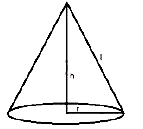
Let radius $(r)=5x,$ hight $(h)=12x$ and slant height $= l$
$l^2=r^2+h^2$
$\Rightarrow l^2=(5 x)^2+(12 x)^2$
$\Rightarrow l^2=25 x^2+144 x^2$
$\Rightarrow l^2=169 x^2$
$\Rightarrow=13 x $
$\text { Now volume }=\frac{1}{3} \pi r^2 h$
$\Rightarrow \frac{1}{3} \pi r^2 h=2512$
$\Rightarrow \frac{1}{3}(3.14)(5 x)^2(12 x)=2512$
$\Rightarrow \frac{1}{3}(3.14)\left(300 x^3\right)=2512$
$\therefore x^3=\frac{2512 \times 3}{3.14 \times 300}=\frac{2512 \times 3 \times 100}{314 \times 300}=8$
$\Rightarrow x=2$
$\therefore \text { Radius }=5 x=5 \times 2=10$
$\text { Height }=12 x=12 \times 2=24 cm$
$\text { Slantheight }=13 x=13 \times 2=26 cm $ View full question & answer→Question 85 Marks
The difference between the outer curved surface area and the inner curved surface area of a hollow cylinder is $352 cm^2$. If its height is $28 \ cm$ and the volume of material in it is $704 cm^3$; find its external curved surface area.
AnswerLLet $R$ and $r$ be the outer and inner radii of hollow metallic cylinder. Let h be the height of the metallic cylinder.
It is given that
Outer curved surface area - Inner curved surface area $=352$
$\Rightarrow 2\pi Rh - 2\pi rh = 352$
$\Rightarrow 2\pi h (R - r) = 352$
$\Rightarrow 2 \times \frac{22}{7} \times 28( R - r )=352$
$\Rightarrow R - r =\frac{352 \times 7}{2 \times 22 \times 28}$
$\Rightarrow R - r = 2 ...(i)$
Volume of material in it$ = 704 cm^3$
$\Rightarrow \pi R^2h - \pi r^2h = 704$
$\Rightarrow \pi h (R^2 - r^2) = 704$
$\Rightarrow \frac{22}{7} \times 28\left( R ^2- r ^2\right)=704$
$\Rightarrow R ^2- r ^2=\frac{704 \times 7}{22 \times 28}$
$\Rightarrow (R + r)(R-r) = 8$
$\Rightarrow (R + r) \times 2 = 8$
$\Rightarrow R + r = 4 ...(ii)$
Adding (i) and (ii) we get
$2R = 6 \Rightarrow R = 3 cm$
$\therefore $ External curved surface area $= 2\pi Rh$
$=2 \times \frac{22}{7} \times 3 \times 28=528 cm ^2$
View full question & answer→Question 95 Marks
The sum of the inner and the outer curved surfaces of a hollow metallic cylinder is $1056 cm^2$ and the volume of material in it is $1056\ cm^3$. Find its internal and external radii. Given that the height of the cylinder is $21 \ cm.$
AnswerLet R and r be the outer and inner radii of hollow metallic cylinder.
Let h be height of the metallic cylinder.
It is given that
Outer curved surface area + Inner curved surface area $= 1056$
$\Rightarrow 2\pi Rh + 2\pi rh = 1056$
$\Rightarrow 2\pi h (R + r) = 1056$
$\Rightarrow 2 \times \frac{22}{7} \times 21(R+r)=1056$
$\Rightarrow R + r =\frac{1056 \times 7}{2 \times 22 \times 21}$
$\Rightarrow R + r =8 \ldots( i )$
Volume of material in it $= 1056 cm^3$
$\Rightarrow \pi R^2h - \pi r^2h = 1056$
$\Rightarrow \pi h (R^2 - r^2) = 1056$
$\Rightarrow \frac{22}{7} \times 21\left( R ^2- r ^2\right)=1056$
$\Rightarrow R ^2- r ^2=\frac{1056 \times 7}{22 \times 21}$
$\Rightarrow (R + r)(R-r) = 16$
$\Rightarrow 8 \times (R - r) = 16$
$\Rightarrow R - r = 2 ....(ii)$
Adding (i) and (ii) , we get
$2R = 10$
$\Rightarrow R = 5 cm$
$\Rightarrow 5 - r = 2$
$\Rightarrow r = 3 cm$
$\therefore$ Internal radius = 3 cm and External radius $= 5 cm$
View full question & answer→Question 105 Marks
The cross$-$section of a tunnel is a square of side $7m$ surmounted by a semi circle as shown in theadjoining figure. The tunnel is $80 m$ long.
$(1)$ its volume
$(2)$ the surface area of the tunnel $($excluding the floor$)$ and
$(3)$ its floor area.
AnswerSide of square $= 7 m$
Radius of semicircle $=\frac{7}{2} m$
Length of the tunnel $= 80 m$
Area of cross section of the front part $=a^2+\frac{1}{2} \pi r^2$
$=7 \times 7+\frac{1}{2} \times \frac{22}{7} \times \frac{7}{2} \times \frac{7}{2}$
$=49+\frac{77}{4} m^2$
$=\frac{196+77}{4}$
$=\frac{273}{4} m^2$
$(1)$ therefore, volume of tunnel $=$ area $\times$ length
$=\frac{273}{4} \times 80$
$=5460 m ^3$
$(2)$ Circumference of the front of tunnel
$=2 \times 7+\frac{1}{2} \times 2 \pi r$
$=14+\frac{22}{7} \times \frac{7}{2}$
$=14+11$
$=25 m $
Therefore, surface area of the inner part of the tunnel
$=25 \times 80$
$=2000 m^2$
$(iii)$ Area of floor $=1 \times b=7 \times 80=560 m ^3$
View full question & answer→Question 115 Marks
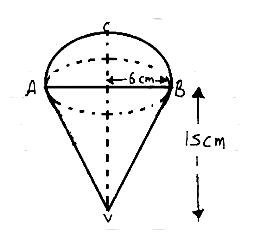
A right circular cylinder having diameter $12 \ cm$ and height $15 \ cm$ is full ice$-$cream. The ice$-$cream is to be filled in cones of height $12 \ cm$ and diameter $6 \ cm$ having a hemispherical shape on the top. Find the number of such cones which can be filled with ice$-$cream.
AnswerWe have
Radius of the cylincler $= 12/2 = 6\ cm$
Height of the cylinder $= 15\ cm$
$\therefore$ volume of the $cy$ linder $= \pi r^2h$
$=\pi x 6^2 x 15$
$= 540\pi cm^3$
Radius of the ice$-$cream cone $= 3\ cm$
Height of the ice$-$cream cone $= 12\ cm$
$\therefore$ volume of the conical part of ice$-$cream
cone $=\frac{1}{3} \pi r^2 h$
volume of the conical part of ice$-$cream
cone $=\frac{1}{3} \times \pi \times 3^2 \times 12 \ cm ^3$
valume of the conical part of ice$-$cream
cone $= 36\pi cm^3$
volume of the hemispherical top of the ice$-$cream $\left.=\frac{2}{3} \pi r^3=\frac{2}{3} \times \pi \times 3^3\right)$
$= 18\pi cm^3$
Total volume of the ice$-$cream
cone $= (36\pi +18\pi )cm^3 = 54\pi cm^3$
$\therefore \text { Number of ice$-$cream cone }=\frac{\text { volume of the cylinder }}{\text { Total volume of ice-cream }}$
$=\frac{540 \pi}{54 \pi}=10$ View full question & answer→Question 125 Marks
A solid is in the form of a right circular cone mounted on a hemisphere. The diameter of the baseof the cone, which exactly coincides with hemisphere, is $7 \ cm$ and its height is $8 \ cm.$ the solid isplaced in a cylindrical vessel of internal radius $7 \ cm$ and height $10 \ cm.$ How much water, in $cm^3,$ will be required to fill the vessel completely.
Answer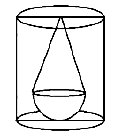
Diameter of hemisphere $= 7 \ cm$
Diameter of the base of the cone $= 7 \ cm$
Therefore, radius $(r) = 3.5 \ cm$
Height $(h) = 8 \ cm$
Volume of the solid $=\frac{1}{3} \pi r^2 h+\frac{2}{3} \pi r^3=\frac{1}{3} \pi r^2(h+2 r)$
$=\frac{1}{3} \times \frac{22}{7} \times 3.5 \times 3.5(8+2 \times 3.5)$
$=\frac{77}{6}(8+7)$
$=\frac{385}{2}$
$=192.5 \ cm ^3$
Now, radius of cylindrical vessel $(R) = 7 \ cm$
Height $(H) = 10 \ cm$
$\therefore$ Volume $=\pi R^2 h$
$=\frac{22}{7} \times 7 \times 7 \times 10$
$=1540 \ cm ^3$
Volume of water required to fill $=1540-192.5=1347.5 \ cm ^3$ View full question & answer→Question 135 Marks
A test tube consists of a hemisphere and a cylinder of the same radius. The volume of the waterrequired to fill the whole tube is $\frac{5159}{6} m ^3$ and $\frac{4235}{6} \ cm ^3 $ of water is required to fill the tube toa level which is $4 \ cm$ below the top of the tune. Find the radius of the tube and the length of its cylindrical part.
Answer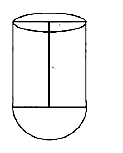
Volume of water filled in the test tube $=\frac{5159}{6} \ cm ^3$
Volume of water filled up to $4 \ cm =\frac{4235}{6} \ cm ^3$
Let $r$ be the radius and $h$ be the height of test tube
$\therefore \frac{2}{3} \pi r^3+\pi r^h g=\frac{5159}{6}$
$\Rightarrow \pi r^2\left(\frac{2}{3} r+h\right)=\frac{5159}{6}$
$\Rightarrow \frac{\pi r^2}{3}(2 r+3 h)=\frac{5159}{6}$
$\Rightarrow \pi r^2(2 r+3 h)=\frac{5159}{2} \ldots .......(1)$
And
$\frac{2}{3} \pi r^3+\pi r^2(h-4)=\frac{4235}{6}$
$\Rightarrow \pi r^2\left(\frac{2}{3} r+h-4\right)=\frac{4235}{6}$
$\Rightarrow \pi \frac{r^2}{3}(2 r+3 h-12)=\frac{4235}{6}$
$\Rightarrow \pi r^2(2 r+3 h-12)=\frac{4235}{2} \ldots.........(2)$
Dividing $(1)$ by $(2)$
$\frac{2 r+3 h}{2 r+3 h-12}=\frac{5259}{4235}......(3)$
Subtracting $(2)$ from $(1)$
$\pi r^2(12)=\frac{5159}{2}-\frac{4235}{2}=\frac{924}{2}$
$\Rightarrow 12 \times \frac{22}{7} \times r^2=\frac{924}{2}$
$\Rightarrow r^2=\frac{924 \times 7}{2 \times 12 \times 22}=\frac{7 \times 7}{2 \times 2}$
$\Rightarrow r^2=\frac{49}{44}$
$\Rightarrow r=\frac{7}{2}=3.5 \ cm $
Subtracting the value of $r$ in $(3)$
$ \frac{2 \times \frac{7}{2}+3 h}{2 \times \frac{7}{2}+3 h-12}=\frac{5159}{4235}$
$\Rightarrow \frac{7+3 h}{7-3 h-12}=\frac{5159}{4235}$
$\Rightarrow \frac{7+3 h}{7+3 h-12}=\frac{469}{385}$
$\Rightarrow 2695++1155 h =1407 h -233455$
$\Rightarrow 252 h =5040$
$\Rightarrow h =20$
Hence, height $= 20 \ cm$ and radius $= 3.5 \ cm$ View full question & answer→Question 145 Marks
An exhibition tent is in the form of a cylinder surmounted by a cone. The height of the tent above the ground is $85 m$ and height of the cylindrical part of $50 m.$ If the diameter of the base is $168 m,$ find the quantity of canvas required to make the tent. Allow $20\%$ extra for fold and for stitching. Give your answer to the nearest $m^2.$
Answer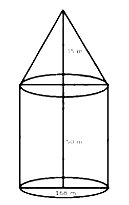
Total height of the tent $= 85 m$
Diameter of the base $= 168 m$
Therefore, radius $(r) = 84 m$
Height of the cylindrical part $= 50 m$
Then height of the conical part $= (85 - 50) = 35 m$
Slant height $(1)=$
$\sqrt{r^2+h^2}=\sqrt{84^2+35^2}=\sqrt{7056+1225}=\sqrt{8281}=91 \ cm$
$\text { Total surface area of the tent }=2 \pi r h+\pi r l=\pi(2 h+l)$
$=\frac{22}{7} \times 84(250+91)$
$=264(100+91)$
$=264 \times 191$
$=50424 m ^2$
Since $20\%$ extra is needed for folds and stitching,
total area of canvas needed
$=50424 \times \frac{120}{100}$
$=60508.8$
$=60509 m ^2$ View full question & answer→Question 155 Marks
A solid, consisting of a right circular cone, standing on a hemisphere, is placed upright, in a right circular cylinder, full of water, and touches the bottom. Find the volume of water left in the cylinder, having given that the radius of the cylinder is $3 \ cm$ and its height is $6 \ cm;$ the radius of the hemisphere is $2 \ cm$ and the height of the cone is $4 \ cm.$ Give your answer to the nearest cubic centimeter.
Answer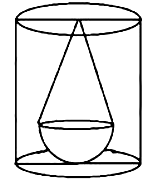
Radius of cylinder $= 3 \ cm$
Height of cylinder $= 6 \ cm$
Radius of hemisphere $= 2 \ cm$
Height of cone $= 4 \ cm$
Volume of water in the cylinder when it is full $=\pi r ^2 h =\pi \times 3 \times 3 \times 6=54 \pi \ cm ^3$
Volume of water displaced $=$ volume of cone $+$ volume ofhemisphere
$=\frac{1}{3} \pi r ^2 h +\frac{2}{3} \pi r ^3$
$=\frac{1}{3} \pi r ^2( h +2 r )$
$=\frac{1}{3} \pi \times 2 \times 2(4+2 \times 2)$
$=\frac{1}{3} \pi \times 4 \times 8$
$=\frac{32}{3} \pi \ cm ^3$
Therefore, volume of water which is left
$=54 \pi-\frac{32}{3} \pi$
$=\frac{130}{3} \pi \ cm ^3$
$=\frac{130}{3} \times \frac{22}{7} \ cm ^3$
$=\frac{2860}{21} \ cm ^3$
$=136.19 \ cm ^3$
$=136 \ cm ^3$ View full question & answer→Question 165 Marks
A cylindrical water tank of diameter $2.8 \ m$ and height $4.2 \ m$ is being fed by a pipe of diameter $7 \ cm$ through which water flows at the rater of $4\ ms^{-1}$. Calculate, in minutes, the time it takes to fill the tank.
AnswerDiameter of cylindrical tank $= 2.8\ m$
Therefore, radius $= 1.4\ m$
Height $= 4.2\ m$
Volume of water filled in it $=\pi r^2 h$
$=\frac{22}{7} \times 1.4 \times 1.4 \times 4.2 m ^3$
$=\frac{181.104}{7} m ^3$
$=25.872 m ^3........(1)$
Diameter of pipe $= 7 \ cm$
Therefore, radius $(r)=\frac{7}{2}$
Let length of water in the pipe $=h_1$
$\therefore$ Volume $=\pi r^2 h_1$
$ =\frac{22}{7} \times \frac{7}{2} \times \frac{7}{2} \times h_1$
$=\frac{77}{2} h_1 \ cm ^3.......(2)$
From $(1)$ and $(2)$
$\frac{77}{2} h_1 \ cm ^3=25.872 \times 100^3 \ cm ^3$
$\Rightarrow h_1=25.872 \times 100^3 \ cm ^3$
$\Rightarrow h_1=\frac{25.872 \times 100^3 \times 2}{77}$
$\Rightarrow h_1=0.672 \times 100^2 m$
$\Rightarrow h_1=6720 m $
Therefore, time taken at the speed of $4\ m$ per second $\frac{6720}{4 \times 60}$ minutes $=28$ minutes
View full question & answer→Question 175 Marks
A vessel is a hollow cylinder fitted with a hemispherical bottom of the same base. The depth ofthe cylindrical part is $4 \frac{2}{3}$ and the diameter of hemisphere is $3.5 m.$ Calculate the capacity andthe internal surface area of the vessel.
Answer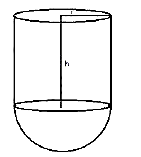
Diameter of the base $= 3.5 m$
Therefore, radius $=\frac{3.5}{2} m=1.75 m=\frac{7}{4} m$ Height of cylindrical part $=4 \frac{2}{3}=\frac{14}{3} m$
$(1)$ Capacity $($volume$)$ of the vessel $=\pi r^2 h+\frac{2}{3} \pi r^3=\pi r^2\left(h+\frac{2}{3} r\right)$
$=\frac{22}{7} \times \frac{7}{4} \times \frac{7}{4}\left(\frac{14}{3}+\frac{2}{3} \times \frac{7}{4}\right)$
$=\frac{77}{8}\left(\frac{14}{3}+\frac{7}{6}\right)$
$=\frac{77}{8}\left(\frac{28+7}{6}\right)$
$=\frac{77}{8} \times \frac{35}{6}$
$=\frac{2695}{48}$
$=56.15 m ^3$
Internal curved surface area
$=2 \pi r h+2 \pi r^2=2 \pi r(h+r)$
$=2 \times \frac{22}{7} \times \frac{7}{4}\left(\frac{14}{3}+\frac{7}{4}\right)$
$=11\left(\frac{56+21}{12}\right)$
$=11 \times \frac{77}{12}$
$=\frac{847}{12}$
$=70.58 m ^2$ View full question & answer→Question 185 Marks
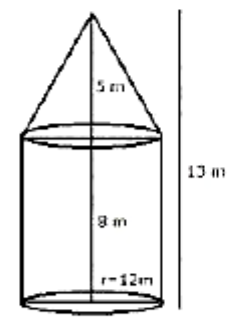
A circus tent is cylindrical to a height of 8m surmounted by a conical part. If total height of thetent is 13m and the diameter of its base is 24m; calculate:
(i) total surface area of the tent,
(ii) area of canvas, required to make this tent allowing 10% of the canvas used for folds andstitching.
Question 195 Marks
From a solid cylinder whose height is $16 \ cm$ and radius is $12 \ cm,$ a conical cavity of height $8 \ cm$ and of base radius $6 \ cm$ is hollowed out. Find the volume and total surface area of the remaining solid.
Answer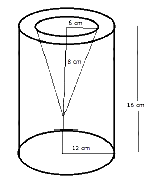
Radius of solid cylinder $(R) = 12 \ cm$
and Height $(H) = 16 \ cm$
$\therefore \text { Volume }=\pi R ^2 H$
$=\frac{22}{7} \times 12 \times 12 \times 16$
$=\frac{50688}{7} \ cm ^3$
Radius of cone $(r) = 6 \ cm,$ and height $(h) = 8 \ cm$.
$\therefore \text { Volume }=\frac{1}{3} \pi r ^2 h$
$=\frac{1}{3} \times \frac{22}{7} \times 6 \times 6 \times 8$
$=\frac{2112}{7} \ cm ^3$
$(1)$ Volume of remaining solid
$=\frac{50688}{7}-\frac{2112}{7}$
$=\frac{48567}{7}$
$=6939.43^2 \ cm ^3$
$(2)$ Slant height of cone $I =\sqrt{ h ^2+ r ^2}$
$=\sqrt{6^2+8^2}$
$=\sqrt{36+64}$
$=\sqrt{100}$
$=10 \ cm $
Therefore, total surface area of remaining solid $=$ curved surface area of cylinder $+$ curvedsurface area of cone $+$ base area of cylinder $+$ area of circular ring on upper side of cylinder
$=2 \pi RH +\pi rl +\pi R ^2+\pi\left( R ^2- r ^2\right)$
$=\left(2 \times \frac{22}{7} \times 12 \times 16\right)+\left(\frac{22}{7} \times 6 \times 10\right)+\left(\frac{22}{7} \times 12 \times 12\right)+\left(\frac{22}{7}\left(12^2-6^2\right)\right)$
$=\frac{8448}{7}+\frac{1320}{7}+\frac{3168}{7}+\frac{22}{7}(144-36)$
$=\frac{8448}{7}+\frac{1320}{7}+\frac{3168}{7}+\frac{2376}{7}$
$=\frac{15312}{7}$
$=2187.43 \ cm ^2$
View full question & answer→Question 205 Marks
A cylindrical can, whose base is horizontal and of radius $3.5 \ cm,$ contains sufficient water sothat when a sphere is placed in the can, the water just covers the sphere. Given that the spherejust fits into the can, calculate:
Answer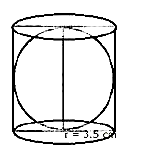
Radius of the base of the cylindrical can $= 3.5 \ cm$
$(1)$ When the sphere is in can, then total surface area of the can $=$ Base area $+$ curved surface area
$=\pi r^2+2 \pi r h$
$=\left(\frac{22}{7} \times 3.5 \times 3.5\right)+\left(2 \times \frac{22}{7} \times 3.5 \times 7\right)$
$=\frac{77}{2}+154$
$=38.5=154$
$=192.5 \ cm ^2$
$(2)$ Let depth of water $= x \ cm$
When sphere is not in the can, then volume of the can $=$ volume of water $+$ volume of sphere
$\Rightarrow \pi r^2 h+\pi^2 x \times+\frac{4}{3} \pi r^3$
$\Rightarrow \pi r^2 h+\pi r^2\left(x+\frac{4}{3} r\right)$
$\Rightarrow h=x+\frac{4}{3} r$
$\Rightarrow x=h-\frac{4}{3} r$
$\Rightarrow x=7-\frac{4}{3} \times \frac{7}{2}$
$\Rightarrow x=7-\frac{14}{3}$
$\Rightarrow x=\frac{21-14}{3}$
$\Rightarrow x=\frac{7}{3}$
$\Rightarrow x=2 \frac{1}{3} \ cm $ View full question & answer→Question 215 Marks
An open cylindrical vessel of internal diameter $7 \ cm$ and height $8 \ cm$ stands on a horizontaltable. Inside this is placed a solid metallic right circular cone, the diameter of whose base is $3 \frac{1}{2} \ cm$ and height $8 \ cm$. Find the volume of water required to fill the vessel.
If this cone is replaced by another cone, whose height is $1 \frac{3}{4} \ cm$ and the radius of whose base is $2 \ cm,$ find the drop in the water level.
AnswerDiameter of the base of the cylinder $=7 \ cm$
Therefore, radius of the cylinder $=\frac{7}{2} \ cm$
Volume of the cylinder $\pi r^2 h$
$=\frac{22}{7} \times \frac{7}{2} \times \frac{7}{2} \times 8$
$=308 \ cm ^3$
Diameter of the base of the cone $=\frac{7}{2} \ cm$
Therefore, radius of the cone $=\frac{7}{4} \ cm$
Volume of the cone $=\frac{1}{3} \pi r^2 h$
$=\frac{1}{3} \times \frac{22}{7} \times \frac{7}{4} \times \frac{7}{4} \times 8$
$=\frac{77}{3} \ cm ^3$
On placing the cone into the cylindrical vessel, the volume of the remaining portion where thewater is to be filled
$=308-\frac{77}{3}$
$=\frac{924-77}{3}$
$=\frac{847}{3}$
$=282.33 \ cm ^3$
Height of new cone $=1 \frac{3}{4}=\frac{7}{4} \ cm$
Radius $= 2 \ cm$
Therefore, volume of new cone
$=\frac{1}{3} \pi r^2 h$
$=\frac{1}{3} \times \frac{22}{7} \times 2 \times 2 \times \frac{7}{4}$
$=\frac{22}{3} \ cm ^3$
Volume of water which comes down $=\frac{77}{3}-\frac{22}{3} \ cm ^3$
$=\frac{55}{3} \ cm ^3......(1)$
Let $h$ be the height of water which is dropped down.
Radius $=\frac{7}{2} \ cm$
$\therefore$ Volume $=\pi r^2 h$
$=\frac{22}{7} \times \frac{7}{2} \times \frac{7}{2} \times h.......(2)$
From $(1)$ and $(2)$
$\frac{77}{2} h=\frac{55}{3}$
$\Rightarrow h=\frac{55}{3} \times \frac{22}{77}$
$\Rightarrow h=\frac{10}{21}$
Drop in water level $=\frac{10}{21} \ cm$
View full question & answer→Question 225 Marks
The horizontal cross $-$ section of a water tank is in the shape of a rectangle with semi $-$ circle at oneend, as shown in the following figure. The water is $2.4$ metres deep in the tank. Calculate thevolume of water in the tank in gallons.
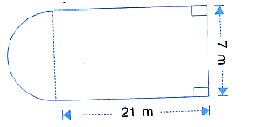
AnswerLength $= 21 m$
Depth of water $= 2.4 m$
Breadth $= 7 m$
Therefore, radius of semicircle $=\frac{7}{2} m$
Area of cross-section $=$ area of rectangle $+ $ Area of semicircle
$=1 \times b+\frac{1}{2} \pi r^2$
$=21 \times 7+\frac{1}{2} \times \frac{22}{7} \times \frac{7}{2} \times \frac{7}{2}$
$=147+\frac{77}{4}$
$=\frac{588+77}{4}$
$=\frac{665}{4} m^2$
Therefore, volume of water filled in gallons
$=\frac{665}{4} \times 2.4 m ^3$
$=665 \times 0.6$
$=399 m ^3$
$=399 \times 100^3 \ cm ^3$
$=\frac{399 \times 100 \times 100 \times 100}{1000} \text { gallons }$
$=\frac{399 \times 100 \times 100 \times 100}{1000 \times 4.5}$
$=\frac{399 \times 100 \times 100 \times 100 \times 10}{1000 \times 45} \text { gallons }$
$=\frac{1330000}{15} \text { gallons }$
$=\frac{266000}{3} \text { gallons }$
$=88666.67 \text { gallons }$
View full question & answer→Question 235 Marks
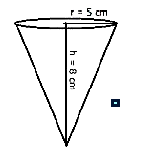
A vessel is in the form of an inverted cone its height is 8 cm and the radius of its top, which isopen, is 5 cm. If is filled with water up to the rim. When lead shots each of which is a sphere ofradius 0.5 cm are dropped into the vessel, one fourth of the water flows out. Find the number oflead shots sopped in the vessel.
Question 245 Marks
From a rectangular solid of metal $42 \ cm$ by $30 \ cm$ by $20 \ cm,$ a conical cavity of diameter $14 \ cm$ and depth $24 \ cm$ is drilled out. Find: the volume of remaining solid
AnswerDimensions of rectangular solids $=(42 \times 30 \times 20) \ cm$
volume $=(42 \times 30 \times 20)=25200 \ cm ^3$
Radius of conical cavity $(r) =7 \ cm$
height $(h)=24 \ cm$
$\text { Volume of cone }=\frac{1}{3} \pi r^2 h$
$=\frac{1}{3} \times \frac{22}{7} \times 7 \times 7 \times 24$
$=1232 \ cm ^3$
Volume of remaining solid $=(25200-1232)=23968 \ cm ^3$
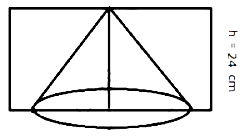
Radius of conical cavity $(r) =7 \ cm$
height $(h) = 24 \ cm$
$\text { Volume of cone }=\frac{1}{3} \pi r ^2 h$
$=\frac{1}{3} \times \frac{22}{7} \times 7 \times 7 \times 24$
$=1232 \ cm ^3$
Volume of remaining solid $= (25200 - 1232) = 23968 \ cm^3$ View full question & answer→Question 255 Marks
A buoy is made in the form of hemisphere surmounted by a right cone whose circular basecoincides with the plane surface of hemisphere. The radius of the base of the cone is $3.5$ metres and its volume is two third of the hemisphere. Calculate the height of the cone and the surfacearea of the buoy, correct to two places of decimal
AnswerRadius of hemispherical part $( r )=3.5 m =\frac{7}{2} m$
Therefore, Volume of hemisphere $=\frac{2}{3} \pi r^3$
$=\frac{2}{3} \times \frac{22}{7} \times \frac{7}{2} \times \frac{7}{2} \times \frac{7}{2}$
$=\frac{539}{6} m^3$
Volume of conical part $\frac{2}{3} \times \frac{539}{6} m^3\left(\frac{2}{3}\right.$ of hemisphere $)$
Let height of the cone $= h$
Then,
$\frac{1}{3} \pi r^2 h=\frac{2 \times 539}{3 \times 6}$
$\Rightarrow \frac{1}{3} \times \frac{22}{7} \times \frac{7}{2} \times \frac{7}{2} \times h=\frac{2 \times 539}{3 \times 6}$
$\Rightarrow=\frac{2 \times 539 \times 2 \times 2 \times 7 \times 3}{3 \times 6 \times 22 \times 7 \times 7}$
$\Rightarrow h=\frac{14}{3} m =4 \frac{2}{3} m =4.67 m $
Height of the cone $=4.67 m$
Surface area of buoy $=2 \pi r^2+\pi r l$
But $ I =\sqrt{r^2+h^2}$
$l=\sqrt{\left(\frac{7}{2}\right)^2+\left(\frac{14}{3}\right)^2}$
$=\sqrt{\frac{49}{4}+\frac{196}{9}}$
$=\frac{\sqrt{1225}}{36}=\frac{35}{6} m$
Therefore, Surface area
$=\left(2 \times \frac{22}{7} \times \frac{7}{2} \times \frac{7}{2}\right)+\left(\frac{22}{7} \times \frac{7}{2} \times \frac{35}{6}\right) m ^2$
$=\frac{77}{1}+\frac{385}{6}=\frac{847}{6}$
$=141.17 m ^2$
Surface Area $=141.17 m ^2$
View full question & answer→Question 265 Marks
Eight metallic spheres; each of radius $2 \ mm,$ are melted and cast into a single sphere. Calculatethe radius of the new sphere.
AnswerRadius of metallic sphere $=2 \ mm =\frac{1}{5} \ cm$
Volume
$=\frac{4}{3} \pi r^3=\frac{4}{3} \times \frac{22}{7} \times \frac{1}{5} \times \frac{1}{5} \times \frac{1}{5}$
$=\frac{88}{21 \times 125} \ cm ^3$
Volume of $8$ spheres $=\frac{88 \times 8}{21 \times 125}$
$=\frac{704}{21 \times 125} \ cm ^3$
Let radius of new sphere $=R$
$\therefore$ volume $=\frac{4}{3} \pi r^3=\frac{4}{3} \times \frac{22}{7} R^3$
$=\frac{88}{21} R^3$
Volume of $8$ spheres $=\frac{88 \times 8}{21 \times 125}$
$=\frac{704}{21 \times 125} \ cm ^3......(1)$
Let radius of new sphere $=R$
$\therefore$ volume $=\frac{4}{3} \pi r^3$
$=\frac{4}{3} \times \frac{22}{7} R^3=\frac{88}{21} R^3.......(2)$
From $(1)$ and $(2)$
$\frac{88}{21} R^3=\frac{704}{21 \times 125}$
$\Rightarrow \frac{88}{21} R^3=\frac{704}{21 \times 125}$
$\Rightarrow R^3=\frac{704}{21 \times 125} \times \frac{21}{88}=\frac{8}{125}$
$\Rightarrow R=\frac{2}{5}=0.4 \ cm =4 \ mm $
View full question & answer→Question 275 Marks
The surface area of a solid sphere is increased by $21\%$ without changing its shape. Find the percentage increase in its: volume
AnswerLet the volume of the sphere be $V$
Let the new volume of the sphere be $V\ '.$
$V=\frac{4}{3} \pi r^3$
$V^I=\frac{4}{3} \pi r_1^3$
$\Rightarrow V^I=\frac{4}{3} \pi\left(\frac{11 r}{10^3}\right)$
$\Rightarrow V^I=\frac{4}{3} \pi \frac{1331}{1000} r^3$
$\Rightarrow v^I=\frac{4}{3} \pi r^3 \frac{1331}{1000}$
$\Rightarrow V^I=\frac{1331}{1000} V$
$\Rightarrow V^I=v+\frac{1331}{1000} v$
$\Rightarrow V^I-v=\frac{331}{1000} v$
$\therefore$ Change in volume $=\frac{331}{10000} v$
Percentage change in volume $=\frac{\text { Change in volume }}{\text { original volume }} \times 100$
$=\frac{\frac{331}{1000} V}{V} \times 100$
$=\frac{331}{10}$
$=33.1$
Percentage change in volume $=33.1\%$
View full question & answer→Question 285 Marks
The surface area of a solid sphere is increased by $12\%$ without changing its shape. Find the percentage increase in its: radius .
AnswerLet the radius of the sphere be $'r\ '.$
Total surface area the sphere, $S=4 \pi r^2$
New surface area of the sphere, $S^{\prime}$
$=4 \pi r^2+\frac{21}{100} \times 4 \pi r^2$
$=\frac{121}{1004} \pi r^2$
$(1)$ let the new radius be $r^1$
$S^I=4 p r_1^2$
$S^I=\frac{121}{1004} \pi r^2$
$\Rightarrow 4 \pi r_1^2=\frac{121}{100} 4 \pi r^2$
$\Rightarrow r_1^2=\frac{121}{100} r^2$
$\Rightarrow r_1=\frac{11}{10} r$
$\Rightarrow r_1=r+\frac{r}{10}$
$\Rightarrow r_1-r=\frac{r}{10}$
$\Rightarrow \text { change in radius }=\frac{r}{10}$
Percentage change in radius $=\frac{\text { change in radius }}{\text { change in radius }} \times 100$
$\Rightarrow \frac{\frac{r}{10}}{r} \times 100$
Percentage change in radius $=10\%$
View full question & answer→Question 295 Marks
A solid sphere and a solid hemi $-$ sphere have the same total surface area. Find the ratio between their volumes.
AnswerLet the radius of the sphere be $I r_1 I$.
Let the radius of the hemisphere be $I r_2 I$
$\text{TSA }$ of sphere $=4 \pi r_1^2$
$\text{TSA }$ of hemisphere $=3 \pi r_2^2 e$
$\text{TSA }$ of sphere $=\text{TSA }$ of hemi $-$ sphre
$4 \pi r_1^2=3 \pi r_2^2$
$\Rightarrow r_2^2=\frac{4}{3} r_1^2$
$\Rightarrow r_2=\frac{2}{\sqrt{3}} r_1$
Volume of sphere, $v_1=\frac{4}{3} \pi r_1^3$
Volume of hemisphere, $v_2=\frac{2}{3} \pi r_2^3$
$v_2=\frac{2}{3} \pi r_2^3$
$\Rightarrow v_2=\frac{2}{3} \pi\left(\frac{r_1 2}{3 \sqrt{3}}\right)^3$
$\Rightarrow v_2=\frac{2}{3} \pi \frac{r_2^3 8}{3 \sqrt{3}}$
Dividing $v_1$ by $ v_2$
$\frac{v_1}{v_2}=\frac{\frac{4}{3} \pi r_1^3}{\frac{2}{3} \pi \frac{8}{3 \sqrt{3}} r_1^3}$
$\Rightarrow \frac{v_1}{v_2}=\frac{\frac{4}{3}}{\frac{2}{3} \frac{8}{3 \sqrt{3}}}$
$\Rightarrow \frac{v_1}{v_2}=\frac{4}{3} \times \frac{9 \sqrt{3}}{16}$
$\Rightarrow \frac{v_1}{v_2}=\frac{3 \sqrt{3}}{4}$
View full question & answer→Question 305 Marks
Find what length of canvas, $1.5\ m$ in width, is required to make a conical tent $48\ m$ in diameterand $7\ m$ in height. Given that $10\%$ of the canvas is used in folds and stitching’s. Also. Find thecost of the canvas at the rate of $Rs. 24$ per metre.
AnswerDiameter of the tent $= 48 m$
Therefore, radius $(r) = 24 m$
Height $(h) = 7 m$
Slant height (ℓ) = $\sqrt{r^2+h^2}$
$=\sqrt{(24)^2+(7)^2}$
$=\sqrt{576+49}$
$=\sqrt{625}$
$=25 m $
Curved surface area $=\pi r l$
$=\frac{22}{7} \times 24 \times 25$
$=\frac{13200}{7} m ^2$
$=1885.71 m ^2$
But it is given that $10\%$ allowance for folds and stiching
Hence modified area $=1885.71 m ^2+\frac{10}{100} \times 1885.71 m ^2$
$=2074.28 m ^2$
Width of canvas $= 1.5 m$
$\therefore$ Length of canvas $= \frac{\text { Area of canvas }}{\text { width of canvas }}$
$=\frac{2074.28 m ^2}{1.5 m }$
$=1382.85 m $
Now cost of $1 m = Rs. 24$
Hence cost of $1382.85 m = Rs. 24 \times 1382.85 $
$= Rs. 33188.4.$
View full question & answer→Question 315 Marks
A heap of wheat is in the form of a cone of diameter $16.8\ m$ and height $3.5\ m$. Find its volume.How much cloth is required to just cover the heap?
AnswerDiameter of the cone $= 16.8 m$
Therefore, radius $(r) = 8.4 m$
Height $(h) = 3.5 m$
$(1)$ Volume of heap of wheat $\frac{1}{3} \pi r^2 h$
$=\frac{1}{3} \times \frac{22}{7} \times 8.4 \times 8.4 \times 3.5$
$=258.72 m ^3$
$(2)$ Slant height $( I )=\sqrt{r^2+h^2}$
$\sqrt{(8.4)^2+(3.5)^2}$
$=\sqrt{70.56+12.25}$
$=\sqrt{82.81}$
$=9.1 m $
Therefore, cloth required or curved surface area $= \pi rℓ$
$=\frac{22}{7} \times 8.4 \times 9.1$
$=240.24 m^ 2$
View full question & answer→Question 325 Marks
Two right circular cone $x$ and $y$ are made x having three times the radius of $y$ and $y$ having halfthe volume of $x$. Calculate the ratio between the heights of $x$ and $y.$
AnswerLet radius of cone $y = r$
Therefore, radius of cone $x = 3r$
Let volume of cone $y = V$
then volume of cone $x = 2V$
Let h1 be the height of $x$ and $h2$ be the height of $y.$
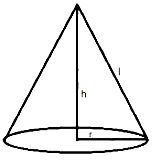
Therefore, Volume of cone$=\frac{1}{3} \pi r^h$
Volume of cone $x=\frac{1}{3} \pi(3 r)^2 h_1=\frac{1}{3} \pi 9 r^2 h_1=3 \pi^2 h_1$
Volume of cone $y=\frac{1}{3} \pi r^2 h_1$
$\therefore 2 \frac{V}{v}=\frac{3 \pi r^2 j_1}{\frac{1}{3} \pi r^2 h_2}$
$\Rightarrow \frac{2}{1}=\frac{3 h_1 \times 3}{h_2}=\frac{9 h_1}{h_2}$
$\Rightarrow \frac{h_1}{h_2}=\frac{2}{1} \times \frac{1}{9}=\frac{2}{9}$
$\therefore h_1: h_2=2: 9$ View full question & answer→Question 335 Marks
The radius and the height of a right circular cone are in the ratio $5 : 12$ and its volume is $2512cubic \ cm$. Find the radius and height of the cone $($Take $\pi = 3.14)$
AnswerThe ratio between radius and height $=5:12$
Volume $=2512 \ cm$
Let radius $(r)=5x,$ hight $(h)=12x$ and slant height $= l$
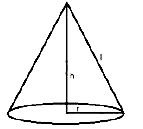
$l^2=r^2+h^2$
$\Rightarrow l^2=(5 x)^2+(12 x)^2$
$\Rightarrow l^2=25 x^2+144 x^2$
$\Rightarrow l^2=169 x^2$
$\Rightarrow=13 x $
Now volume $=\frac{1}{3} \pi r^2 h$
$\Rightarrow \frac{1}{3} \pi r^2 h=2512$
$\Rightarrow \frac{1}{3}(3.14)(5 x)^2(12 x)=2512$
$\Rightarrow \frac{1}{3}(3.14)\left(300 x^3\right)=2512$
$\therefore x^3=\frac{2512 \times 3}{3.14 \times 300}$
$=\frac{2512 \times 3 \times 100}{314 \times 300}=8$
$\Rightarrow x=2$
$\therefore$ Radius $=5 x=5 \times 2=10$
Height $=12 x=12 \times 2=24 \ cm$
Slantheight $=13 x=13 \times 2=26 \ cm $ View full question & answer→Question 345 Marks
A vessel, in the form of an inverted cone, is filled with water to brim. Its height is $32 \ cm$ anddiameter of the base is $25.2 \ cm$. Six equal solid cones are dropped in it, so that they are fullysubmerged. As a result one fourth of water is volume of each of the solid cone submerged?
Answer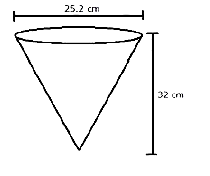
Volume of vessel=volume of water $=\frac{1}{3} \pi r^2 h$
diameter $= 25.2 \ cm,$
therefore radius $= 12.6 \ cm$
height $= 32 \ cm$
Volume of water in the vessel=$\frac{1}{3} \pi r^2 h$
$=\frac{1}{3} \times \frac{22}{7} \times 12.6 \times 12.6 \times 32$
$=5322.24 \ cm ^3$
On submerging six equal solid cones into it, one $-$ fourth of the water overflows.
Therefore, volume of the equal solid cones submerged
$= $ Volume of water that overflows
$=\frac{1}{4} \times 5322.24$
$=1330.56 \ cm ^3$
Now, volume of each cone submerged
$=\frac{1330.56}{6}=221.76 \ cm ^3$ View full question & answer→Question 355 Marks
The area of the base of a conical solid is $38.5 \ cm^2$ and its volume is $154 \ cm^3.$ Find curved surface area of the solid.
AnswerArea of the base, $\pi r^2=38.5 \ cm ^2$
Volume of the solid, $V =154 \ cm ^3$
Curved surface area of the solid $=\pi r^2 h$
$\text { Volume, } V =\frac{1}{3} \pi r^2 h$
$\Rightarrow 154=\frac{1}{3} \pi r^2 h$
$\Rightarrow h =\frac{154 \times 3}{\pi r^2}$
$\Rightarrow h =\frac{154 \times 3}{38.5}$
$=12 \ cm $
$\text { Area }=38.5$
$\pi r^2=38.5$
$\Rightarrow r^2=\frac{38.5}{3.14}$
$\Rightarrow r=\sqrt{\frac{38.5}{3.14}}$
$=3.5$
$\text { Curved surface area of solid }=\pi r l$
$=\pi r \sqrt{r^2+h^2}$
$=\frac{22}{7} \times 3.5 \times \sqrt{3.5^2+12^2}$
$=\frac{22}{7} \times 3.5 \times 12.5$
$=137.5 \ cm ^2$
View full question & answer→Question 365 Marks
A metal pipe has a bore $($inner diameter$)$ of $5 \ cm.$ The pipe is $5 \ mm$ thick all round. Find the weight, in kilogram, of $2$ metresof the pipe if $1 \ cm^3$ of the metal weights $7.7 g.$
AnswerInner radius of the pipe $= r = \frac{5}{2} \ cm = 2.5 \ cm$
External radius of the pipe $= R =$ Inner radius of the pipe $+$ Thickness of the pipes
$= 2.5 \ cm + 0.5 \ cm = 3 \ cm$
Length of the pipe $= h = 2 m = 200 \ cm$
Volume of the pipe $=$ External Volume $-$ Internal volume
$=\pi R ^2 h -\pi r ^2 h$
$=\pi\left( R ^2- r ^2\right) h$
$=\frac{22}{7}\left(3^2-\left(\frac{5}{2}\right)^2\right) \times 200$
$=\frac{22}{7} \times\left(9-\frac{25}{4}\right) \times 200$
$=\frac{22}{7} \times\left(\frac{36-25}{4}\right) \times 200$
$=\frac{22}{7} \times \frac{11}{4} \times 200$
$=\left(\frac{22}{7} \times 550\right)$
$=1728.6 \ cm ^3$
Since $1 \ cm^3$ of the metal weights $7.7 g,$
$\therefore$ Weight of the pipe $= (1728.6 \times 7.7)g$
$=\left(1728 \times \frac{7.7}{1000}\right) \ kg$
$=13.31 \ kg $
View full question & answer→Question 375 Marks
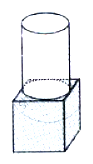
The given figure shows a solid formed of a solid cube of side $40\ cm$ and a solid cylinder of radius $20 \ cm$ and height $50 \ cm$ attached to the cube as shown.
Find the volume and the total surface area of the whole solid $($Take $\pi = 3.14).$AnswerEdge of a cube $= I = 40 \ cm$
$\therefore$ Volume of a cube $= I^3 = (40)^3 = 64000 \ cm^3$
Radius of a solid cylinder $= r = 20 \ cm$
Height of a solid cylinder $= h = 50 \ cm$
$\therefore$ Volume of cylinder $= \pi r^2h$
$= 3.14 \times 20 \times 20 \times 50$
$= 62800 \ cm^3$
$\therefore$ Volume of whole solid $=$ Volume of cube $+$ Volume of cylinder
$= (64000 + 62800) \ cm^3$
$= 126800 \ cm^3$
Total surface area of the whole solid
$=$ Total surface area of a cube $+$ Curved surface area of a cylinder
$= 6l^2 + 2\pi rh$
$= 6 \times (40)^2 \times 2 \times 3.14 \times 20 \times 50$
$= 9600 + 6280$
$= 15880 \ cm^2$
View full question & answer→Question 385 Marks
The total surface area of a hollow cylinder, which is open from both sides, is $3575 \ cm^2;$ area of the base ring is $357.5 \ cm^2$ and height is $14 \ cm.$ Find the thickness of the cylinder.
AnswerTotal surface area of a hollow cylinder $= 3575 \ cm^2$
Area of the base ring $= 357.5 \ cm^2$
Height $= 14 \ cm$
Let external radius $= R$ and internal radius $= r$
Let thickness of the cylinder $= d = (R-r)$
Therefore, Total surface area $= 2\pi Rh + 2\pi rh + 2\pi (R^2 - r^2)$
$= 2\pi h (R+r)+2\pi (R+r)(R-r)$
$= 2\pi (R + r)(h + R - r)$
$= 2\pi (R + r) (h+d)$
$= 2\pi (R+r)(14+d)$
But
$2\pi (R+r)(14+d) = 3575 ...(i)$
and area of base =
$\pi (R^2 - r^2) = 357.5$
$\Rightarrow \pi (R+r)(R-r) = 357.5$
$\Rightarrow \pi (R+r)d = 357.5 ...(ii)$
Dividing $(i)$ by $(ii)$
$\frac{2 \pi( R + r )(14+ d )}{\pi( R + r ) d }=\frac{3575}{357.5}$
$\frac{2(14+ d )}{ d }=10$
$ 28+2 d=10 d$
$ 8 d=28$
$d =\frac{28}{8}=3.5 \ cm$
Hence , thickness of the cylinder $= 3.5 \ cm$
View full question & answer→Question 395 Marks
Two solid cylinders, one with diameter $60 \ cm$ and height $30 \ cm$ and the other with radius $30 \ cm$ and height $60 \ cm,$ aremetledandrecastedinto a third solid cylinder of height $10 \ cm.$ Find the diameter of the cylinder formed.
AnswerFor cylinder $1,$
Height $= h_1 = 30 \ cm$
Radius $=r_1=\frac{60}{2}=30 \ cm$
Volume $= V _1=\pi r _1^2 h _1=\pi \times 30 \times 30 \times 30=27000 \pi \ cm ^3$
For cylinder $2 ,$
Height $= h_2 = 60 \ cm$
Radius $= r_2 = 30 \ cm$
Volume $= V _2=\pi r _2^2 h _2=\pi \times 30 \times 30 \times 60=54000 \pi \ cm ^3$
Let r be the radius of the third cylinder.
Height $= h = 10 \ cm$
Volume $= V = \pi r^2h = \pi r^2 \times 10$
Now,
$V = V_1 + V_2$
$\Rightarrow \pi r^2 \times 10 = 27000 \pi + 54000 \pi$
$\Rightarrow \pi r^2 \times 10 = 81000 \pi$
$\Rightarrow r^2 = 8100$
$\Rightarrow r = 90$
$\Rightarrow$ Diameter $= 2r = 180 \ cm$
View full question & answer→Question 405 Marks
The total surface area of a solid cylinder is $616 \ cm^2.$ If the ratio between its curved surface area and total surface area is $1 :2;$ find the volume of the cylinder.
AnswerLet $r$ and h be the radius and height of a solid cylinder. Total surface area of a cylinder $= 616 \ cm^2$
$\Rightarrow 2\pi r (h+r) = 616 ....(i)$
Curved surface area of a cylinder $= 2\pi rh$
$\text { Now, } \frac{\text { Curved surface area of a cylinder }}{\text { Total surface area of a cylinder }}=\frac{1}{2}$
$\Rightarrow \frac{2 \pi rh }{2 \pi r ( h + r )}=\frac{1}{2}$
$\Rightarrow \frac{ h }{ h + r }=\frac{1}{2}$
$\Rightarrow h =1$
Substituting $h = r$ in $(i) ,$ we get
$2\pi r (r+r) = 616$
$\Rightarrow 2 \times \frac{22}{7} \times 2 r ^2=616$
$\Rightarrow r ^2=\frac{616 \times 7}{2 \times 22 \times 2}=49$
$\Rightarrow r =7= h$
$\therefore \text { Volume of cylinder }=\pi r ^2 h$
$=\frac{22}{7} \times 7 \times 7 \times 7=1078 \ cm ^3$
View full question & answer→Question 415 Marks
The difference between the outer curved surface area and the inner curved surface area of a hollow cylinder is $352 \ cm^2.$ If its height is $28 \ cm$ and the volume of material in it is $ 704 \ cm^3;$ find its external curved surface area.
AnswerLet $R$ and $r$ be the outer and inner radii of hollow mwtallic cylinder.
Let h be the height of the metallic cylinder. It is given that
Outer curved surface area $-$ Inner curved surface area $= 352$
$\Rightarrow 2\pi Rh - 2\pi rh = 352$
$\Rightarrow 2\pi h (R - r) = 352$
$\Rightarrow 2 \times \frac{22}{7} \times 28( R - r )=352$
$\Rightarrow R - r =\frac{352 \times 7}{2 \times 22 \times 28}$
$\Rightarrow R - r = 2 ...(i)$
Volume of material in it $= 704 \ cm^3$
$\Rightarrow \pi R^2h - \pi r^2h = 704$
$\Rightarrow \pi h (R^2 - r^2) = 704$
$\Rightarrow \frac{22}{7} \times 28\left( R ^2- r ^2\right)=704$
$\Rightarrow R ^2- r ^2=\frac{704 \times 7}{22 \times 28}$
$\Rightarrow (R + r)(R-r) = 8$
$\Rightarrow (R + r) \times 2 = 8$
$\Rightarrow R + r = 4 ...(ii)$
Adding $(i)$ and $(ii)$ we get
$2R = 6 \Rightarrow R = 3 \ cm$
$\therefore$ External curved surface area $= 2\pi Rh$
$=2 \times \frac{22}{7} \times 3 \times 28=528 \ cm ^2$
View full question & answer→Question 425 Marks
The sum of the inner and the outer curved surfaces of a hollow metallic cylinder is $1056 \ cm^2$ and the volume of material in it is $1056 \ cm^3.$ Find its internal and external radii. Given that the height of the cylinder is $21 \ cm.$
AnswerLet $R$ and $r$ be the outer and inner radii of hollow metallic cylinder.
Let h be height of the metallic cylinder. It is given that
Outer curved surface area $+$ Inner curved surface area $= 1056$
$\Rightarrow 2\pi Rh + 2\pi rh = 1056$
$\Rightarrow 2\pi h (R + r) = 1056$
$\Rightarrow 2 \times \frac{22}{7} \times 21(R+r)=1056$
$\Rightarrow R + r =\frac{1056 \times 7}{2 \times 22 \times 21}$
$\Rightarrow R + r =8 \ldots( i )$
Volume of material in it $= 1056 \ cm^3$
$\Rightarrow \pi R^2h - \pi r^2h = 1056$
$\Rightarrow \pi h (R^2 - r^2) = 1056$
$\Rightarrow \frac{22}{7} \times 21\left( R ^2- r ^2\right)=1056$
$\Rightarrow R ^2- r ^2=\frac{1056 \times 7}{22 \times 21}$
$\Rightarrow (R + r)(R-r) = 16$
$\Rightarrow 8 \times (R - r) = 16$
$\Rightarrow R - r = 2 ....(ii)$
Adding $(i)$ and $(ii) ,$ we get
$2R = 10 \Rightarrow R = 5 \ cm$
$\Rightarrow 5 - r = 2$
$\Rightarrow r = 3 \ cm$
$\therefore$ Internal radius $= 3 \ cm$ and External radius $= 5 \ cm$
View full question & answer→Question 435 Marks
$3080 \ cm^3$ of water is required to fill a cylindrical vessel completely and $2310 \ cm^3$ of water is required to fill itupto $5 \ cm$ below the top. Find :
$(i)$ radiusof the vessel.
$(ii)$ heightof the vessel.
$(iii)$ wettedsurface area of the vessel when it is half$-$filled with water.
AnswerLet $r$ be the radius of the cylindrival vessel and $h$ be its height
Now, volume of cylindrical vessel $=$ volume of water filled in it
$\Rightarrow \pi r ^2 h =3080$
$\Rightarrow \frac{22}{7} \times r ^2 \times h =3080$
$\Rightarrow r ^2 \times h =980 \ldots \text {. (i) }$
Volume of cylindrical vessel of height $5 \ cm = (3080 - 2310) \ cm^3$
$\Rightarrow \pi r ^2 \times 5=770$
$\Rightarrow \frac{22}{7} \times r ^2 \times 5=770$
$\Rightarrow r ^2=49$
$\Rightarrow r=7 \ cm $
Substituting $r^2 = 49$ in $(i) ,$ we get
$49 \times h = 980$
$\Rightarrow h = 20 \ cm$
Wetted surface area of the vessel when it is half $-$ filled with water
$=2 \pi rh +\pi r ^2$
$=\pi r (2 h + r )$
$=\frac{22}{7} \times 7(2 \times 10+7) \ldots . .\left(\text { Half }- \text { fil } \leq d \Rightarrow \text { Height }=\frac{20}{2}=10 \ cm \right)$
$=22 \times 27$
$=594 \ cm ^2$
View full question & answer→Question 445 Marks
Find the minimum length in $\ cm$ and correct to nearest whole number of the thin metal sheet required to make a hollow and closed cylindrical box of diameter $20 \ cm$ and height $ 35 \ cm.$ Given that the width of the metal sheet is $1 m.$ Also, find the cost of the sheet at the rate of $Rs. 56$ per $m.$ Find the area of metal sheet required, if $10\%$ of it is wasted in cutting, overlapping, etc.
AnswerHeight of the cylindrical box $= h = 35 \ cm$
Base radius of the cylindrical box $= r = 10 \ cm$
Width of metal sheet $= 1 m = 100 \ cm$
Area of metal sheet required $=$ Total surface area of the box
$\Rightarrow$ $\text { Length }$ $\times$ $\text { Width }$ $= 2 \pi r (r + h)$
$\Rightarrow \text { Length } \times 100=2 \times \frac{22}{7} \times 10(10+35)$
$\Rightarrow \text { Length } \times 100=2 \times \frac{22}{7} \times 10 \times 45$
$\Rightarrow \text { Length }=\frac{2 \times 22 \times 10 \times 45}{100 \times 7}=28.28 \ cm =28 \ cm $
$\therefore$ Area of metal sheet $=$ Length $\times$ width $= 28 \times 100 = 2800 \ cm^2 = 0.28 m^2$
$\therefore$ Cost of the sheet at the rate of $Rs. 56$ per $m^2 = Rs. (56 \times 028) = Rs. 15.68$
Let the total sheet required be $x.$
Then , $x - 10 \%$ of $x = 2800 \ cm^2$
$\Rightarrow x -\frac{10}{100} \times x =2800$
$\Rightarrow 9 x =2800$
$\Rightarrow x =3111 \ cm ^2$
View full question & answer→Question 455 Marks
The radius of a solid right circular cylinder decreases by $20\%$ and its height increases by $10\%.$ Find the percentage change in its : curved surface area.
AnswerCurved surface area $($Original$)$ of a solid right circular cylinder$=2 \pi rh$
$= 2 \pi \times 100 \times 100$
$= 20000 \pi \ cm^2$
Curved surface area $($New$)$ of a solid right circular cylinder
$= 2\pi r\ 'h\ '$
$= 2 \pi \times 80 \times 110$
$= 17600 \pi \ cm^2$
Decrease in curved area
$=$ Original $\text{CSA}$ $-$ New $\text{CSA}$
$= (20000 \pi - 17600 \pi ) \ cm^2$
$= 2400 \pi \ cm^2$
Percentage change in curved surface area $=$
$\frac{\text { Decrease in curved surface area }}{\text { Original curved surface area }} \times 100 \%$
$=\frac{2400 \pi \ cm ^2}{20000 \pi \ cm ^2} \times 100 \%$
$=12 \%$
View full question & answer→Question 465 Marks
The radius of a solid right circular cylinder decreases by $20\%$ and its height increases by $10\%$. Find the percentage change in its : volume
AnswerLet the radius of a solid right circular cylinder be $r = 100 \ cm$
And , let the height of a solid right circular be $h = 100 \ cm$
Volume $($original$)$ of a solid right circular cylinder $=\pi r ^2 h$
$=\pi \times(100)^2 \times 100$
$=1000000 \pi \ cm ^3$
New radius $= r' = 80 \ cm$
New height $= h' = 110 \ cm$
$\therefore $ Volume $($New$)$ of a solid right circular cylinder $= \pi r \prime^2 h \prime$
$=\pi \times(80)^2 \times 110$
$=704000 \pi \ cm ^3$
$\therefore$ Decrease in volume $=$ Original Volume $-$ New Volume
$=1000000 \pi \ cm ^3-704000 \pi \ cm ^3$
$=296000 \pi \ cm ^3$
Percentage change in volume $=\frac{\text { Decrease in volume }}{\text { Original Volume }} \times 100 \%$
$=\frac{296000 \pi \ cm ^3}{1000000 \pi \ cm ^3} \times 100 \%$
$=29.6 \%$
View full question & answer→Question 475 Marks
The radius of a solid right circular cylinder increases by $20\%$ and its height decreases by $20\%$. Find the percentage change in its volume.
AnswerLet the radius of a solid right circular cylinder be $r = 100 \ cm$
And let the height of a solid right circular cylinder be $h = 100 \ cm$
$\therefore$ Volume $($original$)$ of a solid right circular cylinder
$=\pi r ^2 h$
$=\pi \times(100)^2 \times 100$
$=1000000\ \pi \ cm ^3$
New radius $= r' = 120 \ cm$
New height $= h' = 80 \ cm$
$\therefore$ Volume $($New$)$ of a solid right circular cylinder $= \pi '^2 h'$
$= \pi \times (120)^2 \times 80$
$= 1152000\ \pi \ cm^3$
$\therefore$ Increase in volume $=$ New Volume $-$ Original Volume
$= 1152000\ \pi \ cm^3 - 1000000\ \pi \ cm^3$
$= 152000\ \pi \ cm^3$
Thus $,$ Percentage change in volume $=\frac{\text { Increase in volume }}{\text { Original Volume }} \times 100 \%$
$=\frac{152000 \pi \ cm ^3}{1000000 \pi \ cm ^3} \times 100 \%$
$=15.2 \%$
View full question & answer→Question 485 Marks
The height and radius of base of a cylinder area in the ratio $3: 1$. if it volume is $1029 \ cm ^3$; find it total surface area.
AnswerRatio between height and radius of a cylinder $=3:1$
Volume $=1029 \pi \ cm ^3 \ldots \ldots .(1)$
Let radium of the base $=r$
then height $= 3r$
$\therefore$ Volume $=\pi r^2 h=\pi \times r^2 \times 3 r=3 \pi r 63 \ldots(2)$
From $(1)$ and $(2)$
$3 \pi r 63=1029 \pi$
$r^3=\frac{1029}{3} \pi=343$
$r=7$
Therefore , radius $= 7 \ cm$ and height $=3 \times 7=21 \ cm$
Now, total surface area $=2 \pi r(h+r)$
$=2 \times \frac{22}{7} \times 7 \times(21+7)$
$=2 \times \frac{22}{7} \times 7 \times 28$
$=1232 \ cm ^2$
View full question & answer→Question 495 Marks
Find the total surface area of an open pipe of length $50 \ cm,$ external diameter $20 \ cm$ and internal diameter $6 \ cm.$
AnswerLength of an open pipe$= 50 \ cm$
external diameter $=20 \ cm $
$\Rightarrow$ External radius $(R) = 10 \ cm$
Internal diameter$= 6 \ cm $
$\Rightarrow$ internal radius $(r)=3 \ cm$
Surface area of pipe open from both sides
$=2 \pi R h+2 \pi r h$
$=2 \pi h(R+r)$
$=2 \times \frac{22}{7} \times 50 \times(10+3)$
$=4085.71 \ cm ^2$
Area of upper and lower part
$2 \pi\left(R^2-r^2\right)$
$=2 \times \frac{22}{7} \times\left(1062-3^2\right)$
$=2 \times \frac{22}{7} \times 91$
$=572 \ cm^2$
Total surface area$=4085.71+572$
$=4657.71 \ cm$
View full question & answer→