MCQ
A solid cylinder and a solid sphere, having same mass $M$ and radius $R$, roll down the same inclined plane from top without slipping. They start from rest. The ratio of velocity of the solid cylinder to that of the solid sphere, with which they reach the ground, will be.
  • A
    $\sqrt{\frac{5}{3}}$
  • B
    $\sqrt{\frac{4}{5}}$
  • C
    $\sqrt{\frac{3}{5}}$
  • $\sqrt{\frac{14}{15}}$

Answer

Correct option: D.
$\sqrt{\frac{14}{15}}$
d
$V=\sqrt{\frac{2 g H}{1+ k ^{2} / R ^{2}}}$

$\frac{V_{\text {cylinder }}}{V_{\text {sphere }}}=\sqrt{\frac{\left(1+ k ^{2} / R ^{2}\right)_{\text {sphere }}}{\left(1+ k ^{2} / R ^{2}\right)_{\text {cylinder }}}}$

$=\sqrt{\frac{1+2 / 5}{1+1 / 2}}=\sqrt{\frac{7}{5} \times \frac{2}{3}}=\sqrt{\frac{14}{15}}$

Need a full question paper?

Generate a complete, print-ready paper with questions like this in minutes — across 16+ boards, with answer keys.

Start Generating Free

Similar questions

The wavelength of a particle is $99 cm$ and that of other is $100 cm$ Speed of sound is $396 m/s$. The number of beats heard is
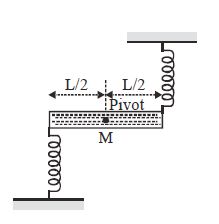
A uniform stick of mass $M$ and length $L$ is pivoted at its centre. Its ends are tied to two springs each of force constant $K$ . In the position shown in figure, the strings are in their natural length. When the stick is displaced through a small angle $\theta $ and released. The stick
Two parallel beams of electrons moving in the same direction produce a mutual force
The mass of the moon is $\frac{1}{{81}}$ of the earth but the gravitational pull is $\frac{1}{6}$ of the earth. It is due to the fact that
For the angle of minimum deviation of a prism to be equal to its refracting angle, the prism must be made of a material whose refractive index
An object at rest at the origin begins to move in the $+x$-direction with a uniform acceleration of $1 \,m / s ^2$ for $4 \,s$ and then it continues moving with a uniform velocity of $4 \,m / s$ in the same direction.The $x-t$ graph for object's motion will be
A zener diode is specified as having a breakdown voltage of $9.1 \;V$, with a maximum power dissipation of $364 \;mW$. What is the maximum current ($mA$) the diode can handle?
The ratio of radii of two wires of same material is $2: 1$. If these wires are stretched by equal force, the ratio of stresses produced in them is $.............$
A particle has an initial velocity of ($3\hat i + 4\hat j)\;ms^{-1}$ and an acceleration of $(0.4\hat i + 0.3\hat j)\;ms^{-1}$ Its speed after $10s$ is:
On rotating a point charge having a charge $q$ around a charge $Q$ in a circle of radius $r$. The work done will be