Question
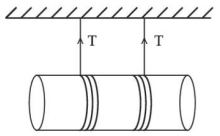
A solid cylinder length is suspended symmetrically through two massless strings, as shown in the figure. The distance from the initial rest position, the cylinder should by unbinding the strings to achieve a speed of $4\,ms ^{-1}$, is$........cm$. $\left(\right.$ take $\left.g=10\,ms ^{-2}\right)$
Answer

From energy conservation

$mgh =\frac{1}{2} m v^{2}+\frac{1}{2} I ^{2}$

$mgh =\frac{1}{2} mv ^{2}+\frac{1}{2} \frac{ mR ^{2}}{2} \omega^{2}$

$10\,h =\frac{16}{2}+\frac{16}{4} \Rightarrow h =1.2\,m =120\,cm$

Need a full question paper?

Generate a complete, print-ready paper with questions like this in minutes — across 16+ boards, with answer keys.

Start Generating Free

Similar questions

The temperature inside a refrigerator is $t_2 \,^o C$ and the room temperature is $t_1\,^o C.$ The amount of heat delivered to the room for each joule of electrical energy consumed ideally will be 
$N( < 100)$ molecules of a gas have velocities $1, 2, 3\,.\,.\,.\,.\,.N/km/s$ respectively. Then
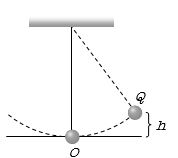
The bob of a simple pendulum is displaced from its equilibrium position $O$ to a position $Q$ which is at height h above $O$ and the bob is then released. Assuming the mass of the bob to be $m$ and time period of oscillations to be $2.0\, sec$, the tension in the string when the bob passes through $O$ is
On an electric heater $220\, volt$ and $1100\, watt$ are marked. On using it for $4$ hours, the energy consumed in $kWh$ will be
In $P-$type semiconductor the majority and minority charge carriers are respectively
Two waves are simultaneously passing through a string and their equations are :

${y}_{1}={A}_{1} \sin {k}({x}-v {t}), {y}_{2}={A}_{2} \sin {k}\left({x}-{vt}+{x}_{0}\right) .$ Given amplitudes ${A}_{1}=12\, {mm}$ and ${A}_{2}=5\, {mm}$ ${x}_{0}=3.5\, {cm}$ and wave number ${k}=6.28\, {cm}^{-1}$. The amplitude of resulting wave will be $......\,{mm}$

A disc of radius $2\; \mathrm{m}$ and mass $100\; \mathrm{kg}$ rolls on a horizontal floor. Its centre of mass has speed of $20\; \mathrm{cm} / \mathrm{s} .$ How much work is needed to stop it?
A particle executing simple harmonic motion with amplitude of $0.1 \,m$. At a certain instant when its displacement is $0.02 \,m$, its acceleration is $0.5 \,m/s^2$. The maximum velocity of the particle is (in $m/s$)
The ratio of the adiabatic to isothermal elasticities of a triatomic gas is
Two ideal gases at absolute temperature $T_1$ and $T_2$ are mixed. There is no loss of energy. The masses of the molecules are $m_1$ and $m_2$ and the number of molecules in the gases are $n_1$ and $n_2$ respectively. The temperature of mixture will be