Question
A solid cylinder of mass $20kg$ rotates about its axis with angular speed $100rads^{-1}$. The radius of the cylinder is $0.25m$. What is the kinetic energy associated with the rotation of the cylinder? What is the magnitude of angular momentum of the cylinder about its axis?
Answer

Mass of the cylinder, m = 20kg Angular speed, $\omega= 100\text{rads}^{-1}$ Radius of the cylinder, r= 0.25m The moment of inertia of the solid cylinder, $\text{I}=\frac{\text{mr}^2}{2}$
$=\frac{1}{2}\times20\times(0.25)^2$
$=0.625\text{kgm}^2$
$\therefore$ Kinetic energy $=\frac{1}{2}\text{I}\omega^2$
$=\frac{1}{2}\times6.25\times100^2=3125\text{J}$
$\therefore$ Angular momentum, $\text{L} = \text{I}\omega = 6.25\times100 = 62.5\text{Js}$

Need a full question paper?

Generate a complete, print-ready paper with questions like this in minutes — across 16+ boards, with answer keys.

Start Generating Free

Similar questions

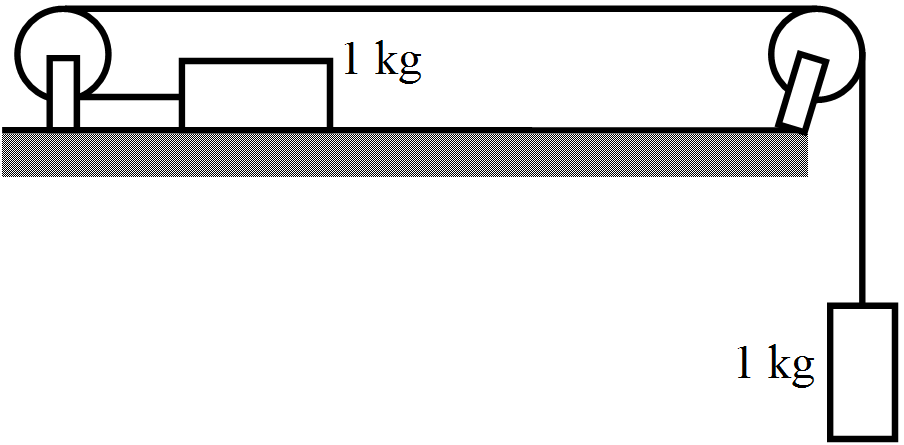
Calculate the tension in the string shown in figure. The pulley and the string are light and all surfaces are frictionless. Take $g = 10m/s^2$.
If the time of flight of a projectile projected with a velocity u at an angle $\theta$ is $\frac{2\text{u}\sin\theta}{\text{g}},$ find the condition for maximum range and its value?
A gram molecule of a gas at $127°C$ expands isothermally until its volume is doubled. Find the amount of work done and heat absorbed.
The sap in trees, which consists mainly of water in summer, rises in a system of capillaries of radius $r = 2.5 \times 10^{-5}m$. The surface tension of sap is $T = 7.28 \times 10^{-2}N m^{-1}$ and the angle of contact is $0°$. Does surface tension alone account for the supply of water to the top of all trees?
Two vessels A and B of different materials but having identical shape, size and wall thickness are filled with ice and kept at the same place. Ice melts at the rate of $100 g min ^{-1}$ and $150 g min ^{-1}$ in $A$ and $B$, respectively. Assuming that heat enters the vessels through the walls only, calculate the ratio of thermal conductivities of their materials.
The displacement of a progressive wave is represented by $\text{y} = \text{A} \sin(\omega \text{t} – \text{k x} ),$ where $x$ is distance and $t$ is time. Write the dimensional formula of $(i) \omega$ and $(ii) k.$
The Sun is a hot plasma (ionized matter) with its inner core at a temperature exceeding 107K, and its outer surface at a temperature of about 6000K. At these high temperatures, no substance remains in a solid or liquid phase. In what range do you expect the mass density of the Sun to be, in the range of densities of solids and liquids or gases? Check if your guess is correct from the following data : mass of the Sun = 2.0 × 1030kg, radius of the Sun = 7.0 × 10⁸m.
A constant force of 2.50N accelerates a stationary particle of mass 15g through a displacement of 2.50m. Find the work done and the average power delivered.
Figure shows a smooth track, a part of which is a circle of radius R. A block of mass m is pushed against a spring of spring constant k fixed at the left end and is then released. Find the initial compression of the spring so that the block presses the track with a force mg when it reaches the point P, where the radius of the track is horizontal.
If the earth has a mass nine times and radius twice that of the planet Mars, calculate the maximum velocity required by a rocket to pull out of the gravitational force of Mars. Given escape velocity on the surface of earth is $11.2km/sec$.