- A$\sqrt{\frac{3}{4}}$
- ✓$\sqrt{\frac{3}{2}}$
- C$\sqrt{\frac{2}{3}}$
- D$\sqrt{\frac{4}{3}}$
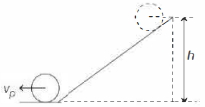
In presence of friction, cylinder rolls and by energy conservation, we have
Initial potential energy $=$ Kinetic energy at bottom
$m g h =( KE )_{\text {translation }}+( KE )_{\text {rotation }}$
$=\frac{1}{2} m v^2+\frac{1}{2} I \omega^2$
$=\frac{1}{2} m v^2+\frac{1}{2}\left(\frac{1}{2} m r^2\right) \omega^2$
$=\frac{3}{4} m v^2 \quad[\therefore v=r \omega]$
So, $\quad v_p=\sqrt{\frac{4}{3} g h}$
In absence of friction, cylinder slips without rolling.
Hence, $\frac{1}{2} m v^2=m g h$
$\Rightarrow \quad v_q=\sqrt{2 g h}$
So, ratio of $v_q / v_p=\frac{\sqrt{2 g h}}{\sqrt{\frac{4}{3} g h}}=\sqrt{\frac{3}{2}}$
Generate a complete, print-ready paper with questions like this in minutes — across 16+ boards, with answer keys.
If a point charge $q_A$ is placed at the center of the shell, then choose the correct statement $(s)$