A block is placed on a frictionless horizontal table. The mass of the block is m and springs are attached on either side with force constants ${K_1}$ and ${K_2}$. If the block is displaced a little and left to oscillate, then the angular frequency of oscillation will be
Easy
Download our app for free and get started
(a)In this case springs are in parallel, so${k_{eq}} = {k_1} + {k_2}$
and $\omega = \sqrt {\frac{{{k_{eq}}}}{m}} = \sqrt {\frac{{{k_1} + {k_2}}}{m}} $
and $\omega = \sqrt {\frac{{{k_{eq}}}}{m}} = \sqrt {\frac{{{k_1} + {k_2}}}{m}} $

Download our appand get started for free
Experience the future of education. Simply download our apps or reach out to us for more information. Let's shape the future of learning together!No signup needed.*
Similar Questions
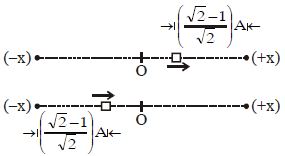
- 1Two bodies performing $SHM$ have same amplitude and frequency. Their phases at a certain instant are as shown in the figure. The phase difference between them isView Solution
- 2The kinetic energy of a particle executing $S.H.M.$ is $16\, J$ when it is at its mean position. If the mass of the particle is $0.32 \,kg$, then what is the maximum velocity of the particle ..... $m/s$View Solution
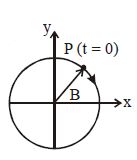
- 3Figure shows the circular motion of a particle. The radius of the circle, the period, sense of revolution and the initial position are indicated on the figure. The simple harmonic motion of the $x-$ projection of the radius vector of the rotating particle $P$ isView Solution
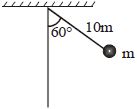
- 4View SolutionIf pendulum is released from given position find velocity of Bob when it reaches the lowest position
- 5The angular amplitude of a simple pendulum is $\theta_0$. The maximum tension in its string will beView Solution
- 6View SolutionA flat horizontal board moves up and down in $SHM$ of amplitude $\alpha$. Then the shortest permissible time period of the vibration such that an object placed on the board may not lose contact with the board is
- 7As a body performs $S.H.M.$, its potential energy $U.$ varies with time as indicated inView Solution
- 8Which of the following expressions corresponds to simple harmonic motion along a straight line, where $x$ is the displacement and $a, b, c$ are positive constants?View Solution
- 9A particle performs $S.H.M.$ of amplitude $A$ with angular frequency $\omega$ along a straight line. Whenit is at a distance $\frac{{\sqrt 3 }}{2}$ $A$ from mean position, its kinetic energy gets increased by an amount $\frac{1}{2}m{\omega ^2}{A^2}$ due to an impulsive force. Then its new amplitude becomesView Solution
- 10When a mass $m$ is hung from the lower end of a spring of neglibgible mass, an extension $x$ is produced in the spring. The time period of oscillation isView Solution