Question
A solid floats in a liquid in a partially dipped position.
  1. The solid exerts a force equal to its weight on the liquid.
  2. The liquid exerts a force of buoyancy on the solid which is equal to the weight of the solid.
  3. The weight of the displaced liquid equals the weight of the solid.
  4. The weight of the dipped part of the solid is equal to the weight of the displaced liquid.
Answer

  1. The solid exerts a force equal to its weight on the liquid.
  2. The liquid exerts a force of buoyancy on the solid which is equal to the weight of the solid.
  3. The weight of the displaced liquid equals the weight of the solid.

Expalnation:

Force exerted by any solid on a liquid = F = mg = W = Weight of the solid.

According to Archimedes' principle, any object, wholly or partially immersed in a fluid, is buoyed up by a force equal to the weight of the fluid displaced by the

Object.

Also, any floating object displaces its own weight of fluid. Thus, we can say that the weight of the object is equal to the weight of the fluid displaced.

Need a full question paper?

Generate a complete, print-ready paper with questions like this in minutes — across 16+ boards, with answer keys.

Start Generating Free

Similar questions

A circular plate of uniform thickness of diameter $56\, cm$, whose center is at origin. A circular part of diameter $42\, cm$ is removed from one edge. What is the distance of the centre of mass of the remaining part ........ $cm.$
A ring takes time ${t_1}$ in slipping down an inclined plane of length $L$ and takes time ${t_2}$ in rolling down the same plane. The ratio $\frac{{{t_1}}}{{{t_2}}}$ is
A particle is moving along the $x-$axis with its coordinate with the time '$t$' given be $\mathrm{x}(\mathrm{t})=10+8 \mathrm{t}-3 \mathrm{t}^{2} .$ Another particle is moving the $y-$axis with its coordinate as a function of time given by $\mathrm{y}(\mathrm{t})=5-8 \mathrm{t}^{3} .$ At $\mathrm{t}=1\; \mathrm{s},$ the speed of the second particle as measured in the frame of the first particle is given as $\sqrt{\mathrm{v}} .$ Then $\mathrm{v}$ (in $\mathrm{m} / \mathrm{s})$ is
Regarding speed of sound in gas match the following

$(A)$ Temperature of gas is made $4$ times and pressure $2$ times

$(P)$ Speed becomes $2\sqrt 2$ times

$(B)$ Only pressure is made $4$ times without change in temperature

$(Q)$ Speed become $2$ times

$(C)$ Only temperature is changed to $4$ times

$(R)$ Speed remains unchanged

$(D)$ Molecular mass of the gas is made $4$ times

$(S)$ Speed becomes half

At what temperature the centigrade (Celsius) and Fahrenheit, readings are the same ........ $^o$
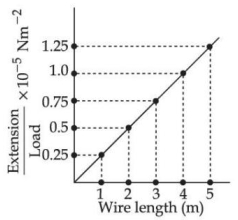
In an experiment to determine the Young's modulus, steel wires of five different lengths $(1,2,3,4$ and $5\,m )$ but of same cross section $\left(2\,mm ^{2}\right)$ were taken and curves between extension and load were obtained. The slope (extension/load) of the curves were plotted with the wire length and the following graph is obtained. If the Young's modulus of given steel wires is $x \times 10^{11}\,Nm ^{-2}$, then the value of $x$ is
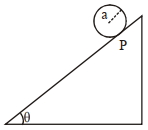
A solid disc of radius $'a'$ and mass $'m'$ rolls down without slipping on an inclined plane making an angle $\theta$ with the horizontal. The acceleration of the disc will be $\frac{2}{ b } g \sin \theta$ where $b$ is $........$. (Round off to the Nearest Integer)

$( g =$ acceleration due to gravity)

$(\theta=$ angle as shown in figure $)$

A projectile is thrown with velocity $u$ making angle $\theta$ with vertical. It just crosses the tops of two poles each of height $h$ after $1\,s$ and $3\,s$, respectively. The maximum height of projectile is ............ $m$
An electric current i enters and leaves a uniform circular wire of radius a through diametrically opposite points. A charged particle q moving along the axis of the circular wire passes through its centre at speed v. The magnetic force acting on the particle when it passes through the centre has a magnitude:

  1. $\text{qv}\frac{\mu_0\text{i}}{2\text{a}}$

  2. $\text{qv}\frac{\mu_0\text{i}}{2\pi\text{a}}$

  3. $\text{qv}\frac{\mu_0\text{i}}{\text{a}}$

  4. $\text{Zero}$

Let I1 and I2 be the moments of inertia of two bodies of identical geometrical shape, the first made of aluminium and the second of iron.