MCQ
A solid sphere, a hollow sphere and a disc, all having same mass and radius, are placed at the top of a smooth incline and released. Least time will be taken in reaching the bottom by:
  • A
    The solid sphere.
  • B
    The hollow sphere.
  • C
    The disc.
  • All will take same time.

Answer

Correct option: D.
All will take same time.
The incline is smooth; therefore, all bodies will slip on the incline. Also, as the mass of bodies is same, they will reach the bottom in equal time.

Need a full question paper?

Generate a complete, print-ready paper with questions like this in minutes — across 16+ boards, with answer keys.

Start Generating Free

Similar questions

A body initially at $80^o C$ cools to $64^o C$ in $5$ minutes and to $52^o C$ in $10 $ minutes. The temperature of the body after $15$ minutes will be ...... $^oC$
A train is moving towards east and a car is along north, both with same speed. The observed direction of car to the passenger in the train is
With the propagation of a longitudinal wave through a material medium, the quantities transmitted in the propagation direction are
The distance travelled by a body is directly proportional to the square of the time taken. Its acceleration:
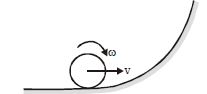
A solid sphere rolling without slipping on a horizontal rough surface and starts rising on inclined rough surface as shown in the figure assume pure rolling throughout the motion. Choose the $INCORRECT$ statement
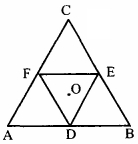
The equilateral triangle $ABC$ is cut from a thin solid sheet of wood. (See figure) $D, E$ and $F$ are the mid points of its sides as shown and $G$ is the centre of the triangle. The moment of inertia of the triangle about an axis passing through $G$ and perpendicular to the plane of the triangle is $I_0.$ If the smaller triangle $DEF$ is removed from $ABC,$ the moment of inertia of the remaining figure about the same axis is $I.$ Then
If $g$ is the acceleration due to gravity at the surface of the earth. The force acting on the particle of mass $m$ placed at the surface is:
Black Hole is
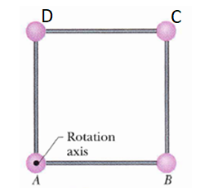
Four particles of equal masses are placed on the vertices of a square and are rotated with a uniform angular velocity about one of the edges $(A)$ as shown in the figure. Which particle will have a larger angular momentum:
A steel wire of length $3.2 m \left( Y _{ S }=2.0 \times 10^{11}\,Nm ^{-2}\right)$ and a copper wire of length $4.4\,M$ $\left( Y _{ C }=1.1 \times 10^{11}\,Nm ^{-2}\right)$, both of radius $1.4\,mm$ are connected end to end. When stretched by a load, the net elongation is found to be $1.4\,mm$. The load applied, in Newton, will be. (Given $\pi=\frac{22}{7}$)