MCQ
The distance travelled by a body is directly proportional to the square of the time taken. Its acceleration:
  • A
    Increases.
  • B
    Decreases.
  • C
    Becomes zero.
  • Remains constant.

Answer

Correct option: D.
Remains constant.

Need a full question paper?

Generate a complete, print-ready paper with questions like this in minutes — across 16+ boards, with answer keys.
Start Generating Free

Similar questions

The momentum is most closely related to
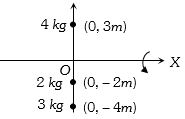
Three particles are situated on a light and rigid rod along $Y$axis as shown in the figure. If the system is rotating with an angular velocity of $2\,rad/\sec $about $X$axis, then the total kinetic energy of the system is ...... $J$
If a system is in thermodynamic equilibrium with its surroundings, it means:
A closed pipe of length $10 \,cm$ has its fundamental frequency half that of the second overtone of an open pipe. The length of the open pipe ......... $cm$
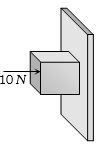
A horizontal force of $10 \,N$ is necessary to just hold a block stationary against a wall. The coefficient of friction between the block and the wall is $0.2$. the weight of the block is ........ $N$
A source of sound is travelling towards a stationary observer. The frequency of sound heard by the observer is of three times the original frequency. The velocity of sound is $v\, m/sec.$ The speed of source will be
A particle is projected vertically upwards from $O$ with velocity $v$ and a second particle is projected at the same instant from $P$ (at a height h above $O$) with velocity $v$ at an angle of projection $\theta$ . The time when the distance between them is minimum is
When an air column at $15\,^oC$ and a tunning fork are sounded together then $4$ beats per second are produced, the frequency of the fork is less then that of air column. When the temperature falls to $10\,^oC$ , then the beat frequency decreases by one. The frequency of the fork will be ..... $Hz$ $[V_{sound}$ at $0\,^oC = 332\,m/s]$
If $x=5 \sin \left(\pi t+\frac{\pi}{3}\right) \mathrm{m}$ represents the motion of a particle executing simple harmonic motion, the amplitude and time period of motion, respectively, are
A train is moving towards east and a car is along north, both with same speed. The observed direction of car to the passenger in the train is