MCQ
A solid sphere, a solid cylinder, a disc and a ring are rolling down an inclined plane. Which of these bodies will reach the bottom simultaneously
  • A
    Solid sphere and solid cylinder
  • Solid cylinder and disc
  • C
    Disc and ring
  • D
    Solid sphere and ring    

Answer

Correct option: B.
Solid cylinder and disc
b

Need a full question paper?

Generate a complete, print-ready paper with questions like this in minutes — across 16+ boards, with answer keys.

Start Generating Free

Similar questions

$A$ small bead of mass $m$ moving with velocity $v$ gets threaded on a stationary semicircular ring of mass $m$ and radius $R$ kept on a horizontal table. The ring can freely rotate about its centre. The bead comes to rest relative to the ring. What will be the final angular velocity of the system?
$A$ light of wavelength $600nm$ in air enters a medium of refractive index $1.5$. Inside the medium :
Water is filled to a height $H$ behind a dam of width $w$. The resultant force on dam is ..............
An electron of mass $m$ and charge $e$ is accelerated from rest through a potential difference $V$ in vacuum. The final speed of the electron will be
A satellite of mass $200 \,kg$ revolves around a planet of mass $5 \times 10^{30} \,kg$ in a circular orbit of radius $6.6 \times 10^6 \,m$. Binding energy of the satellite is .............. $J$
If $\overrightarrow A \times \overrightarrow B = \overrightarrow C ,$then which of the following statements is wrong
A ray of light incident on a glass sphere (refractive index $\sqrt{3}$ ) suffers total internal reflection before emerging out exactly parallel to the incident ray. The angle of incidence was
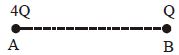
Force between $A$ and $B$ is $F$. If $75\%$ charge of $A$ is transferred to $B$ then force between $A$ and $B$ is
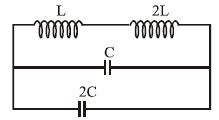
The frequency of oscillation of current in the inductance is
The average translational kinetic energy of ${N}_{2}$ gas molecules at $\ldots \ldots \ldots . .{ }^{\circ} {C}$ becomes equal to the ${K} . {E}$. of an electron accelerated from rest through a potential difference of $0.1$ $volt.$

$\left(\right.$ Given $\left.{k}_{{B}}=1.38 \times 10^{-23} \, {J} / {K}\right)$

(Fill the nearest integer).